Candidates, 1903.

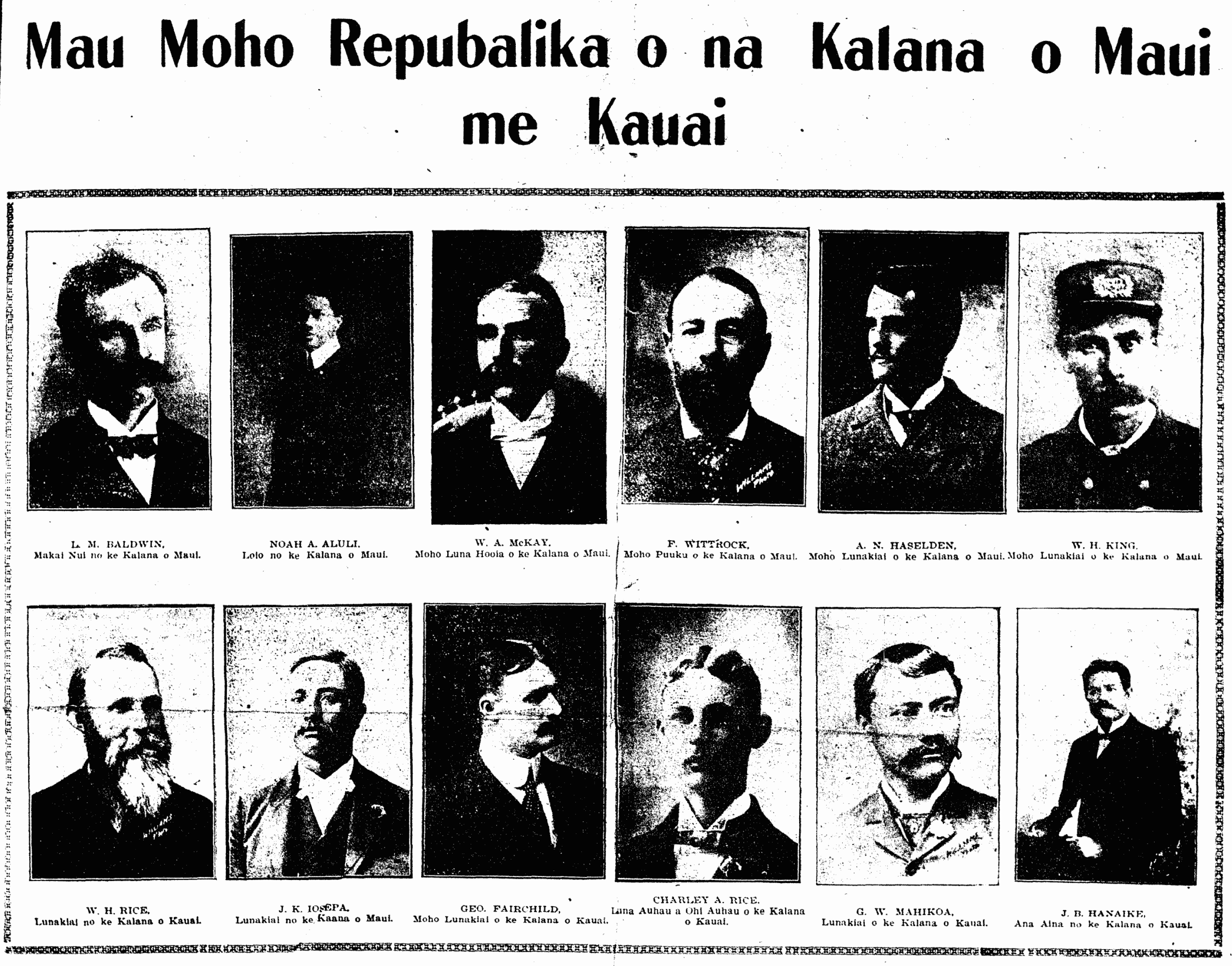
Republican Candidates of the Counties of Maui and Kauai

L. M. BALDWIN, Chief Sheriff of Maui County.

NOAH A. ALULI, Lawyer of Maui County.

W. A. McKAY, Candidate for Auditor of Maui County.

F. WITTROCK, Candidate for Treasurer of Maui County.

A. N. HASELDEN, Candidate for Supervisor of Maui County.

W. H. King, Candidate for Supervisor of Maui County.

W. H. RICE, Supervisor for Kauai County.

J. K. IOSEPA, Supervisor for Maui County.

GEORGE FAIRCHILD, Candidate for Supervisor of Kauai County.

CHARLEY A. RICE, Tax Assessor and Collector of Kauai County.

G. W. MAHIKOA, Supervisor of Kauai County.

J. B. HANAIKE, Surveyor of Kauai County.

(Kuokoa, 10/23/1903, p. 1)

He Mau Moho Repubalika o na Kalana o Maui me Kauai

Ka Nupepa Kuokoa, Buke XLI, Helu 43, Aoao 1. Okatoba 23, 1903.

The first newspaper article printed following July 31, 1843.

BATTLESHIP.

On the 26th of July, the British Warship named Dublin arrived. Rear Admiral Thomas is the Captain. He is the officer in charge of all of the British warships in the Pacific Ocean.

When he received documents pertaining to Capt. Lord George Paulet aboard Victoria’s ship, and he heard clearly that the British flag was raised over these islands, he came quickly to restore the government to Kamehameha III. How fine is his aloha for the king, isn’t it! and for the citizens as well.

(Nonanona, 8/8/1843, p. 25)

MOKU MANUWA.

Ka Nonanona, Buke 3, Pepa 6, Aoao 25. Augate 8, 1843.

This is some list of names. July 18, 1898.

DAY OF PARDON FOR THE PEOPLE.

Monday, July 18, 1898.

THE PRISONERS ARE FORGIVEN.

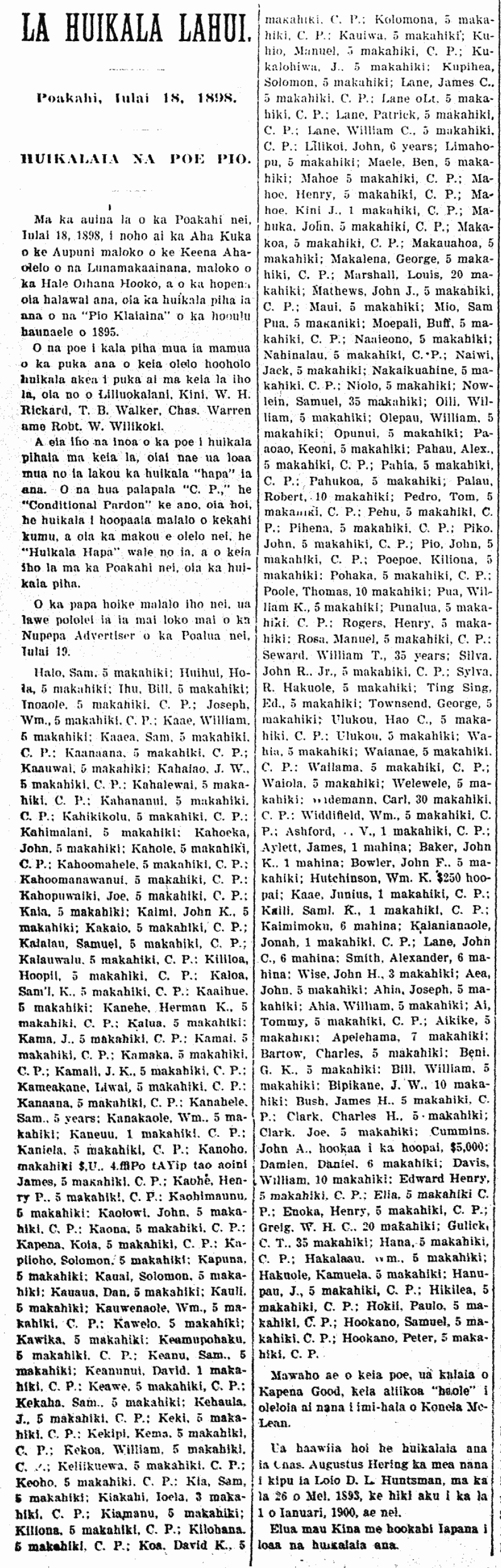
On the afternoon of this Monday, July 18, 1898, the Council of State held session in the Office of the House of Representatives in the Executive Office, and as a result of this meeting, the “Political Prisoners” of the 1895 rebellion [haunaele] were fully pardoned.

Those fully pardoned before the proclamation of this general pardon of the other day, was Liliuokalani, Kini, W. H. Rickard, T. B. Walker, Charles Warren, and Robert W. Wilcox.

Here is the list of those fully pardoned on this day, although they received a partial pardon earlier. The letters “C. P.,” stands for “Conditional Pardon,” meaning that it is a pardon under certain terms, and that is what we are calling just a “Partial Pardon,” but this on the past Monday was a full pardon.

The list below it taken directly from the Advertiser of Tuesday, July 19.

Halo, Sam, 5 years; Huihui, Hola, 5 years; Ihu, Bill, 5 years; Inoaole, 5 years; C. P.; Joseph, William, 5 years, C. P.; Kaae, William, 5 years; Kaaea, Sam, 5 years, C. P.; Kaanaana, 5 years, C. P.; Kaauwai, 5 years; Kahaiao, J. W., 5 years, C. P.; Kahalewai, 5 years, C. P.; Kahananui, 5 years, C. P.; Kahikikolu, 5 years, C. P.; Kahimalani, 5 years; Kahoeka, John, 5 years; Kahole, 5 years, C. P.; Kahoomahele, 5 years, C. P.; Kahoomanawanui, 5 years, C. P.; Kahopuwaiki, Joe, 5 years, C. P.; Kaia, 5 years; Kaimi, John K., 5 years; Kakaio, 5 years, C. P.; Kalalau, Samuel, 5 years, C. P.; Kalauwalu, 5 years, C. P.; Kililoa, Hoopii, 5 years, C. P.; Kaloa, Samuel, K., 5 years, C. P.; Kaaihue, 5 makahiki; Kanehe, Herman K., 5 years, C. P.; Kalua, 5 makahiki; Kama, J., 5 years, C. P.; Kamai, 5 years, C. P.; Kamaka, 5 years, C. P.; Kamali, J. K., 5 years, C. P.; Kameakane, Liwai, 5 years, C. P.; Kanaana, 5 years, C. P.; Kanahele, Samuel, 5 years; Kanakaole, William, 5 years; Kaneuu, 1 year, C. P.; Kaniela, 5 years, C. P.; Kanoho, James, 5 years, C. P.; Kaohe, Henry P., 5 years, C. P.; Kaohimaunu, 5 years; Kaolowi, John, 5 years, C. P.; Kaona, 5 years, C. P.; Kapena, Koia, 5 years, C. P.; Kapiioho, Solomon, 5 years; Kapuna, 5 years; Kauai, Solomon, 5 years; Kauaua, Dan, 5 years; Kauli, 5 years; Kauwenaole, William, 5 years, C. P.; Kawelo, 5 years; Kawika, 5 years; Keamupohaku, 5 years, C. P.; Keanu, Samuel, 5 years; Keanunui, David, 1 year, C. P.; Keawe, 5 years, C. P.; Kekaha, Samuel, 5 years; Kehaula, J., 5 years, C. P.; Keki, 5 years, C. P.; Kekipi, Kema, 5 years, C. P.; Kekoa, William, 5 years, C. P.; Keliikuewa, 5 years, C. P.; Keoho, 5 years, C. P.; Kia, Sam, 5 years; Kiakahi, Ioela, 3 years, C. P.; Kiamanu, 5 years; Kiliona, 5 years, C. P.; Kilohana, 5 years, C. P.; Koa, David K., 5 years, C. P.; Kolomona, 5 years, C. P.; Kauiwa, 5 years; Kuhio, Manuel, 5 years, C. P.; Kukalohiwa, J., 5 years; Kupihea, Solomon, 5 years; Lane, James C., 5 years, C. P.; Lane, Lot, 5 years, C. P.; Lane, Patrick, 5 years, C. P.; Lane, William C., 5 years, C. P.; Lilikoi, John, 6 years; Limahopu, 5 years; Maele, Ben, 5 years; Mahoe, 5 years, C. P.; Mahoe, Henry, 5 years, C. P.; Mahoe, Kini J., 1 year, C. P.; Mahuka, John, 5 years, C. P.; Makakoa, 5 years, C. P.; Makauahoa, 5 years; Makalena, George, 5 years, C. P.; Marshall, Louis, 20 years; Mathews, John J., 5 years, C. P.; Maui, 5 years; Mio, Sam Pua, 5 years; Moepali, Buff, 5 years, C. P.; Naaieono, 5 years; Nahinalau, 5 years, C. P.; Naiwi, Jack, 5 years; Nakaikuahine, 5 years, C. P.; Niolo, 5 years; Nowlein, Samuel, 35 years; Oili, William, 5 years; Olepau, William, 5 years; Opunui, 5 years; Paaoao, Keoni, 5 years; Pahau, Alex., 5 years, C. P.; Pahia, 5 years, C. P.; Pahukoa, 5 years; Palau, Robert, 10 years; Pedro, Tom, 5 years, C. P.; Pehu, 5 years, C. P.; Pihena, 5 years, C. P.; Piko, John, 5 years, C. P.; Pio, John, 5 years, C. P.; Poepoe, Kiliona, 5 years; Pohaka, 5 years, C. P.; Poole, Thomas, 10 years; Pua, William, K., 5 years; Punalua, 5 years, C. P.; Rogers, Henry, 5 years; Rosa, Manuel, 5 years, C. P.; Seward, William T., 35 years; Silva, John R., Jr., 5 years, C. P.; Sylva, R. Hakuole, 5 years; Ting Sing, Ed., 5 years; Townsend, George, 5 years; Ulukou, Hao C., 5 years, C. P.; Ulukou, 5 years; Wahia, 5 years; Waianae, 5 years, C. P.; Wailama, 5 years, C. P.; Waiola, 5 years; Welewele, 5 years; Widemann, Carl, 30 years, C. P.; Widdifield, William, 5 years, C. P.; Ashford, V. V., 1 year, C. P.; Aylett, james, 1 month; Baker, John K., 1 month; Bowler, John F., 5 years; Hutchinson, William K., $250 fine; Kaae, Junius, 1 year, C. P.; Kaili, Samuel K., 1 year, C. P.; Kaimimoku, 6 months; Kalanianaole, Jonah, 1 year, C. P.; Lane, John C., 6 months; Smith, Alexander, 6 months; Wise, John H., 3 years; Aea, John, 5 years; Ahia, Joseph, 5 years; Ahia, William, 5 years; Ai, Tommy, 5 years, C. P.; Aikike, 5 years; Apelehama,  7 years; Bartow, Charles, 5 years; Beni, G. K., 5 years; [Bertleman, H. F., 35 years;] Bill, William, 5 years; Bipikane, J. W., 10 years; Bush, James H., 5 years, C. P.; Clark, Charles H., 5 years; Clark, Joe, 5 years; Cummins, John A., fine payed, $5,000; Damien, Daniel, 6 years; Davis, William, 10 years; Edward, Henry, 5 years, C. P.; Elia, 5 years, C. P.; Enoka, Henry, 5 years, C. P.; Greig, W. H. C., 20 years; Gulick, C. T., 35 years; Hana, 5 years, C. P.; Hakalaau, William, 5 years; Hakuole, Kamuela, 5 years; Hanupau, J., 5 years, C. P.; Hikilea, 5 years, C. P.; Hokii, Paulo, 5 years, C. P.; Hookano, Samuel, 5 years, C. P.; Hookano, Peter, 5 years, C. P.;

Outside of these people, Captain Good, that “haole” officer who is said to have sought to discredit Colonel McLean, was pardoned.

Also pardon was granted to Charles Augustus Hering, the one who shot Lawyer D. L. Huntsman, on the 26th of May, 1893, when the 1st of January, 1900 arrives.

Two Chinese and one Japanese were pardoned [Akoi Akanu, Lum Sing, and Yakoyama? Yokoyama?].

(Kuokoa, 7/22/1898, p. 8)

LA HUIKALA LAHUI.

Ka Nupepa Kuokoa, Buke XXXVII, Helu 29, Aoao 8. Iulai 22, 1898.

Letter from Iosepa, Utah, 1913.

A VOICE FROM UTAH.

Iosepa, Toole County. Dec. 19, 1912.

Solomon Hanohano, Editor of the Kuokoa, Aloha oe:—Because I want to know the news of the land of our birth, the desire to get a subscription to the Kuokoa grew. Being the the new year is coming, it would be a means for me to see the news of our home and the progress of the political scene or its regression, as well as the victories or discouragements of our fellow makaainana.

Not because Iosepa lacks newspaper subscribers, but for me to get a personal one.

This is one of the important years regarding the nation, being that the leadership of the power of the nation went to the Democrats; the big question is just this: Will the poor makaainana really benefit, or will they be left unstable once again like during the presidency of Cleveland, but it is only time that will tell.

If those elected could follow through on what their lips pledge to the masses, then we indeed will be blessed, however if it is like what Isaiah said, thusly: “These people come near to me with their mouth, but their hearts are far from me.” [Isaiah 29:13] Then comes those famous words of that old timer of Lahaina: “Saying, when indeed will that happen.” [“I mai hoi, ahea la ka hoi.”] The big-eyed images know that the small-eyed images are not watched. [Ikeia aku la no na kii maka nunui, nana oleia iho la na wahi kii maka liilii ??]

My aloha to the few Hawaiian makaainana left who are squeezed and assimilated [i ka opaia aku ua pili pu ?] until they are totally gone from the beloved face of Hawaii, along with the increase of the other races upon the land. And so too with the various diseases of the different races whose devastation spread to our people who lack immunity. Aloha to our people.

As for our living in this unfamiliar land, this land that true Mormons know as the chosen land, and a land to foster the believers in that one faith, all of the Hawaiians are in good health as well as the Samoans, from the old to the young.

I have faith that Iosepa will become a place where Hawaiians will multiply once again, and that these valleys will become full of true Hawaiians and Samoans, when the children are born, and grow up, and marry and give birth.

Some proof of this belief is the great desire of the president of the Mormons for the youths to marry of their own race so that this land is full of Hawaiians. For according to him, it is here that the people of the islands of the ocean will spread.

The town of Iosepa is growing. The church is building homes for the people without homes, lest they live in disarray as the Hawaiians before, with two or three families in a single dwelling.

The workers are paid a dollar every Saturday. The children are taught in the school here in Iosepa. Two children graduated from the local school of Iosepa, and are attending high school, they are Joseph H. Bird and William Pukahi, both are true Hawaiians.

I have been just chosen as judge, and George K. Hubbell as sheriff of the district. We are both Republicans, which also are the majority of the Hawaiians here.

Perhaps this will do.

Charles J. Broad.

Iosepa, Toole County, Utah.

(Kuokoa, 1/10/1913, p. 6)

HE LEO MAI UTAH MAI.

Ka Nupepa Kuokoa, Buke XLIX, Helu 2, Aoao 6. Ianuari 10, 1913.

Harper’s New Monthly Magazine and Kekuanaoa, 1871.

Here is the short piece described in the last post:

The last that we have from “the Pacific slope” speaks of a practice that prevailed some years since at the Sandwich Islands, when it was the custom of the American consuls to be present at the trials of American sailors for breaches of the peace. The consul, at a trial before the sturdy old magistrate and native Governor Kekuanoa [Kekuanaoa], objected to the testimony of an islander on the grounds that it was false. The Governor replied, “Yes, I’m perfectly aware of that; but so was the sailor’s. Let us hear both sides, and then decide the matter.” A mere “question of veracity.”

(Harper’s New Monthly, 4/1871, p. 797)

The last that we have from...

Harper’s New Monthly Magazine, Volume 42, Issue 251, Page 797. April 1871.

In praise of Mataio Kekuanaoa, 1871.

The different Father of Chiefs.

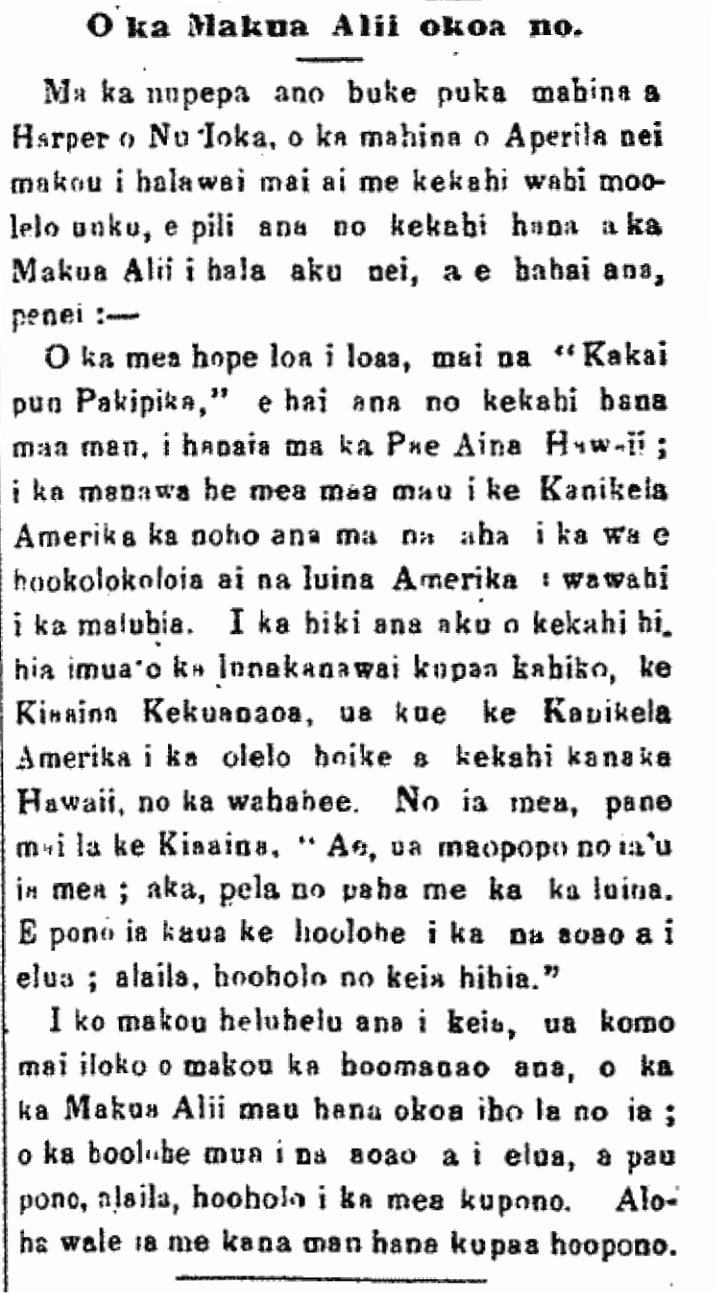
In the monthly magazine, Harper’s of New York, we came across in the April edition, a short story about something done by the Alii Father [Makua Alii] who has passed, and it reports:—

The latest received from the “Pacific String of Hills” speaks of a regular practice carried out in the Hawaiian Islands; during the times when it was a regular thing for the American Consul to sit at court when an American sailor was on trial for disturbing the peace. When a case came before the traditional judge, the Governor Kekuanaoa, the American Consul objected to the testimony of a Hawaiian on the grounds of perjury. At which the Governor replied, “Yes, I am aware of this; but the same may be true of the sailor. The two of us must hear both sides and then rule on this matter.”

When we read this, we recalled that is the different way the Father of Chiefs did things; he listened to both sides first, and when that was finished, he would decide what was proper. Aloha to him and his deeds of steadfast righteousness.

(Au Okoa, 4/13/1871, p. 1)

O ka Makua Alii okoa no.

Ke Au Okoa, Buke VI, Helu 52, Aoao 1. Aperila 13, 1871.

On Liliuokalani’s composition of “Mele Lahui Hawaii,” 1898.

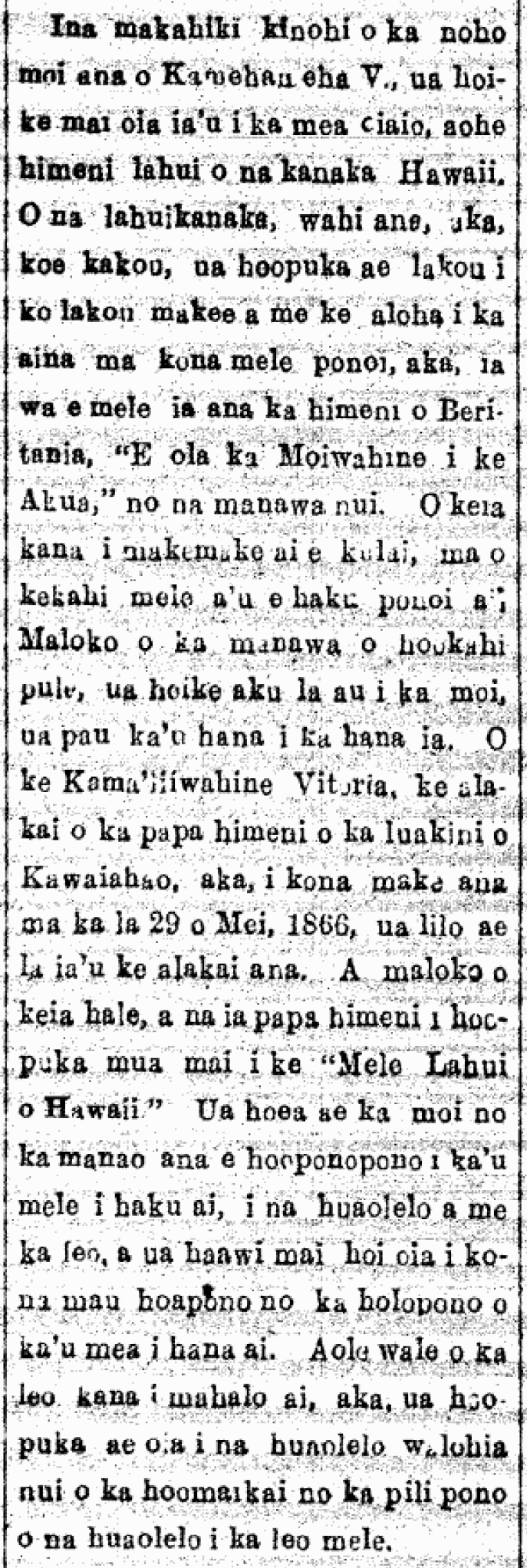
“In the early years of the reign of Kamehameha V, he brought to my notice the fact that the Hawaiian people had no national air. Each nation, he said, but ours had its expression of patriotism and love of country in its own music; but we were using for the purpose on state occasions the time-honored British anthem, “God save the Queen.” This he desired me to supplant by one of my own composition. In one week’s time I notified the king that I had completed my task. The Princess Victoria had been the leader of the choir of the Kawaiahao church; but upon her death, May 29, 1866, I assumed the leadership. It was in this building and by that choir that I first introduced the “Hawaiian National Anthem.” The king was present for the purpose of criticising my new composition of both words and music, and was liberal in his commendations to me on my success. He admired not only the beauty of the music, but spoke enthusiastically of the appropriate words, so well adapted to the air and to the purpose of which they were written.”

(from Hawaii’s Story by Hawaii’s Queen, pp. 31–32.)

“Ina makahiki kinohi o ka noho moi ana o Kamehameha V., ua hoike mai oia ia’u i ka mea oiaio, aohe himeni lahui o na kanaka Hawaii. O na lahuikanaka, wahi ana, aka, koe kakou, ua hoopuka ae lakou i ko lakou makee a me ke aloha i ka aina ma kona mele ponoi, aka, ia wa e mele ia ana ka himeni o Beritania, “E ola ka Moiwahine i ke Akua,” no na manawa nui. O keia kana i makemake ai e kulai, ma o kekahi mele a’u e haku ponoi ai. Maloko o ka manawa o hookahi pule, ua hoike aku la au i ka moi, ua pau ka’u hana i ka hana ia. O ke Kama’liiwahine Vitoria, ke alakai o ka papa himeni o ka luakini o Kawaiahao, aka, i kona make ana ma ka la 29 o Mei, 1866, ua lilo ae la ia’u ke alakai ana. A maloko o keia hale, a na ia papa himeni i hoopuka mua mai i ke “Mele Lahui o Hawaii.” Ua hoea ae ka moi no ka manao ana e hooponopono i ka’u mele i haku ai, i na huaolelo a me ka leo, a ua haawi mai hoi oia i kona mau hoapono no ka holopono o ka’u mea i hana ai. Aole wale o ka leo kana i mahalo ai, aka, ua hoopuka ae oia i na huaolelo walohia nui o ka hoomaikai no ka pili pono o na huaolelo i ka leo mele.”

(Aloha Aina, 5/14/1898, p. 7)

KA BUKE MOOLELO HAWAII I HAKUIA E KA Moiwahine Liliuokalani...

Ke Aloha Aina, Buke IV, Helu 20, Aoao 7. Mei 14, 1898.

Hawaiian National Anthem, 1866.

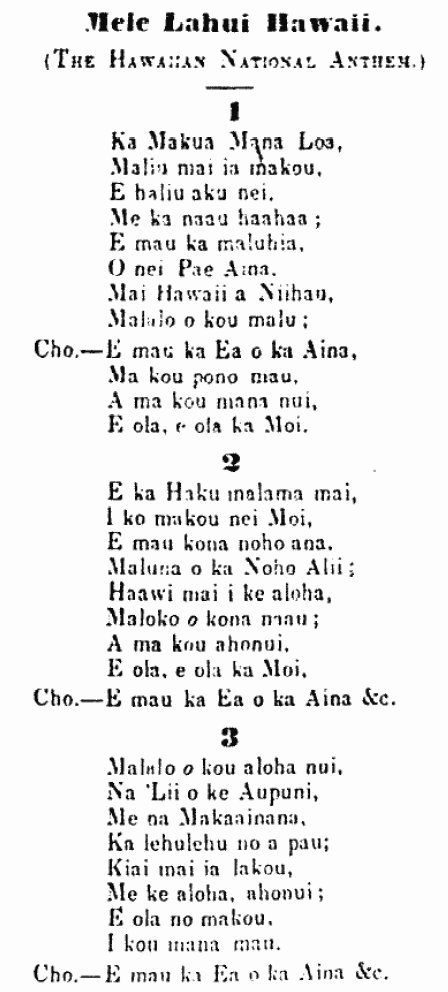
Mele Lahui Hawaii.
(The Hawaiian National Anthem.)

1

Ka Makua Mana Loa,
Maliu mai ia makou,
E haliu aku nei,
Me ka naau haahaa;
E mau ka maluhia,
O nei Pae Aina,
Mai Hawaii a Niihau,
Malalo o kou malu.

Cho.—E mau ka Ea o ka Aina,
Ma kou pono mau,
A ma kou mana nui,
E ola, e ola ka Moi.

2

E ka Haku malama mai,
I ko makou nei Moi,
E mau kona noho ana,
Maluna o ka Noho Alii;
Haawi mai i ke aloha,
Maloko o kona naau;
A ma kou ahonui,
E ola, e ola ka Moi.

Cho.—E mau ka Ea o ka Aina, &c.

3

Malalo o kou aloha nui,
Na ‘Lii o ke Aupuni,
Me na Makaainana,
Ka lehulehu no a pau;
Kiai mai ia lakou,
Me ke aloha, ahonui;
E ola no makou,
I kou mana mau.

Cho.—E mau ka Ea o ka Aina, &c.

The Hawaiian National Anthem.

1

Almighty Father,
Heed us,
Who turn to you,
With humble hearts;
Let there forever be peace,
In these Islands,
From Hawaii to Niihau,
Under your protection;

Cho.—Let the Sovereignty of this Land be for always,
By your never ending righteousness,
And by your great power,
Long live, long live the King.

2

O Lord, protect,
Our King,
Let his rule continue,
Upon the Throne;
Bestow him aloha,
Within his heart;
And by your grace
Long live, long live the King.

Cho.—Let the Sovereignty of this Land be for always, &c.

3

Under your great love,
Are the Alii of the Nation,
And the Makaainana,
All the people;
Do watch over them,
With aloha and magnanimity,
Let us live,
By your eternal power.

Cho.—Let the Sovereignty of this Land be for always, &c.

(Kuokoa, 11/24/1866, p. 2)

Mele Lahui Hawaii.

Ka Nupepa Kuokoa, Buke V, Helu 47, Aoao 2. Novemaba 24, 1866.

Law banning the killing of imported birds, 1870.

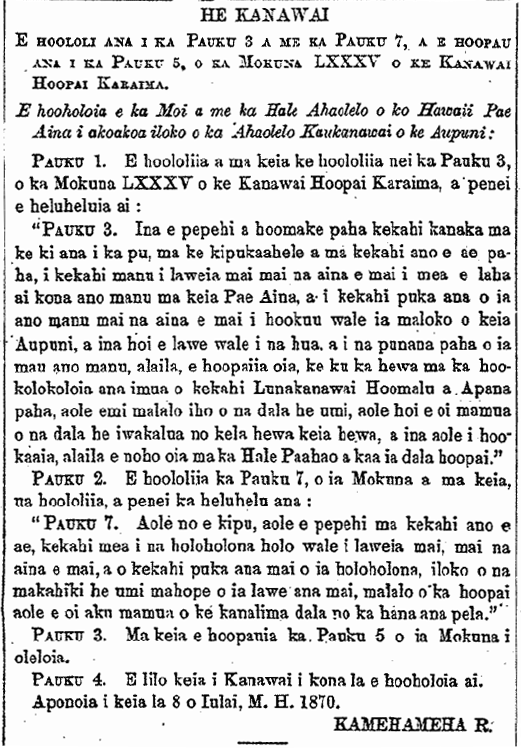
HE KANAWAI

E HOOLOLI ANA I KA PAUKU 3 A ME KA PAUKU 7, A E HOOPAU ANA I KA PAUKU 5, O KA MOKUNA LXXXV O KE KANAWAI HOOPAI KARAIMA.

E hooholoia e ka Moi a me ka Hale Ahaolelo o ko Hawaii Pae Aina i akoakoa iloko o ka Ahaolelo Kaukanawai o ke Aupuni:

PAUKU 1. E hoololiia a ma keia ke hoololiia nei ka Pauku 3, o ka Mokuna LXXXV o ke Kanawai Hoopai Karaima, a penei e heluheluia ai:

“PAUKU 3. Ina e pepehi a hoomake paha kekahi kanaka ma ke ki ana i ka pu, ma ke kipukaahele a ma kekahi ano e ae paha, i kekahi manu i laweia mai mai na aina e mai i mea e laha ai kona ano manu ma keia Pae Aina, a i kekahi puka ana o ia ano manu mai na aina e mai i hookuu wale ia maloko o keia Aupuni, a ina hoi e lawe wale i na hua, a i na punana paha o ia mau ano manu, alaila, e hoopaiia oia, ke ku ka hewa ma ka hookolokoloia ana imua o kekahi Lunakanawai Hoomalu a Apana paha, aole emi malalo iho o na dala he umi, aole hoi e oi mamua o na dala he iwakalua no kela hewa keia hewa, a ina aole i hookaaia, alaila e noho oia ma ka Hale Paahao a kaa ia dala hoopai.”

PAUKU 2. E hoololiia ka Pauku 7, o ia Mokuna a ma keia, ua hoololiia, a penei ka heluhelu ana:

“PAUKU 7. Aole no e kipu, aole e pepehi ma kekahi ano e ae, kekahi mea i na holoholona holo wale i laweia mai, mai na aina e mai, a o kekahi puka ana mai o ia holoholona, iloko o na makahiki he umi mahope o ia lawe ana mai, malalo o ka hoopai aole e oi aku mamua o ke kanalima dala no ka hana ana pela.”

PAUKU 3. Ma keia e hoopauia ka Pauku 5 o ia Mokuna i oleloia.

PAUKU 4. E lilo keia i Kanawai i kona la e hooholoia ai.

Aponoia i keia la 8 o Iulai, M. H. 1870.

KAMEHAMEHA R.

(Au Okoa, 8/4/1870, p. 4)

HE KANAWAI, E HOOLOLI ANA I KA PAUKU 3 A ME KA PAUKU 7...

Ke Au Okoa, Buke VI, Helu 16, Aoao 4. Augate 4, 1870.

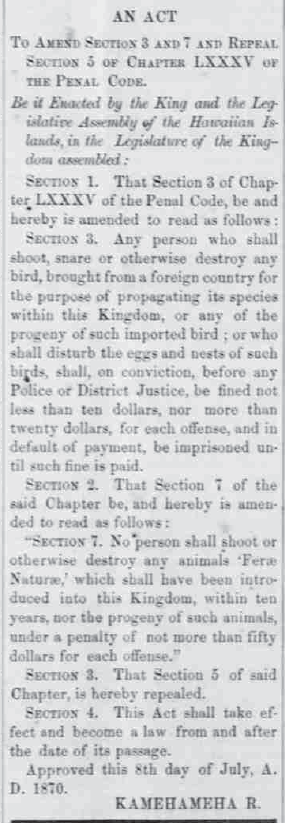
AN ACT

TO AMEND SECTION 3 and 7 AND REPEAL SECTION 5 OF CHAPTER LXXXV OF THE PENAL CODE.

Be it Enacted by the King and the Legislative Assembly of the Hawaiian Islands, in the Legislature of the Kingdom assembled:

SECTION 1. That Section 3 of Chapter LXXXV of the Penal Code, be and hereby is amended to read as follows:

Section 3. Any person who shall shoot, snare or otherwise destroy any bird, brought from a foreign country for the purpose of propagating its species within this Kingdom, or any of the progeny of such imported bird; or who shall disturb the eggs and nests of such birds, shall, on conviction, before any Police or District Justice, be fined not less than ten dollars, nor more than twenty dollars, for each offense, and in default of payment, be imprisoned until such fine is paid.

SECTION 2. That Section 7 of the said Chapter be, and hereby is amended to read as follows:

“SECTION 7. No person shall shoot or otherwise destroy any animals ‘Feræ Naturæ,’ which shall have been introduced into this Kingdom, within ten years, nor the progeny of such animals, under a penalty of not more than fifty dollars for each offense.”

SECTION 3. That Section 5 of said Chapter, is hereby repealed.

SECTION 4. This Act shall take effect and become a law from and after the date of its passage.

Approved this 8th day of July, A. D. 1870.

KAMEHAMEHA R.

(Hawaiian Gazette, 7/27/1870, p. 4)

AN ACT, TO AMEND SECTION 3 and 7 AND REPEAL SECTION 5...

Hawaiian Gazette, Volume VI, Number 28, Page 4. July 27, 1870.

Oneha family history, 1876.

[Found under: “News”]

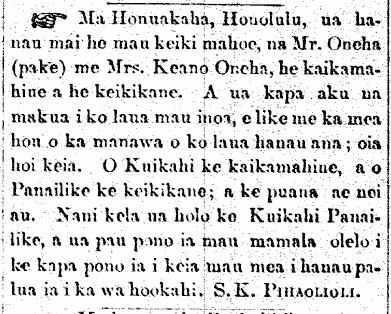
At Honuakaha, Honolulu, twins were born to Mr. Oneha (Chinese) and Mrs. Keano Oneha, one girl and one boy. The parents named them after the current news at the time of their birth; that being this: Kuikahi [Treaty] is the girl, and Panailike [Reciprocity] is the boy, and I announce it. How great that the Reciprocity Treaty has passed, and that this phrase is complete when speaking the names of these children born together at the same time. S. K. Pihaolioli.

[Children were often named after current events to commemorate the occasion.

There was a great debate over the merits of the Reciprocity Treaty with America, with many articulate compositions for and against it in the Hawaiian-Language Newspapers. More on that at a later date.]

(Lahui Hawaii, 10/19/1876, p. 3)

Ma Honuakaha, Honolulu...

Ka Lahui Hawaii, Buke II, Helu 43, Aoao 3. Okatoba 19, 1876.