Hawaiian Homes on Molokai, 1922.

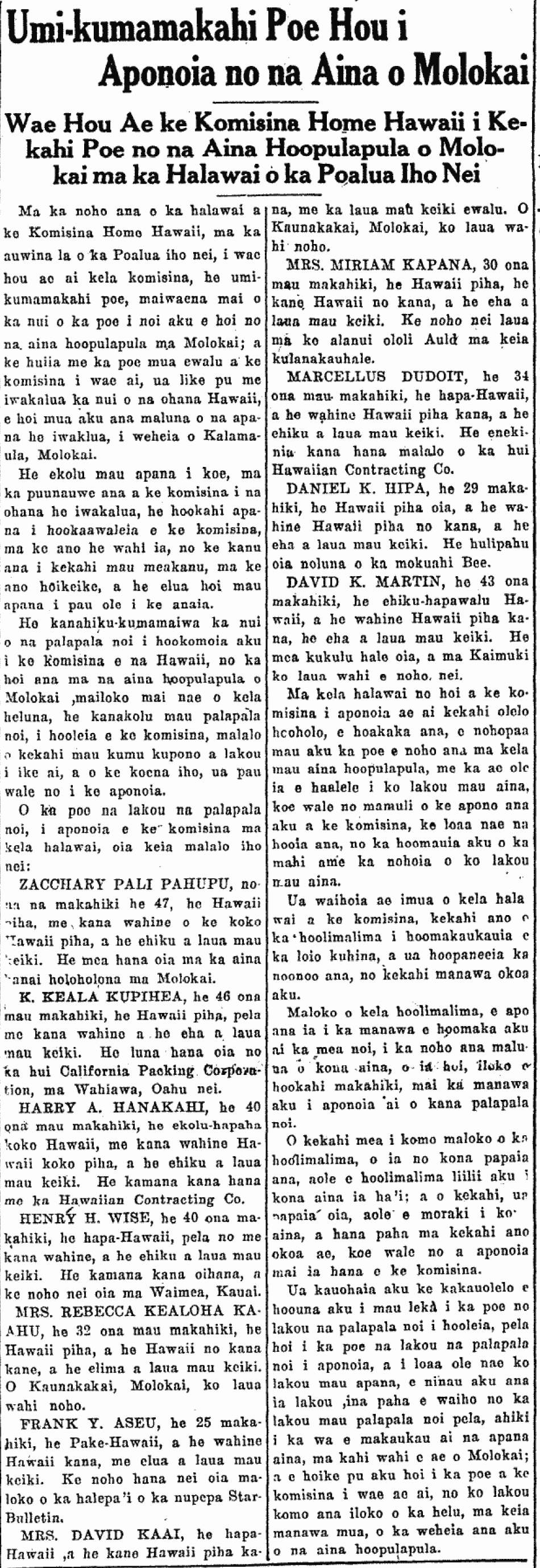
Eleven More People Approved for Lands on Molokai

The Hawaiian Homes Commission Selects Once More People for Homestead Lands on Molokai at the Meeting on this Past Tuesday

At the meeting of the Hawaiian Homes Commission on the afternoon of this past Tuesday, the commission selected eleven more people from amongst the many who applied to return to the homestead lands [aina hoopulapula] on Molokai; and added to the eight who the commission previously selected, that makes twenty Hawaiian families total who will be the first to go back to the twenty parcels opened up in Kalamaula, Molokai.

There are three parcels left to be divided up by the commission for twenty families and one section is set aside by the commission as an area to grow plants as a sample, and there are two pieces of land left to be surveyed.

There were seventy-nine applications submitted to the commission by Hawaiians, to return to homestead lands on Molokai, abut from amongst this number, there were thirty applications denied by the commission for appropriate reasons as deemed by them, and as for the rest, they were all approved.

The people whose applications were approved by the commission in that meeting are these below:

ZACCHARY PALI PAHUPU, who is 47 years old, a full Hawaiian, whose wife is also full Hawaiian, and they have seven children. He is employed at the ranch on Molokai.

K. KEALA KUPIHEA, who is 46 years old, a full Hawaiian, and so is his wife, and they have four children. He is a supervisor at the California Packing Corporation [CPC] in Wahiawa, Oahu.

HARRY A. HANAKAHI, who is 40 years old, three-fourths blooded Hawaiian, along with his wife who is full-blooded Hawaiian, and their seven children. He is a carpenter for the Hawaiian Contracting Co.

HENRY H. WISE, is 40 years old, a hapa Hawaiian, as well as his wife, along with their seven children. He is a carpenter by trade, and is living in Waimea, Kauai.

MRS. REBECCA KEALOHA KAAHU, is 32 years old, a full Hawaiian, and her husband is a Hawaiian as well, and they have five children. They reside in Kaunakakai, Molokai.

FRANK Y. ASEU, is 25 years old, Chinese-Hawaiian, and he has a Hawaiian wife, with two children. He is employed at the press of the Star-Bulletin Newspaper.

MRS. DAVID KAAI, is a hapa Hawaiian, and she has a full-Hawaiian husband, and they have eight children. They live in Kaunakakai, Molokai.

MRS. MIRIAM KAPANA, is 30 years old, she is full Hawaiian, she has a Hawaiian husband, and they have four children. They live on Auld Lane in this town.

MARCELLUS DUDOIT, is 34 years old, a hapa Hawaiian, and his wife is full Hawaiian, and they have seven children. He is an engineer working under the Hawaiian Contracting Co.

DANIEL K. HIPA, is 29 years old, a full Hawaiian, and he has a full-Hawaiian wife, and they have four children. He is a second mate aboard the ship the Bee.

DAVID K. MARTIN, is 43 years old, he is seven-eighths Hawaiian, and he has a full-Hawaiian wife, and they have four children. He is a house builder, and they reside in Kaimuki.

During that meeting of the commission, a resolution was passed clarifying that those who live on the homesteads must  live there permanently and not be allowed to move away from their land, except with approval from the commission with their promise that they will continue to farm and live on their land.

Put before the meeting of the commission were some terms of the lease drawn out by the attorney general and considerations of these were postponed until another time.

In the lease, it will specify the time when the person who applied must begin living on his land, that being within one year of his application being approved.

Another thing included in the lease is that it prohibits them from releasing out sections of their land to others; also, they are not to mortgage off their land, or do else wise other than what is approved of by the commission.

The secretary was instructed to send out letters to those whose applications were denied; as well as to those whose applications were approved but did not receive a parcel, asking them if they will leave their applications in until land is made available elsewhere on Molokai; and also to notify those who the commission selected that they will be put in a lottery [? komo ana iloko o ka helu] in the future when the homesteads open up.

(Kuokoa, 8/17/1922, p. 1)
Umi-kumamakahi Poe Hou i Aponoia no na Aina o Molokai

Ka Nupepa Kuokoa, Buke LXI, Helu 33, Aoao 1. Augate 17, 1922.

Beginning of line-by-line commentary of “Aia i Honolulu kuu pohaku,” 1929.

EXPLANATION OF THE FIRST LINE.

1. Aia i Honolulu kuu pohaku

Kapanookalani’s thoughts:—This land Honolulu, it is close to Nanawale, Puna, by the sea. It is a ku, a small land in between large lands.

The stone [pohaku] is Lord [Haku] of the chiefess and in this word, the important idea is chiefess [‘lii wahine].

Kahapula’s thoughts:—Honolulu is on Oahu, where King Kamehameha V dwelt and those who opposed him is the Honolulu in this first line of the mele. It was here his enemies schemed and carried out all their defiant acts against him. While they knew the wish of the King to marry the chiefess Pauahi, her teacher, Amos Cooke secretly agreed to  Bishop for him to meet with Pauahi without the knowledge of her parents. That is how Pauahi became Bishop’s, and this is how Bishop and his relative Lee [? William Little Lee] became dignitaries of the land.

Kupihea’s thoughts:—Honolulu is a fish stone called a Kuula, and was brought here to this Honolulu [on Oahu] from the Honolulu of Puna [on Hawaii]. This Kuula was placed in the tiny land of Honolulu where an Alii called Honolulu lived, who was related to the chiefess Peleula, whose younger sister was the beautiful Waikiki. This place is mauka of the old Rawlin’s Estate. There is a bank of coral where Honolulu is; the fishing altar [Kuula] for the fish ponds [loko i’a] is on the Waikiki side of Liliha Street and between Vineyard and King Streets.

The stone is related to chiefs from times immemorial [mai ka po mai]. It is a manifestation made by God.

Iokepa’s thoughts:—Honolulu is a small land and a canoe landing makai of Nanawale, Puna, between two sand dunes, one on the Hilo side and one on the Puna side, called Puu Waawaa. From this Honolulu is called the Honolulu here [on Oahu] which used to be called Kou before, and after it was called Honolulu until this day.

This is the meaning for the word Honolulu:—The wind is very calm [lulu] an the sea is serene; it is very fine and peaceful. Bay [? Hono] of calm sea; Hono that is peaceful.

Kuluwaimaka’s thoughts:—The stone is related to Kamehameha V. Honolulu in Puna is a lowland next to the sea. Its width is perhaps half a mile long between Na Puu o Pele and Waiakahiula on the Hilo side. Honolulu is a place where you pick opihi [ku’i opihi] and pick limu [hana limu]. There is a fine spring [punawai] there and there is a foot path there.

[And to think that this is but the very beginning of Kelsey’s detailed account of the explanation of the six loea of the mele “Aia i Honolulu kuu pohaku.” This is just the first line! It continues in the following issues!!

One more (huge) reason that Hawaiian-Language Newspapers are priceless!!!]

(Alakai o Hawaii, 12/5/1929, p. 2)

NA MANAO WEHEWEHE MALUNA O KA LAINA EKAHI.

Ke Alakai o Hawaii, Buke 1, Helu 32, Aoao 2. Dekemapa 5, 1929.

Hawaiian Pine purchases Lanai, 1922.

LANAI GOES TO THE HAWAIIAN PINEAPPLE COMPANY

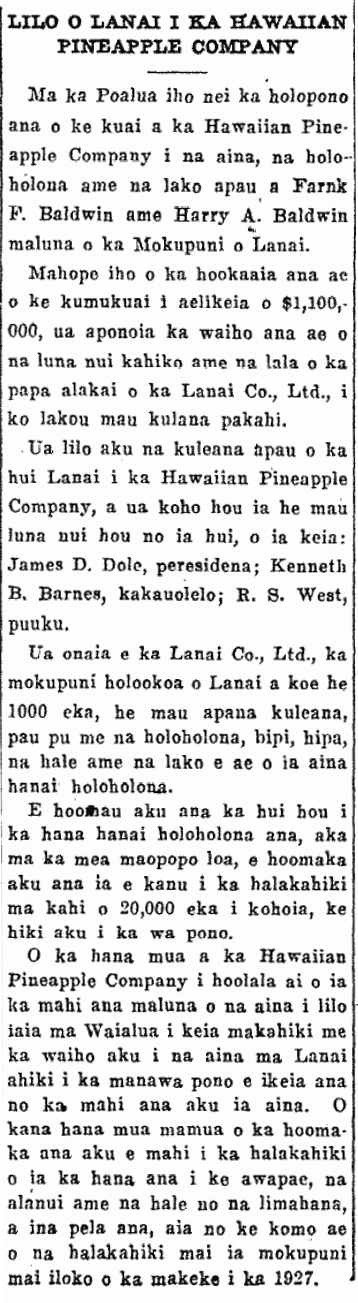
Last Tuesday the deal went through for Hawaiian Pineapple Company to purchase the land, the animals, and all equipment of Frank F. Baldwin and Harry A. Baldwin upon the Island of Lanai.

After paying the agreed price of $1,100,000, the retention of the old head managers and the members of the board of supervisors [papa alakai] of the Lanai Company, Ltd., of each of their positions was approved.

All of the rights of the Lanai Company has accrued to the Hawaiian Pineapple Company, and a number of new leaders have been chosen for that company, those being: James D. Dole, president; Kenneth B. Barnes, secretary; R. S. West, treasurer.

The entirety of Lanai is owned by the Lanai Co., Ltd, except for 1,000 acres, some kuleana lands, and all animals, cows, sheep, structures and other equipment of the ranch.

The new company will continue ranching, however, according to what is clearly understood, it will begin to plant pineapple on approximately 20,000 acres of chosen land, when the time is right.

The first thing planned by the Hawaiian Pine Company is to farm on land bought in Waialua this year while put aside the lands on Lanai until the right time comes to farm there. What it must do prior to farming pineapple is to build a pier, roads, and housing for the laborers, and if that happens, then pineapple from that island will hit the market in 1927.

(Kuokoa, 12/7/1922, p. 1)

LILO O LANAI I KA HAWAIIAN PINEAPPLE COMPANY

Ka Nupepa Kuokoa, Buke LXI, Helu 49, Aoao 1. Dekemaba 7, 1922.

Punchbowl to go to the rich, 1912.

CRYING IN REGRET

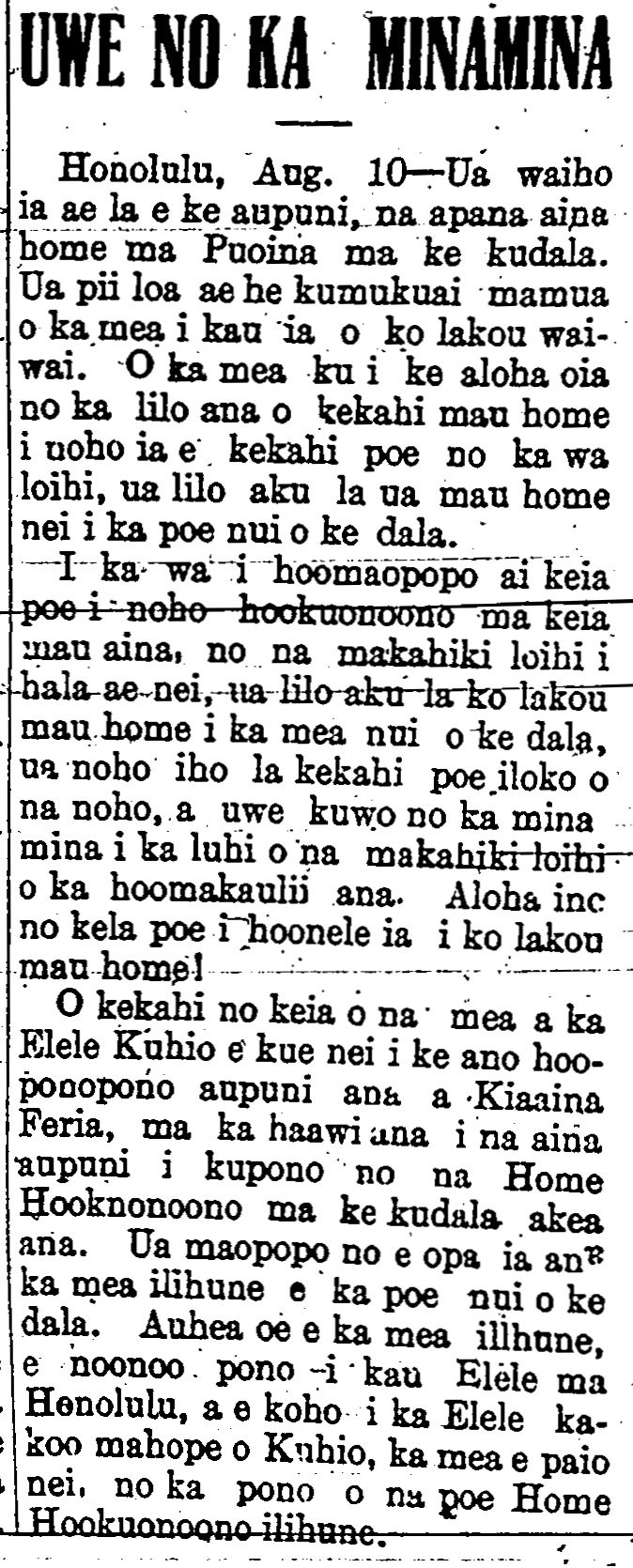
Honolulu, Aug. 10—The government has set aside the home lots at Puoina [Punchbowl] to be auctioned off. The prices have gone much higher than their value. What is so sad is that some homes which have been lived in by people for a long time will go to those who have a lot of money.

When these people who have homesteaded on these lands for many years in the past learned that their homes will go to the rich, some sat down in chairs and cried in despair over all the long years spent saving. How sad for those people who will lose their homes!

This is one of the things that Representative Kuhio opposes in the administering of the government by Governor Frear, that being the putting up for open auction lands suitable for Homesteads. It is clear that the poor will be crushed by the wealthy. Listen, oh you poor people, think carefully about your Representative of Honolulu, and choose a Representative who supports Kuhio, the one who is fighting for the rights of the poor Homesteaders [na poe Home Hookuonoono].

[The newspaper in which this article appears, “Ka Hoku o Hawaii,” is only available online from the middle of 1917. Although ulukau.org received funding many years ago to digitize all Hawaiian-Language Newspapers, many inexplicably fell through the crack. All the twelve prior years (which includes the issue from which this article was taken) can at this stage only be seen on microfilm…]

(Hoku o Hawaii, 8/22/1912, p. 1)

UWE NO KA MINAMINA

Ka Hoku o Hawaii, Buke 7, Helu 12, Aoao 1. Augate 22, 1912.

Makalei Cave, North Kona, Hawaii, 1924.

ENJOYMENT OF TIME

DESCRIPTION OF MAKALEI

This is a cave to the south of the hill of Akahipuu, and it was there that a man named Ko’amokumoku-o-hueia [Ko’amokumokuoheeia] lived, who came from Koolau and settled here, living as a newcomer.

And he lived here with his family: his wife, whose name was Kahaluu; and their two daughters; and one young son named Makalei.

And it was for this boy that this cave is called the cave of Makalei until this day.

While this man was living here, he began to farm taro, sweet potato, banana, sugar cane, and awa; and it all appeared to be well watered.

The natives of the area came to him and said, “The problem with this land is the water; it is a land without water, and you have to get water from the cave, but the places to store water here are kapu and cannot be fetched from in secret; if you are caught, you will be killed by the one who the water belongs.

Ko’amokumoku-o-heeia heard this talk of the locals, and this caused him to contemplate about where he and his family could get their water; and therefore, he made a reservoir [pa-o wai ?] for himself, and when the rains returned, water would fill receptacles [haona] then be held in the reservoir.

While living there with the family, one day, the boy went to relieve himself at a ravine behind their house, and while he was throwing the old waste into a plain old hole, right then wind blew out from that hole, and Makalei examined it and saw this deep, dark hole.

This boy was however not frightened at all; he stood up and went to where his father was farming and said:

“I went over there to defecate, but this is the astonishing thing, there was a lot of wind coming from that pit, maybe it is a hole of winds.”

“Where?” the father asked. “Down there,” and the father went to see.

When Ko’amokumoku-o-heeia reached the area and cleared away the stones covering the hole, he saw that it was a deep cave and wind rose from it as if it came from the mountains.

He turned and said to the child, “We have our place to hold water for our life here in this land without water, and I will make a hole for us to defecate in.”

The mouth to the cave was finished off nicely and there they defecated; while one side of the opening was made so that a person could enter.

No kamaaina knew of this cave, and he did not tell his wife, and nor did he talk of it again to his son; he totally refused to speak of the things pertaining to this cave.

One day, he entered the cave and saw the great vastness, and that he could walk upright without his head touching the wall above, and there was a lot of water dripping down; he decided to make containers [waa] of ohia, and containers of wiliwili.

In the night he fetched wiliwili and carried it on his back inside the cave, and it was inside of the cave that he dug until he made the opening of the wiliwili water container; the ohia chosen was dug out by the farmer and he carried it on his back into the cave. The inside of the cave grew criss-crossed with water troughs of wiliwili and ohia; there was just so many of the water containers that continued to be fitted inside.

When the dry season of this land returned as always, he did nothing other than farm, and he had ample water and had no problems with it.

It was at night that he fetched water and filled containers and gourds [olo], until the reservoir was full, and this was their drinking water for the month, and so forth.

The locals were suspicious about where these people go their water from, being that they did not see the source of their water, and they spoke often about the water of these malihini.

This cave still remains, and the entrance is very small but made like the entrance to a house, but within is very spacious and the walls are very tall.

When Maguire lived at Huehue, a great water catchment was built inside of the cave and a pipe was laid from the catchment until his house because he wanted cold water like ice water; also, pipes were laid above the catchment so that more water would go into it.

The story of this boy, Makalei is a beautiful one, along with his father, and it is a very long story; and should the writer have time to write this touching entertainment, then Makalei will be seen, the one whose name this cave is named after, Makalei Cave.

Here we will list the famous storied places [wahi pana kaulana] of these ahupuaa, from the sea until the summit of the mountain of Hualalai. With their names that they were called by the people of old.

1. Kileo hill.

2. Kaaialalaua.

3. Kapuukao.

4. Pahulu.

5. Moanuiahea.

6. Puumamaki.

7. Puuiki.

8. Puukoa.

9. Kaiwopele [Kaiwiopele].

10. Puuuhinuhinu.

11. Kahuaiki.

12. Kamawae.

13. Hikuhia, in the uplands of Napua.

14. Uau pooole [Uaupooole].

15. Na hale o Kaua [Nahaleokaua].

16. Kipuka o Oweowe.

17. Pualala.

18. Kawahapele.

19. Keoneeli.

20. Hinakapoula.

21. Kalulu.

22. Na puu Mahoe [Napuumahoe].

23. Kumu mamane [Kumumamane].

24. Kaluamakani.

25. Pohokinikini.

26. Hopuhopu.

27. Kipahee.

28. Hanakaumalu.

29. Kapuu o Honuaula [Honuaula Hill].

30. Ka puu o Hainoa [Hainoa Hill].

31. The summit of Hualalai and the pit of Milu.

32. Kipahee.

33. Makanikiu, Hill.

The pit of Milu [lua o Milu] spoken of is the pit which Hikuikanahele went to fetch Kawelu under the [Nuu ?] of Milu, the chief of the dark night; this is the round pit atop the summit of Hualalai which still remains to this day; it is a very deep hole and if you drop a rock down the pit, you will not hear the rattling of the rock.

The width of the mouth of this pit is perhaps about 6 to 7 feet in my estimation as I am familiar with those regions.

The water of Kipahee is a pit which goes down and reaches a spring.

It is not rippling water from which to scoop water out of, but it is moss [limu] which you collect until the container is full and then return to the top.

Climbing back up is troublesome; should you try to go straight up thinking you will exit immediately, you won’t be able to because you will keep sliding back until you are sitting after exhaustion from sliding down. In order to return to the top with ease, you have to climb zigzag, turning to the right and then to the left, and that is how you climb back to the top easily.

(Not complete.)

[This article continues into the next issue (6/5/1924, p. 4) and is signed: “Ka Ohu Haaheo I na Kuahiwi Ekolu. Kona Hawaii, April 30 1924.”]

(Hoku o Hawaii, 5/29/1924, p. 4)

NA HOONANEA O KA MANAWA

Ka Hoku o Hawaii, Buke XVIII, Helu 1, Aoao 4. Mei 29, 1924.

Replanting of native plants, 1901!

HAWAIIAN PLANTS WILL BE GROWN AGAIN.

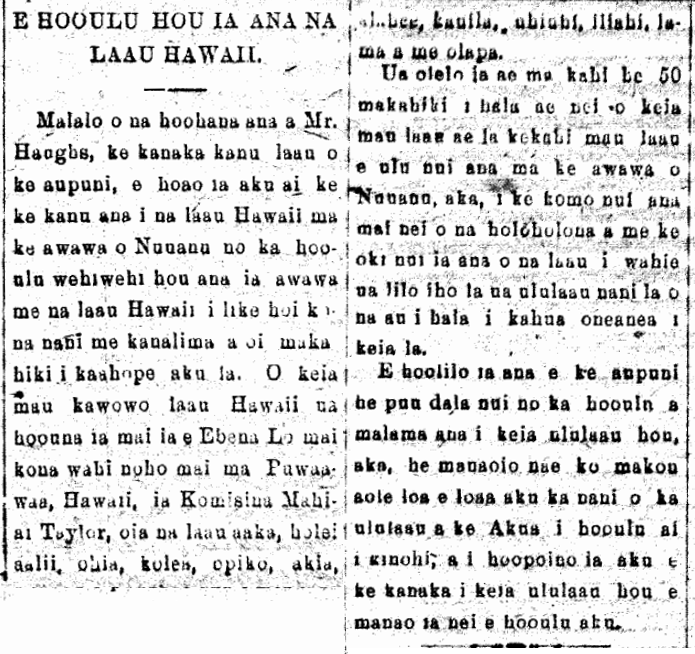
Under the direction of Mr. Haughs, the nurseryman of the government, the planting of Hawaiian plants in the valley of Nuuanu will be attempted, to make that valley verdant once again with native plants, so that it will be just as beautiful as it was fifty or more years ago. These seedlings were sent by Ebena Lo [Eben Low] from his residence at Puuwaawaa, Hawaii, to Commissioner Taylor, those being aaka, holei, aalii, ohia, kolea, opiko, akia, alahee, kauila, uhiuhi, iliahi, lama, and olapa.

It is said that it has been about 50 years that these plants were growing in abundance in Nuuanu Valley, for with the influx of animals and the mass cutting of trees for firewood, the beautiful forest of times gone by became a barren field.

The government will spend a sum of money to grow and foster this new forest, however, we believe that there is no way that the beauty of the forest which God grew originally and which was damaged by man will be attained by this new forest which is intended to be grown.

(Aloha Aina, 12/7/1901, p. 4)

E HOOULU HOU IA ANA NA LAAU HAWAII.

Ke Aloha Aina, Buke VII, Helu 49, Aoao 4. Dekemaba 7, 1901.

Moo at Mokuhinia, Lahaina, 1861.

Child Grabbed by Moo.

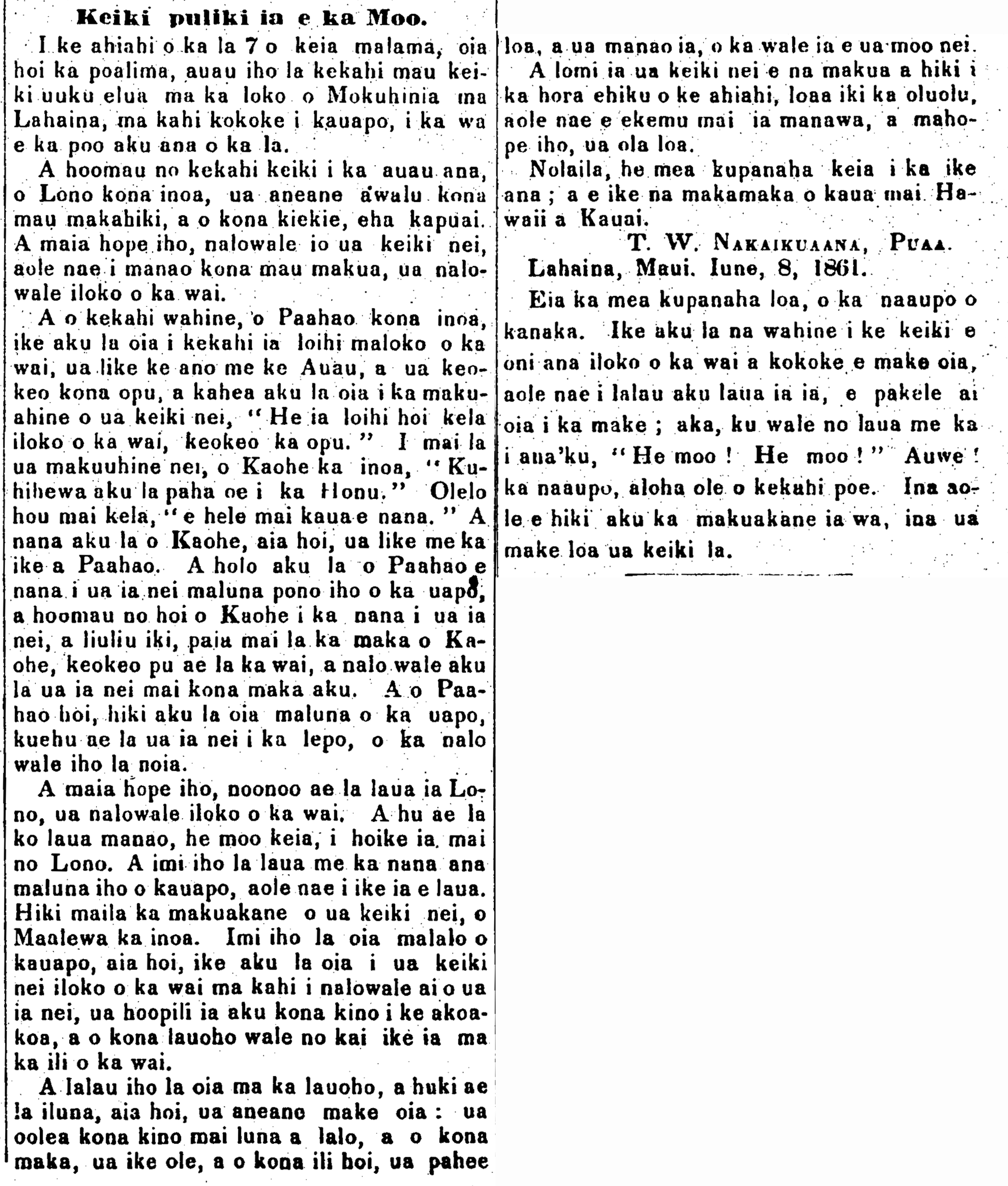
On the evening of the 7th of this month, that being a Friday, a couple of small children were bathing in Mokuhinia Pond in Lahaina, close to the bridge [uapo], when the sun was going down.

One of them continued to bathe, his name was Lono; he was almost eight years old, and his height was four feet. Right then after, this boy plain disappeared, but his parents did not think that he disappeared in the water.

A woman named Paahao saw a long fish in the water like an Swordfish [Auau], and its belly was white; she called out to the mother of the boy, “There is a long fish in the water with a white belly.” The mother named Kaohe said, “You must be confusing it with a Turtle.” The other responded, “Let’s go and see.” Kaohe went, and lo and behold, it was as Paahao had seen. Paahao went to go see the fish from atop the bridge while Kaohe continued to watch the fish; after a little time, Kaohe’s eyes were struck [temporarily blinded? “paia mai la ka maka”] and the water turned white, and the fish disappeared from her sight. As for Paahao, she arrived atop the bridge and the fish sprayed up dust, and it disappeared.

Then after, the two thought of Lono, and that he disappeared in the water. And they concluded that this was a moo that had revealed itself for Lono. They searched and went to look on the bridge, but it was not seen.

The father of the boy arrived, named Maalewa. He looked under the bridge, and come to find out, he saw the boy in the water where he was hidden by the moo; his body was attached to the coral and his hair was all that could be seen on the surface of the water.

The father grabbed him by the hair, and pulled him up, and he was almost dead; his body was stiff from top to bottom, and his eyes could not see, and his skin was slimy, which was believed to be the slime of the moo.

He was massaged by his parents until seven in the evening, whereupon he got slightly better but did not say a word, but later he revived.

Therefore, this was something miraculous to see; let it be known to all our friends from Hawaii to Kauai.

T. W. NAKAIKUAANA, PUAA.

Lahaina, Maui. June 8, 1861.

This is the remarkable thing; the foolishness of man. The women saw the child shaking in the water, close to dying, and they did not grab him and save him; but they just stood there saying, “A moo! A moo!” Auwe! the foolishness and heartlessness of some people. If the father had not arrived then, the child would be dead.

[I posted this article a long time ago on the Hoolaupai Facebook page, but because it has such bad search capabilities, i can’t find it. That is one of the reasons i started this blog. Searching for names or places or subjects, etc., is so much easier to do!

I am not sure what the commentary at the bottom is referring to, about the women seeing the boy shaking in the water…

For more on Mokuhinia and the work being done to restore this historic place, see: Friends of Mokuula.]

(Hae Hawaii, 6/12/1861, p. 41)

Keiki puliki ia e ka Moo.

Ka Hae Hawaii, Buke 6, Ano Hou.—Helu 11, Aoao 41. Iune 12, 1861.

Crown Lands and Government Lands, 1896.

GOVERNMENT LANDS.

Under the Republic of Hawaii that stands now, the crown lands have been returned and added with the other lands of the government, and are referred to as government lands. Currently, the entirety of these lands are under the authority of a Commission appointed for that purpose under the law. The Commission is active today and its members are putting into order matters that pertain to their duties as per the laws. The finding of all lands that are not to be owned by someone, as well as the leasing, selling, and dividing of lands that are recognized as lands fitting to be homes for people without homesteads for themselves. This idea was devised by Mr. S. B. Dole while he was a member of the Legislature for a session under the monarchy.

It seems that this was what he focused on, for the good of those without. He kept at this idea until it became law, amidst much skepticism by friends and fellow representatives.

But he did not relent until he succeeded, and now he is working to move forward his loving idea for his fellow man, to increase, and to make prosperous, the poor people. Under his law and its revisions, this Government Lands Commission was created.

At this time, the Commission is trying to carefully carry out their duties so that the lahui will not once again be hurt like under the benefits intended for the masses with the quiet land titles in the time of Kauikeaouli’s rule. They are surveying parcels from areas suited for a man and his family to live. The doors to this great right is opened and Hawaiians will receive land before all other ethnicities and then thereafter those from the outside. There are some Hawaiians taking advantage of this opportunity, along with some haole and other ethnicities. But the majority of those that know of the good offered up by this law are the people of foreign lands, the ones who know the value of land for which one is able to say that he is patriotic to the land of his birth.

By this law, power is give to advertise land to those who claim land for themselves, under the condition that they cannot use it for profit. The land is available to those without land or those with wetlands of less than an acre under his name, or under the husband or wife in some other area of the archipelago; they will live on the land for six years after the request for land and should they meet the qualifications under the law, the applicant will receive a lease or 999 years. The requirements for the application and stipulations of the lease are shown in full in sections 31–54 of the Land Act of 1895.

[Just as it is today, it was back then. Different newspapers and sources had different stances. It is perhaps not best thing to base your opinions on a single article or the words of a single person. It is important to try and see all that was written and handed down in other ways (for ink and paper is not necessarily the best way that information is passed down), and then decide what you think on the subject…

Oh, and see here for the Land Act of 1895.]

(Oiaio Puka La, 4/3/1896, p. 2)

NA AINA AUPUNI.

Ka Oiaio Puka La, Buke I, Helu 67, Aoao 2. Aperila 3, 1896.

More on the lowering of the flag, 1898.

WHO HATH EARS TO HEAR, LET HIM HEAR.*

Being that in time that news reported of earlier will come, about the raising of the American Flag above Hawaii, from the authority of the Republic of America; and in regard to this, word is being sent out to my beloved nation of Patriots.

DECLARATION TO THE LAHUI.

To all Patriots, we pray [ke Ka o ia aku nei? ke Kalo ia aku nei?] that you will not visit nor approach the area where the American Flag will be raised; let everyone remain at their own Home, kneel and look to the almighty one to ask for his help for the Hawaiian Nation, Land, and Kingdom.

All heads and leaders of the men’s and women’s Ahahui Aloha Aina [Hawaiian Patriotic League] and Hui Kalaiaina [Hawaiian Political Association], are directed to heed this as well.

JAMES K. KAULIA.

President.

*Mataio (Matthew) 13:9.

(Aloha Aina, 8/6/1898, p. 4)

O KA MEA PEPEIAO LOHE E HOOLOHE IA.

Ke Aloha Aina, Buke IV, Helu 32, Aoao 4. Augate 6, 1898.