More on “Aia i Honolulu kuu pohaku”! 1929.

A MELE FOR KAMEHAMEHA V.

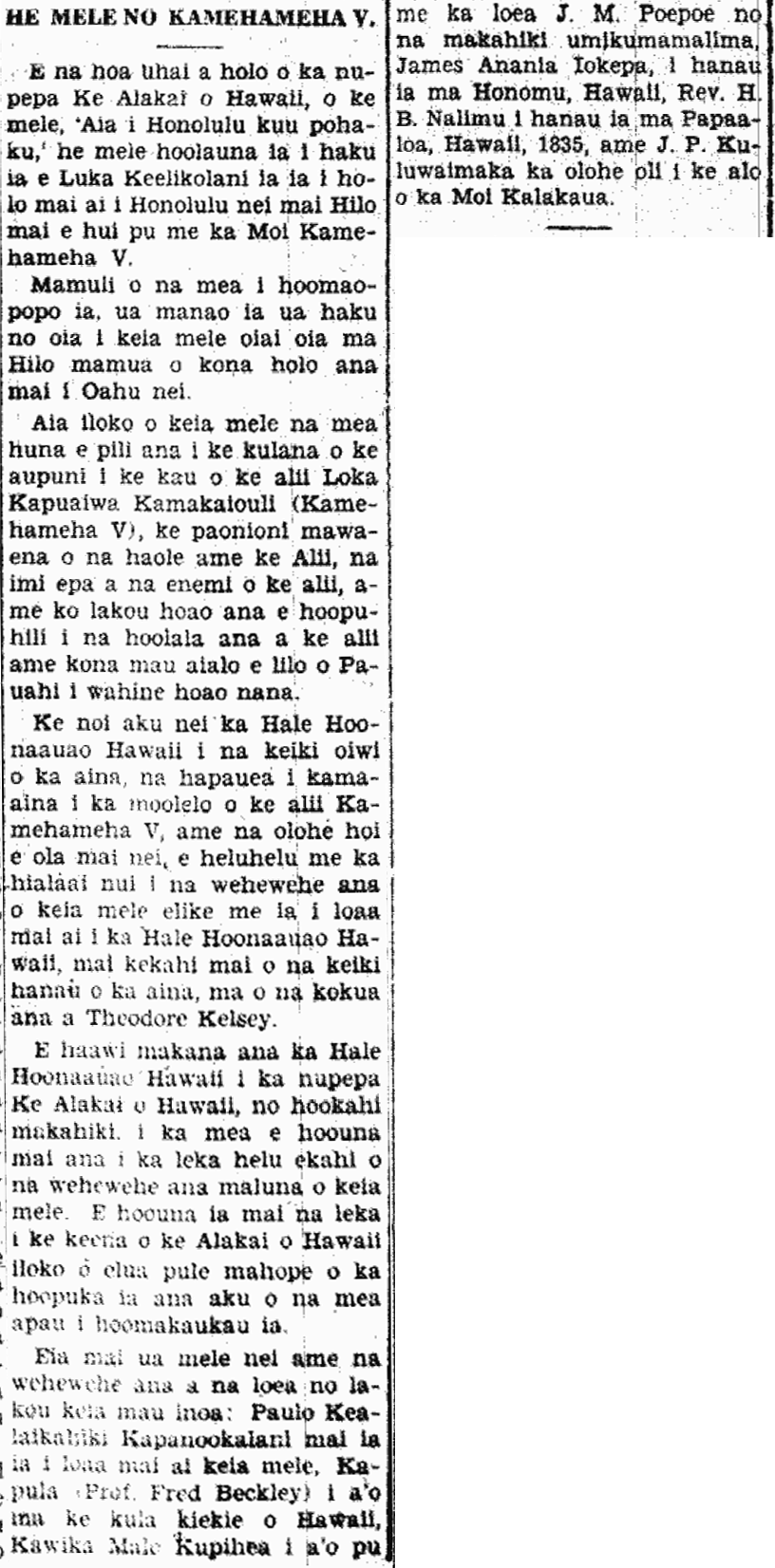
O Friends who chase after Ke Alakai o Hawaii, the mele, “Aia i Honolulu kuu pohaku,” is a mele of familiarity [mele hoolauna] composed by Luka Keelikolani when she was coming to here in Honolulu from Hilo to meet with King Kamehameha V.

From what is understood, it is believed that she composed this mele while she was in Hilo before her travelling to Oahu nei.

In this mele are hidden things dealing with the nation in the time of the alii Loka Kapuaiwa Kamakaiouli (Kamehameha V); the contention between the haole and the King, the deceit of the enemies of the King and their attempt to thwart the plans by the King and his court to make Pauahi his wife.

The Hale Hoonaauao Hawaii asks the native ones of the land, the old ones familiar with the history of King Kamehameha V, and the experts still living, to read with much pleasure the explanations of this mele as per what was obtained by the Hale Hoonaauao Hawaii from those native born of the land through the assistance of Theodore Kelsey.

The Hale Hoonaauao Hawaii will award a one-year subscription of the newspaper Ke Alakai o Hawaii to the one who sends the best letter with explanations on this mele. Send the letters to the office of Ke Alakai o Hawaii withing two weeks of the completion of the publishing of all that has been compiled.

Here is the mele and the explanations of the experts [loea] whose names are: Paulo Kealaikahiki Kapanookalani from whom we received this mele, Kahapula (Prof. Fred Beckley) who teaches at the University of Hawaii, Kawika Malo Kupihea who studied with the loea J. M. Poepoe for fifteen years. James Anania Iokepa who was born in Honomu, Hawaii, Rev. H. B. Nalimu who was born in Papaaloa, Hawaii in 1835, and J. P. Kuluwaimaka the skilled chanter [olohe oli] in the court of King Kalakaua.

[“Aia i Honolulu kuu pohaku” is perhaps the most widely studied mele i have seen, with line-by-line interpretations by experts of the day. It continues on for a number of issues of Alakai o Hawaii.

Does anyone have any details on the organization called Hale Hoonaauao Hawaii, or Hale Hoonaauao o Hawaii?]

(Alakai o Hawaii, 12/5/1929, p. 2)
HE MELE NO KAMEHAMEHA V.

Ke Alakai o Hawaii, Buke 1, Helu 32, Aoao 2. Dekemapa 5, 1929.

“Aia i Honolulu kuu pohaku,” name song for Kamehameha V., 1929.

AIA I HONOLULU KUU POHAKU.

1. Aia i Honolulu kuu pohaku

2. O Kealohilani kuu haku ia

3. Ua holo ka wela i na mokupuni

4. Ua puni hei au leo o ka manu

5. O a’u lehua i Mokaulele

6. Hooneenee mai e ka iliahi

7. Hoohanua mai la ka ua iuka

8. Aia ka pono ia Oniula

10. Ua malu ka honua ia Kalani

11. Kuu Haku i ka ehuehu kai olalo

12. I ahona Puna i ke ala o ka hala

13. Paa mai la Olaa i ka ua noe

14. Noho i ka ehuehu kai o Hilo

15. Kahiko Poliahu i ka hau anu

16. He manao paa ko’u a hiki aku

17. Ua lahui ia mai e iala

18. Hea aku no wau o mai oe

19. O Kamakaiouli kou inoa.

(Alakai o Hawaii, 12/5/1929, p. 2)

AIA I HONOLULU KUU POHAKU.
Ke Alakai o Hawaii, Buke 1, Helu 32, Aoao 2. Dekemapa 5, 1929.

The Kings of Hawaii, 1876.

This is from an issue of “The Friend,” which includes a short biography in English of the ruling monarchs of Hawaii nei, written by S. C. Damon. As for this page of illustrations, they say:

The illustrations accompanying this number of the Friend we could wish were better executed. The plate was made in New York, from the best photographs we could procure in Honolulu. The original of Kamehameha 1st was executed in 1817 by a Russian artist, who accompanied Kotzebue in his voyage, and may be seen by referring to the third volume of his voyage. The original of Kamehameha 2d was executed in England in 1824, in the style of the dress of George 4th’s reign. We think those of Kamehameha 3d, 4th and 5th are very good, but not quite so good those of Lunalilo or His Majesty Kalakaua.

[For the biographies, find them here: The Friend, February 1, 1876.

Although it is clunky to maneuver, most of this series of news letters is available from the Mission Houses Museum here: The Friend.]

(Friend, 2/1/1876, pp. 9–13)

[Monarchs]

The Friend, New Series, Volume 25, Number 2, Page unnumbered. February 1, 1876.

More on Kaheleiki trial: “Something not to be forgotten.” 1863.

Voyage of the Hawaiian Chiefs to San Francisco.

This past Wednesday morning [4/15/1863], the Honorable C. Gordon Hopkins [Hapakini], John Ii [Ioane Ii], Kaisara Kapaakea [Caesar Kapaakea], and J. Koii Unauna, along with the one who is involved in the dispute for whom they went to testify for, namely Harry Kaheleiki, came to shore riding aboard the ship, Yankee; and we are pleased to report the public that they are in good health.

During the trial of Harry Kaheleiki in San Francisco, there were many witnesses strongly against him; however, with the arrival of the alii mentioned above, there was true testimony in favor of the accused, and the error of those who testified against him was clear. The newspapers of San Francisco were filled with thoughts of appreciation for this Nation sending witnesses at much expense to have one of its citizens wrongly charged in a foreign land set free; according to one of the papers, this is a benevolent act not done by the enlightened Nations of the world, and so the Hawaiian Nation has taken the lead in this fine action. This is truly an act of aloha, and it is something not to be forgotten for all times.

The reason it was heard that a Hawaiian was being imprisoned in San Francisco was because of Doctor Gulick [Gulika], the one who was previously living in the islands of Micronesia, and due to weakening health, arrived in California. While he was in San Francisco several months ago, he heard that there was a Hawaiian man being held in one of the Jails there on the charge of murder; he therefore went quickly to meet with the man, and when he got there, he spoke with the aforementioned Kaheleiki, and though this conversation, it was clear in Doctor Gulick’s mind that the accused was innocent. And because Kaheleiki asked him if they could wait until witnesses were sent for from Hawaii for him, there would be many who would testify that he was innocent of the charges against him. So Doctor Gulick immediately went to the office of the Hawaiian Consul, Mr. Hitchcock [Kanikela Hawaii o Mr. Hikikoki], and told him about the circumstances of Kaheleiki and how he was certain that Kaheleiki was innocent of the charges. When the Hawaiian Consul heard of this, he went at once to meet with the accused, and upon seeing his demeanor and what he had to say, he knew for himself that Kaheleiki was innocent. He then went quickly to see the Judge to ask that the trial of Kaheleiki be postponed until he heard from here; for he had witnesses here for him. And that is how time was given to send his witnesses, and that is how he was freed. And when he sent for witnesses here, along with a letter from Doctor Gulick, and when His Highness L. Kamehameha heard of this, he along with Sheriff W. C. Parke put great effort into finding appropriate witnesses to testify for Kaheleiki, the one who was falsely charged. We are filled with appreciation for the Royal One, His Highness, and the Sheriff.

We must thank Doctor Gulick, and we are truly thankful for him in the name of all who desire that the innocent who are persecuted be freed, and in the name of all who strive to find ways to free the innocent from the hands of those who oppose them, while they live in foreign lands. God shall free the righteous.

[There are countless stories like this in the Hawaiian-Language Newspapers that should be relearned and retold and retold again, so they are not forgotten!]

(Kuokoa, 4/18/1863, p. 3)

Ka Huakai a na 'Lii Hawaii i Kapalakiko.

Ka Nupepa Kuokoa, Buke II, Helu 16, Aoao 3. Aperila 18, 1863.

Near tragedy caused by Kamehameha V’s deer, 1868.

[Found under: “LOCAL NEWS: Maui”]

Life saved from deer.—P. Kawelakawai of Kawela, Molokai wrote to us like this: On the 29th of April, I saw Kaukino, the one who barely survived. Here is the reason; one of the animals of our King, a deer set loose on his ranch, entered the sweet potato patch of at Kalamaula to eat the uala, and this man saw this and went to shoo it off; the animal rushed forward but he saw it coming, and it was but a few feet away and it caught him and thrust its antlers, whereupon he fell down, face thrown back. He was jabbed in the armpit, and the antler pierced through. His wife saw this happen and she brought him back to the houses and the man was very weak. We are relieved at the news following that letter that he has recovered.

[See earlier articles on the deer gifted to Kamehameha V. Deer imported from Japan in 1867. and Deer of Kamehameha V., 1867.]

(Kuokoa, 5/23/1868, p. 3)

Pakele ke ola i ke dia.

Ka Nupepa Kuokoa, Buke VII, Helu 21, Aoao 3. Mei 23, 1868.

On Liliuokalani’s composition of “Mele Lahui Hawaii,” 1898.

“In the early years of the reign of Kamehameha V, he brought to my notice the fact that the Hawaiian people had no national air. Each nation, he said, but ours had its expression of patriotism and love of country in its own music; but we were using for the purpose on state occasions the time-honored British anthem, “God save the Queen.” This he desired me to supplant by one of my own composition. In one week’s time I notified the king that I had completed my task. The Princess Victoria had been the leader of the choir of the Kawaiahao church; but upon her death, May 29, 1866, I assumed the leadership. It was in this building and by that choir that I first introduced the “Hawaiian National Anthem.” The king was present for the purpose of criticising my new composition of both words and music, and was liberal in his commendations to me on my success. He admired not only the beauty of the music, but spoke enthusiastically of the appropriate words, so well adapted to the air and to the purpose of which they were written.”

(from Hawaii’s Story by Hawaii’s Queen, pp. 31–32.)

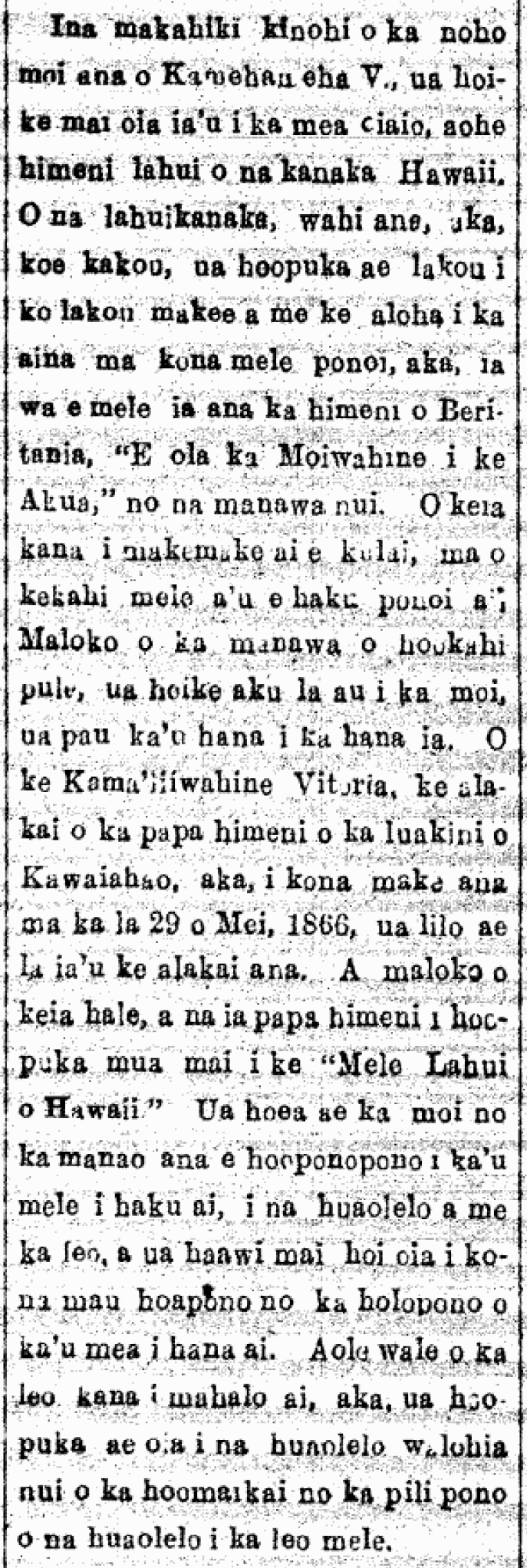
“Ina makahiki kinohi o ka noho moi ana o Kamehameha V., ua hoike mai oia ia’u i ka mea oiaio, aohe himeni lahui o na kanaka Hawaii. O na lahuikanaka, wahi ana, aka, koe kakou, ua hoopuka ae lakou i ko lakou makee a me ke aloha i ka aina ma kona mele ponoi, aka, ia wa e mele ia ana ka himeni o Beritania, “E ola ka Moiwahine i ke Akua,” no na manawa nui. O keia kana i makemake ai e kulai, ma o kekahi mele a’u e haku ponoi ai. Maloko o ka manawa o hookahi pule, ua hoike aku la au i ka moi, ua pau ka’u hana i ka hana ia. O ke Kama’liiwahine Vitoria, ke alakai o ka papa himeni o ka luakini o Kawaiahao, aka, i kona make ana ma ka la 29 o Mei, 1866, ua lilo ae la ia’u ke alakai ana. A maloko o keia hale, a na ia papa himeni i hoopuka mua mai i ke “Mele Lahui o Hawaii.” Ua hoea ae ka moi no ka manao ana e hooponopono i ka’u mele i haku ai, i na huaolelo a me ka leo, a ua haawi mai hoi oia i kona mau hoapono no ka holopono o ka’u mea i hana ai. Aole wale o ka leo kana i mahalo ai, aka, ua hoopuka ae oia i na huaolelo walohia nui o ka hoomaikai no ka pili pono o na huaolelo i ka leo mele.”

(Aloha Aina, 5/14/1898, p. 7)

KA BUKE MOOLELO HAWAII I HAKUIA E KA Moiwahine Liliuokalani...

Ke Aloha Aina, Buke IV, Helu 20, Aoao 7. Mei 14, 1898.

Hawaiian National Anthem, 1866.

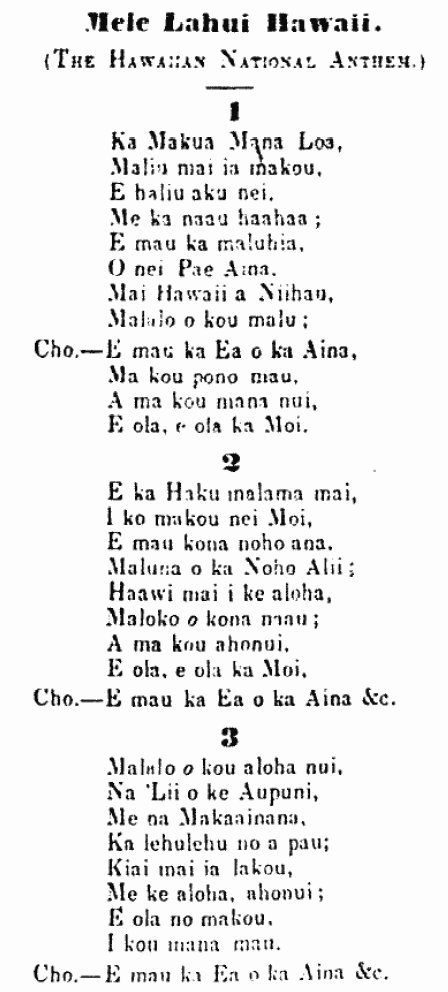
Mele Lahui Hawaii.
(The Hawaiian National Anthem.)

1

Ka Makua Mana Loa,
Maliu mai ia makou,
E haliu aku nei,
Me ka naau haahaa;
E mau ka maluhia,
O nei Pae Aina,
Mai Hawaii a Niihau,
Malalo o kou malu.

Cho.—E mau ka Ea o ka Aina,
Ma kou pono mau,
A ma kou mana nui,
E ola, e ola ka Moi.

2

E ka Haku malama mai,
I ko makou nei Moi,
E mau kona noho ana,
Maluna o ka Noho Alii;
Haawi mai i ke aloha,
Maloko o kona naau;
A ma kou ahonui,
E ola, e ola ka Moi.

Cho.—E mau ka Ea o ka Aina, &c.

3

Malalo o kou aloha nui,
Na ‘Lii o ke Aupuni,
Me na Makaainana,
Ka lehulehu no a pau;
Kiai mai ia lakou,
Me ke aloha, ahonui;
E ola no makou,
I kou mana mau.

Cho.—E mau ka Ea o ka Aina, &c.

The Hawaiian National Anthem.

1

Almighty Father,
Heed us,
Who turn to you,
With humble hearts;
Let there forever be peace,
In these Islands,
From Hawaii to Niihau,
Under your protection;

Cho.—Let the Sovereignty of this Land be for always,
By your never ending righteousness,
And by your great power,
Long live, long live the King.

2

O Lord, protect,
Our King,
Let his rule continue,
Upon the Throne;
Bestow him aloha,
Within his heart;
And by your grace
Long live, long live the King.

Cho.—Let the Sovereignty of this Land be for always, &c.

3

Under your great love,
Are the Alii of the Nation,
And the Makaainana,
All the people;
Do watch over them,
With aloha and magnanimity,
Let us live,
By your eternal power.

Cho.—Let the Sovereignty of this Land be for always, &c.

(Kuokoa, 11/24/1866, p. 2)

Mele Lahui Hawaii.

Ka Nupepa Kuokoa, Buke V, Helu 47, Aoao 2. Novemaba 24, 1866.

Law banning the killing of imported birds, 1870.

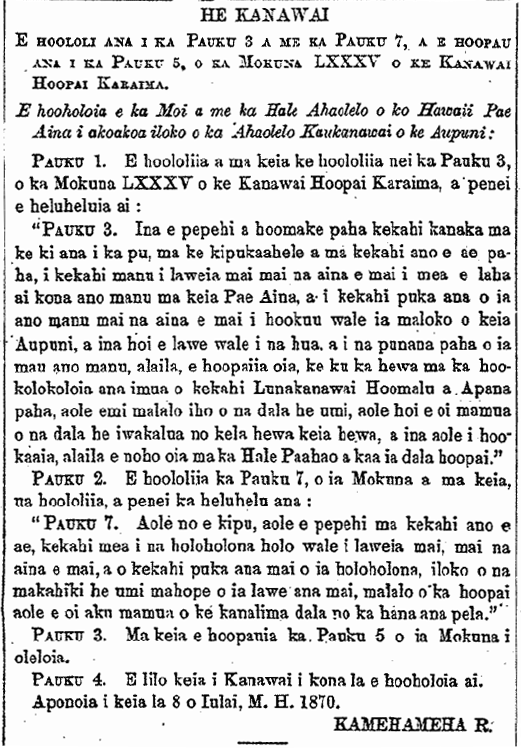
HE KANAWAI

E HOOLOLI ANA I KA PAUKU 3 A ME KA PAUKU 7, A E HOOPAU ANA I KA PAUKU 5, O KA MOKUNA LXXXV O KE KANAWAI HOOPAI KARAIMA.

E hooholoia e ka Moi a me ka Hale Ahaolelo o ko Hawaii Pae Aina i akoakoa iloko o ka Ahaolelo Kaukanawai o ke Aupuni:

PAUKU 1. E hoololiia a ma keia ke hoololiia nei ka Pauku 3, o ka Mokuna LXXXV o ke Kanawai Hoopai Karaima, a penei e heluheluia ai:

“PAUKU 3. Ina e pepehi a hoomake paha kekahi kanaka ma ke ki ana i ka pu, ma ke kipukaahele a ma kekahi ano e ae paha, i kekahi manu i laweia mai mai na aina e mai i mea e laha ai kona ano manu ma keia Pae Aina, a i kekahi puka ana o ia ano manu mai na aina e mai i hookuu wale ia maloko o keia Aupuni, a ina hoi e lawe wale i na hua, a i na punana paha o ia mau ano manu, alaila, e hoopaiia oia, ke ku ka hewa ma ka hookolokoloia ana imua o kekahi Lunakanawai Hoomalu a Apana paha, aole emi malalo iho o na dala he umi, aole hoi e oi mamua o na dala he iwakalua no kela hewa keia hewa, a ina aole i hookaaia, alaila e noho oia ma ka Hale Paahao a kaa ia dala hoopai.”

PAUKU 2. E hoololiia ka Pauku 7, o ia Mokuna a ma keia, ua hoololiia, a penei ka heluhelu ana:

“PAUKU 7. Aole no e kipu, aole e pepehi ma kekahi ano e ae, kekahi mea i na holoholona holo wale i laweia mai, mai na aina e mai, a o kekahi puka ana mai o ia holoholona, iloko o na makahiki he umi mahope o ia lawe ana mai, malalo o ka hoopai aole e oi aku mamua o ke kanalima dala no ka hana ana pela.”

PAUKU 3. Ma keia e hoopauia ka Pauku 5 o ia Mokuna i oleloia.

PAUKU 4. E lilo keia i Kanawai i kona la e hooholoia ai.

Aponoia i keia la 8 o Iulai, M. H. 1870.

KAMEHAMEHA R.

(Au Okoa, 8/4/1870, p. 4)

HE KANAWAI, E HOOLOLI ANA I KA PAUKU 3 A ME KA PAUKU 7...

Ke Au Okoa, Buke VI, Helu 16, Aoao 4. Augate 4, 1870.

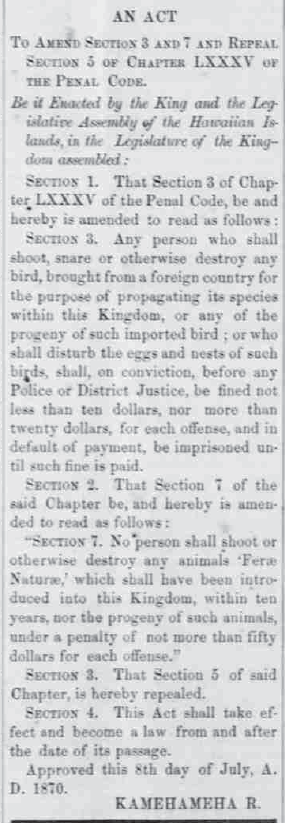
AN ACT

TO AMEND SECTION 3 and 7 AND REPEAL SECTION 5 OF CHAPTER LXXXV OF THE PENAL CODE.

Be it Enacted by the King and the Legislative Assembly of the Hawaiian Islands, in the Legislature of the Kingdom assembled:

SECTION 1. That Section 3 of Chapter LXXXV of the Penal Code, be and hereby is amended to read as follows:

Section 3. Any person who shall shoot, snare or otherwise destroy any bird, brought from a foreign country for the purpose of propagating its species within this Kingdom, or any of the progeny of such imported bird; or who shall disturb the eggs and nests of such birds, shall, on conviction, before any Police or District Justice, be fined not less than ten dollars, nor more than twenty dollars, for each offense, and in default of payment, be imprisoned until such fine is paid.

SECTION 2. That Section 7 of the said Chapter be, and hereby is amended to read as follows:

“SECTION 7. No person shall shoot or otherwise destroy any animals ‘Feræ Naturæ,’ which shall have been introduced into this Kingdom, within ten years, nor the progeny of such animals, under a penalty of not more than fifty dollars for each offense.”

SECTION 3. That Section 5 of said Chapter, is hereby repealed.

SECTION 4. This Act shall take effect and become a law from and after the date of its passage.

Approved this 8th day of July, A. D. 1870.

KAMEHAMEHA R.

(Hawaiian Gazette, 7/27/1870, p. 4)

AN ACT, TO AMEND SECTION 3 and 7 AND REPEAL SECTION 5...

Hawaiian Gazette, Volume VI, Number 28, Page 4. July 27, 1870.

Look back at the 1867 laying of the cornerstone of St. Andrew’s Cathedral, 1906.

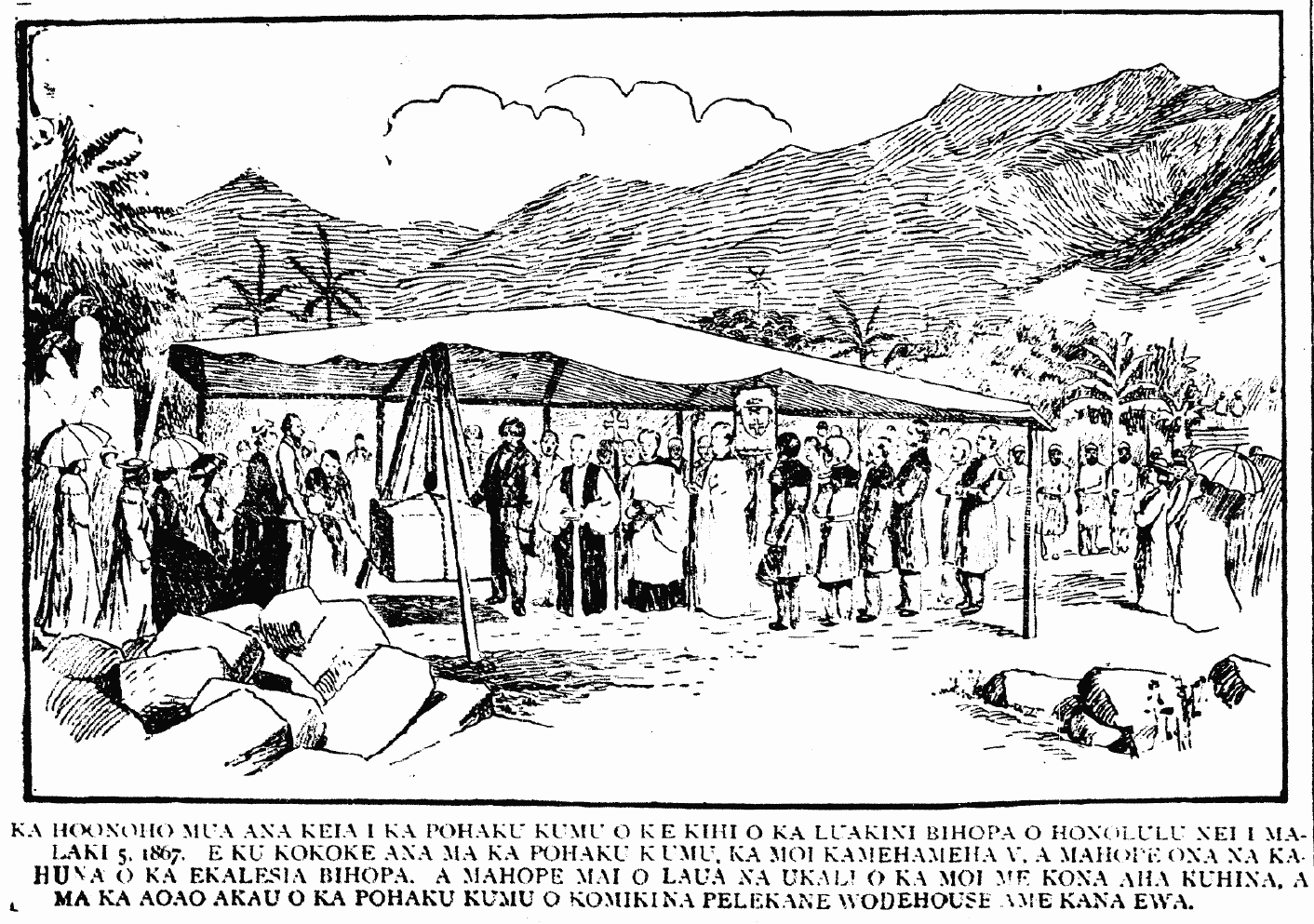
This is the first laying of the cornerstone of the Anglican Church of Honolulu, on March 5, 1867. Standing near the cornerstone is King Kamehameha V, and behind him are the priests of the Anglican Church. And behind those two are the attendants of the King and his Cabinet of Ministers, and to the right side of the cornerstone is the British Consul Wodehouse and his wife.

(Kuokoa, 11/30/1906, p. 2)

KA HOONOHO MUA ANA KEIA I KA POHAKU KUMU...

Ka Nupepa Kuokoa, Buke XLV, Helu 48, Aoao 2. Novemaba 30, 1906.

Niihau purchased for $10,800. 1864.

The Haole are Really Working Niihau.

O Kuokoa Newspaper; Aloha to you:—I met up with the newspaper article under News of Hawaii, in Issue 15 of the 9th of April, about the selling of Niihau to Mr. James Francis Sinclair, for $10,800, along with the lands of Kuakanu, which are the konohiki lands of Halewela and Kahuku, which the Government sold to the one named above, along with the konohiki lands, and this whole island has gone to the haole; perhaps you all and those others as well have heard that Niihau was sold, along with those penny-pinching folks who don’t get the shining beacon of Hawai nei through the Kuokoa Newspaper. And it is we who know of the great, who know of the small, and who know of the wide, that knows of the selling from Kii to Kawaihoa, from the Makahuena Point to Pueo Point; everything upon the land is bought and there is nothing left for us, the Hawaiians, under the haole owners.

Their Way of Living: They are pleasant and good, and speak nicely with the people, but they are not very proficient in the Hawaiian language. The haole say, “mahope aku kumaki” [?] There are ten Hawaiians, caretakers [hoaaina] of the land, chosen from amongst the locals, but two are from elsewhere, they are newcomers, one from Hawaii and the other from Maui, and including them there are ten caretakers. Here are each of their names which the haole selected: A. Puko, D. Kauki, Hetesia, J. H. Kanakaiki, P. R. Holiohana, H. Haokaku, Mose Kanohai, Ioela, Kapahee and Pouli; Kanakaiki is from Napoopoo, Hawaii, and Holiohana is from Hana, Maui, and are locals from there. Those caretakers are in charge of the three work days every month just like the konohiki of the chiefs, should there be work by haole owner to be done.

Their Number: Mr. James Francis Sinclair them total twelve in number; two brothers, three sisters, five children, one mother, and one in-law, which totals twelve; they live in Kununui; they are religious, with one God, but their religion is very different; their houses were constructed in Britain and brought to Niihau: three houses, one currently stands, and two more to follow; we appreciate how nice and beautiful it is to see.

Dealing with the Animals: There are two horses per man and woman, and should there be three, it is killed, and so forth; as for dogs, there are none left, they were all killed, from the big ones to the small ones because sheep were being killed, and so the government is without money from the dog tax, also the goats were all killed. You Kauai people who own horses and sheep, get them quick, don’t dawdle, or they will be taken by the haole.

Things Grown by the People.

The Hawaiians consume what they produce, and they also assist with the land owners in the watering of the sweet potato, ke pola akaakai [?], and chickens, as long as they were pleasant, or else that was that.

On the Number of Sheep

Set loose on Niihau are the sheep which you have perhaps seen in our Newspaper; as for the count, you probably have not heard; this is the truth as to the abundance or dearth: the number of sheep is 3,400, with 1,400 belonging to the Hon. W. Webster and 2,000 belonging to the King; there is no end to their desire for sheep.

Sugar Cane Cultivation.

Niihau will be planted with sugar cane if the test on one acre goes well; and if the cane grows nicely, then planting will commence, but if it doesn’t grow, that’s it, because it is an arid land.

This is an undesirable land for those foreigners seeking to make money because it is dry and scorched by the sun, and crops die; but here are people who are after wealth, and they tell us, the locals, that this is very valuable land for sheep and cane; our good friend, H. M. Whitney, the local of Waimea and Niihau, along with his parents, are familiar with this island and its extreme heat in the Makalii months [summer]. I will stop writing as the Naulu rain of Niihau is falling. With aloha.

P. R. Holiohana.

Kihalaui, Niihau, May 2, 1864.

[This P. R. Holiohana (later it seems he goes by the name P. R. Holi) writes in to the newspapers often from Niihau on a number of subjects.]

(Kuokoa, 6/4/1864, p. 1)

Hana io ka Haole ia Niihau.

Ka Nupepa Kuokoa, Buke III, Helu 23, Aoao 1. Iune 4, 1864.