Harrowing octopus encounter, 1896.

Fierce Battle with a Hee.

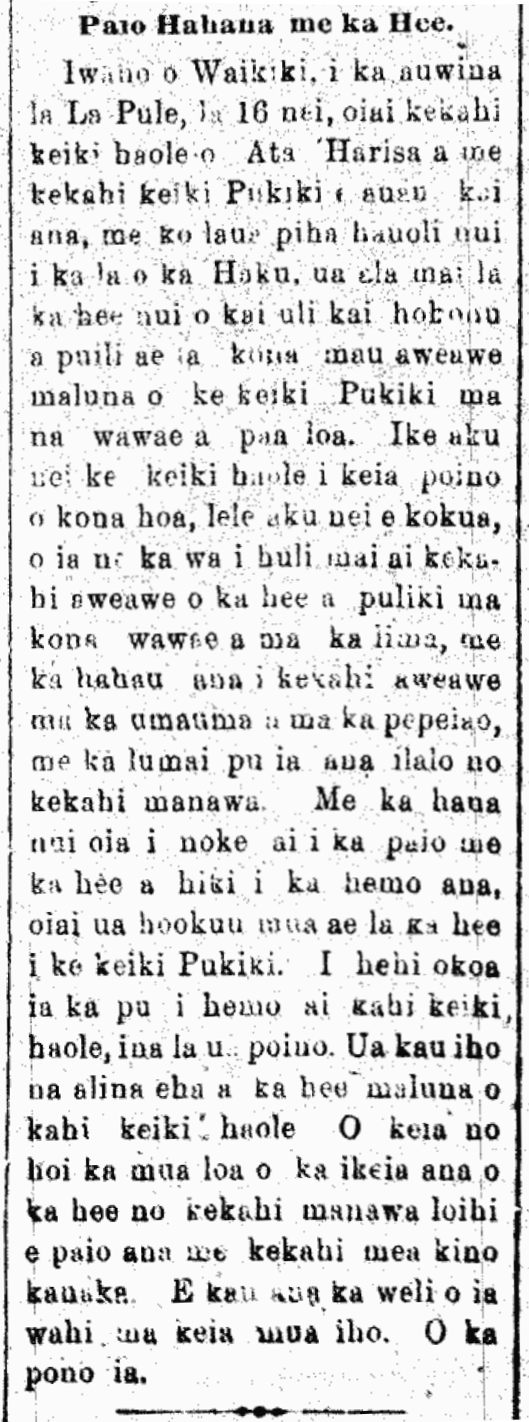
Outside of Waikiki, in the afternoon of Sunday, the 16th, while the haole children of Arthur Harris [Ata Harisa] and some Portuguese children were swimming in the ocean, full of joy on the day of the Lord, a great octopus from the deep, dark sea, rose up and wrapped its tentacles tightly about the legs of the Portuguese boy. The haole boy saw this trouble faced by his friend, and sped over to help; that is when one of the tentacles of the hee swung and grabbed on to his leg and arm while one of the tentacles pummeled his chest and ear, while he was pulled down under for a time. With much effort, he kept on fighting with the hee until he was free, being that it had previously released the Portuguese boy. The head of the hee was stomped full on so that it released the haole boy, or he would have been in trouble. The haole boy was left with scars on him from the hee. This is the first time in a long time that a hee was seen fighting with a person. That place will be feared from here forth. This is as it should be.

(Makaainana, 2/24/1896, p. 2)

Paio Hahana me ka Hee.

Ka Makaainana, Buke V—-Ano Hou, Helu 8, Aoao 2. Feberuari 24, 1896.

Johnny Noble’s band, 1925.

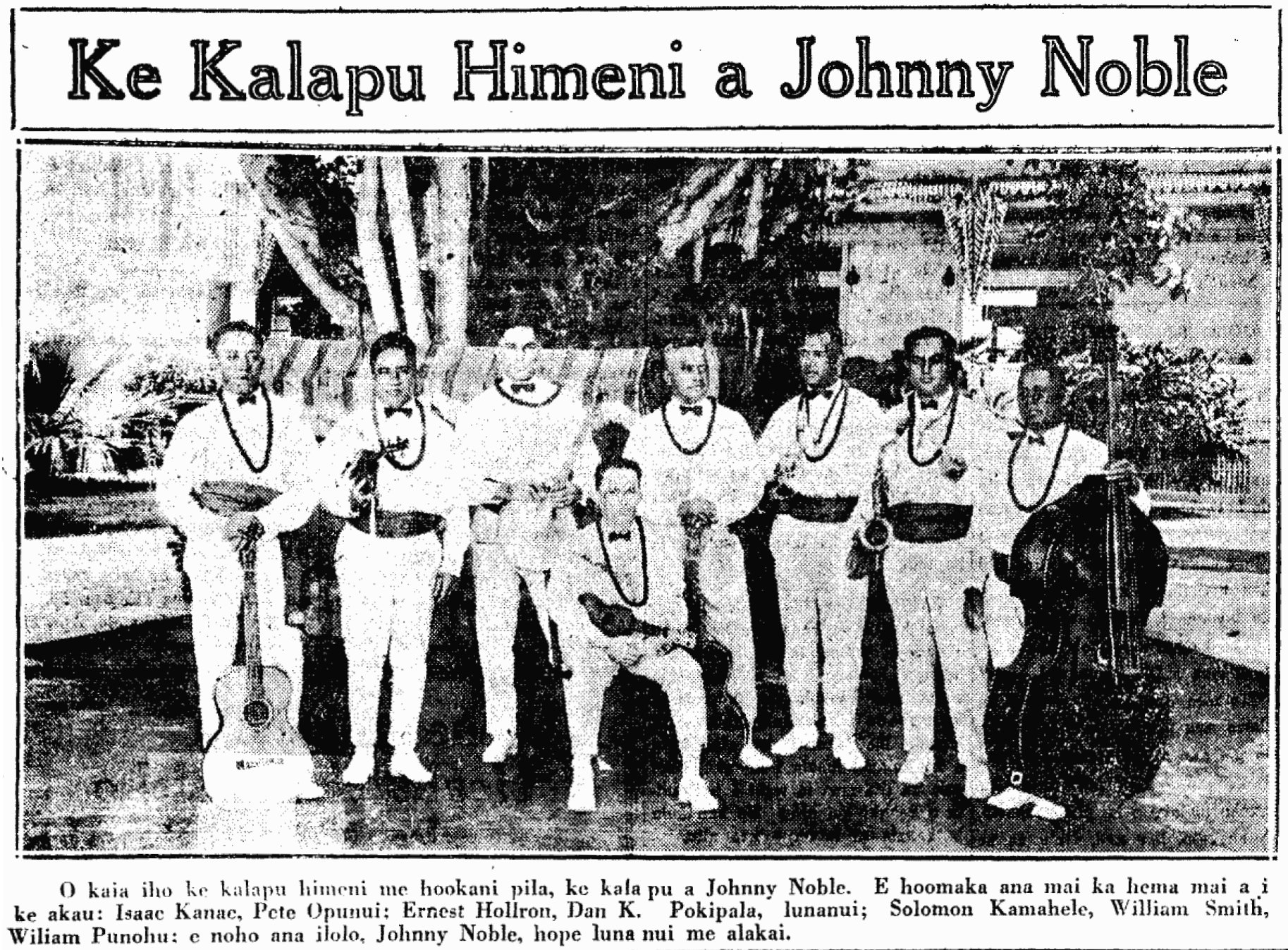
Johnny Noble’s Singing Group

This is the singing group and band, the club of Johnny Noble. Starting from the left to right, Isaac Kanae, Pete Opunui, Ernest Hollron, Dan K. Pokipala (manager), Solomon Kamahele, William Smith, William Punohu, and seated is Johnny Noble (second in charge and leader of the band).

[If this image looks familiar to you and you were following the Hoolaupai page on Facebook, i am reposting past articles i previously put up there, so that they can be easily searched here at http://nupepa-hawaii.com. I try to categorize it under “repost” when i remember…]

(Kuokoa, 4/23/1925, p. 5)

Ke Kalapu Himeni a Johnny Noble

Ka Nupepa Kuokoa, Buke LXIV, Helu 17, Aoao 5. Aperila 23, 1925.

Albert Loomens of Wilcox Rebellion sentenced, 1890.

[Found under: “HAWAII NEWS”]

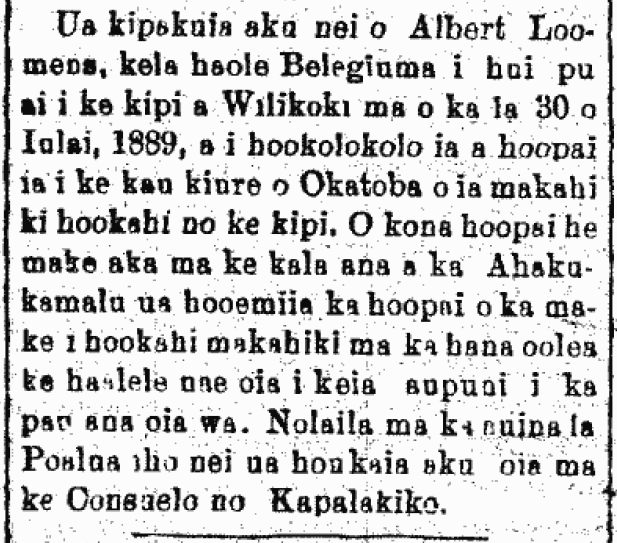
Albert Loomens is being banished, that Belgian who joined the rebellion with Wilcox and party on the 30th of July 1889; and he was tried and sentenced by jury on October of the same year for treason. His sentence was death but this was forgiven by the Privy Council [Ahakukamalu], and the death sentence was reduced to one year of hard labor on the condition that he leave this country at the end of this term. Therefore, on the afternoon of this Tuesday, he was sent aboard the Consuelo for San Francisco.

(Ko Hawaii Pae Aina, 10/18/1890, p. 2)

Ua kipakuia aku nei o Albert Loomens...

Ko Hawaii Pae Aina, Buke XIII, Helu 42, Aoao 2. Okatoba 18, 1890.

Food Exports, 1890.

[Found under: “HAWAII NEWS”]

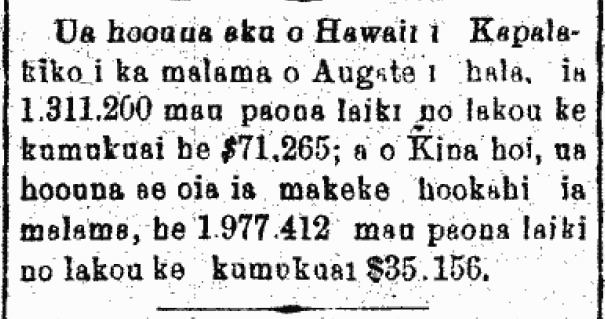
Hawaii exported to San Francisco in the month of this past August, 1,311,200 pounds of rice at the price of $71,265; and China exported to the same market in that month, 1,977,412 pounds of rice at the price of $35,156.

[What a different world we live in where we import most of our food…]

(Ko Hawaii Pae Aina, 10/18/1890, p. 2)

Ua hoouna aku o Hawaii i Kapalakiko...

Ko Hawaii Pae Aina, Buke XIII, Helu 42, Aoao 2. Okatoba 18, 1890.

Different view of the seal of the republic, 1896.

Great Seal of the Republic of Hawaii.

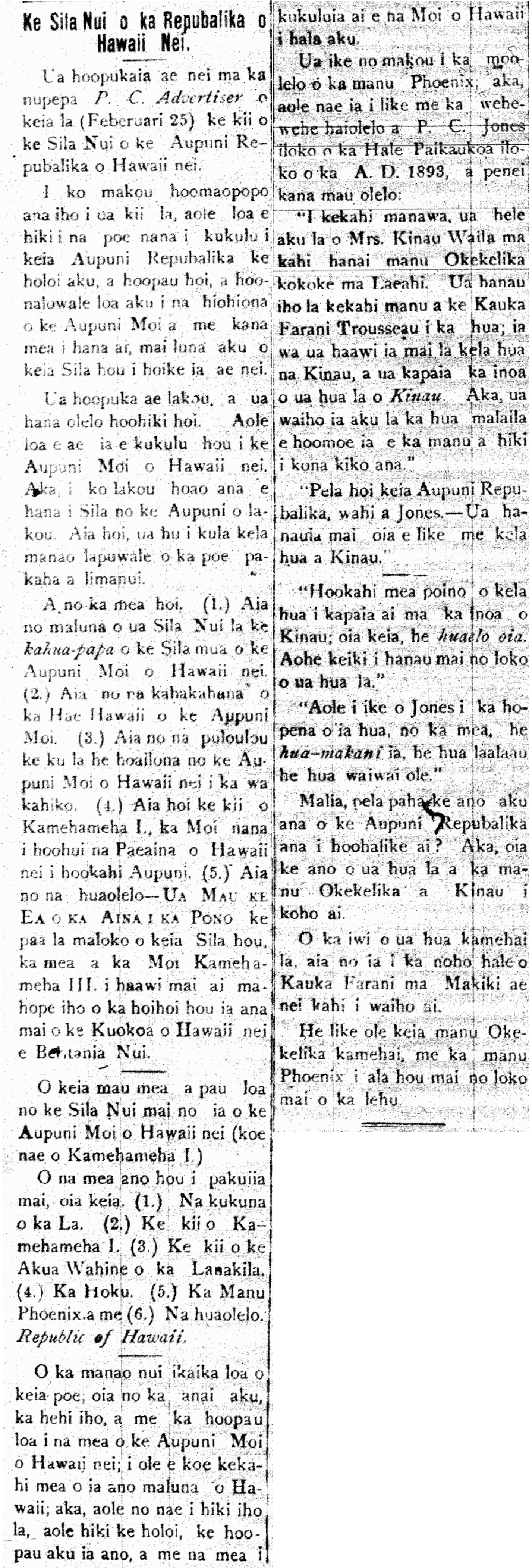
In today’s P. C. Advertiser (February 25), a picture of the Great Seal of the Republic of Hawaii was printed.

By our understanding of that image, there is no way that those who established this Republic can erase or end or eradicate visages of the Monarchy and its accomplishments, from the seal mentioned above.

They stated and vowed that there will be no way that the reestablishment of the Kingdom of Hawaii nei will be allowed. However, when they set out to create a Seal for their Government. And now, that foolish idea of the plunderers and thugs has gone awry.

Being that, (1.) On that Great Seal, is the foundation of the first Seal of the Monarchy of Hawaii nei. (2.) There is the stripes of the Hawaiian Flag of the Monarchy. (3.) There stand puloulou, a symbol of the Hawaiian Monarchy of old. (4.) There is an image of Kamehameha I., the King who unified the Hawaiian Archipelago into one Nation. (5.) There are the words—”Ua Mau ke Ea o ka Aina i ka Pono” affixed onto this new Seal, the words given by King Kamehameha III after the restoration of the Independence of Hawaii nei by Great Britain.

All these things were from the Great Seal of the Monarchy of Hawaii nei (except Kamehameha I.)

The new things added are these. (1.) Rays of the Sun. (2.) The image of Kamehameha I. (3.) The image of the Goddess of Victory. (4.) The Star. (5.) The Phoenix Bird, and (6.) The words, Republic of Hawaii.

Their intense desire is to rub out, to stomp out, and to end for all time, things of the Monarchy of Hawaii nei, lest vestiges of that sort remain in Hawaii; but that is not possible: there is no erasing, nor putting end to deeds done by the past Monarchs of Hawaii.

We know the story of the Phoenix, but it is not the same as the explanatory speech by P. C. Jones at the Armory [Hale Paikaukoa] in the year 1893, and these are his words:

“Once, Mrs. Kinau Wilder [Waila] went to where Ostrich were raised near Diamond Head [Laeahi]. One of the birds of the French Doctor Trousseau laid an egg, and it was on that occasion given to Kinau, and the egg was called Kinau. However, it was left there to be sat on by a bird until it hatched.

“This is similar to this Republic,” according to Jones. “It was born like that egg, Kinau.”

There is one unfortunate thing about that egg called by the name of Kinau, that being, it was a rotten egg [huaelo]. There was no chick born from that egg.

Jones didn’t know of the outcome of that egg, for it was but a yolk-less egg [hua makani], a hua laalaau?, a worthless egg.

Perhaps this will be the outcome of the Republic to which he compares it to? But at any rate, that is the kind of Ostrich egg that Kinau chose.

The shell of that astonishing egg is kept at the residence of Trousseau [Kauka Farani] in Makiki.

This astonishing Ostrich is not the same as a Phoenix which rises from the ashes.

(Aloha Aina, 2/29/1896, p. 4)

Ke Sila Nui o ka Repubalika o Hawaii Nei.

Ke Aloha Hawaii, Buke II, Helu 9, Aoao 4. Feberuari 29, 1896.

Use of tradition for propaganda, 1896.

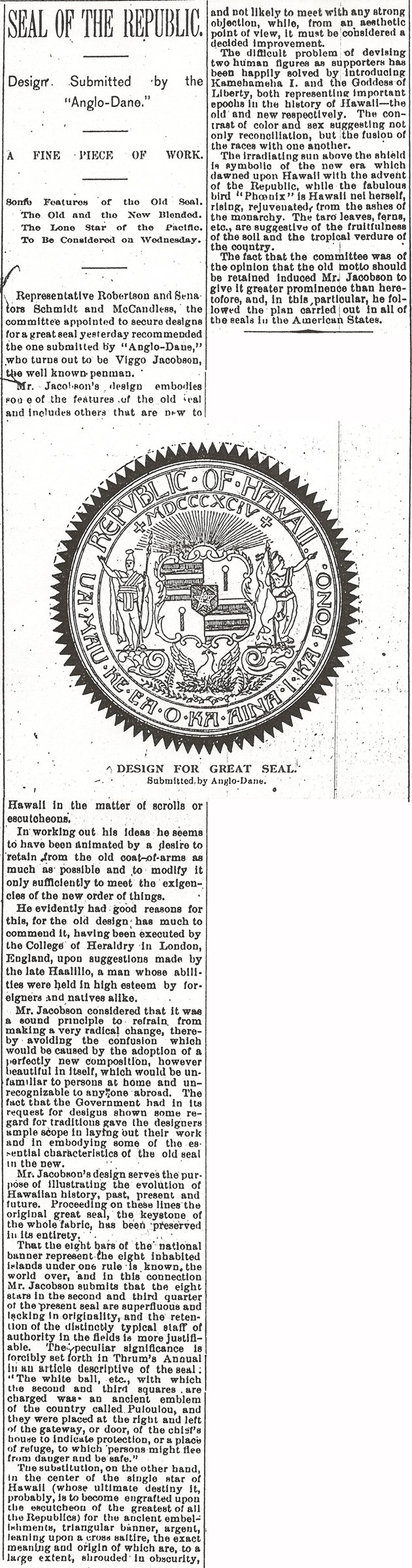
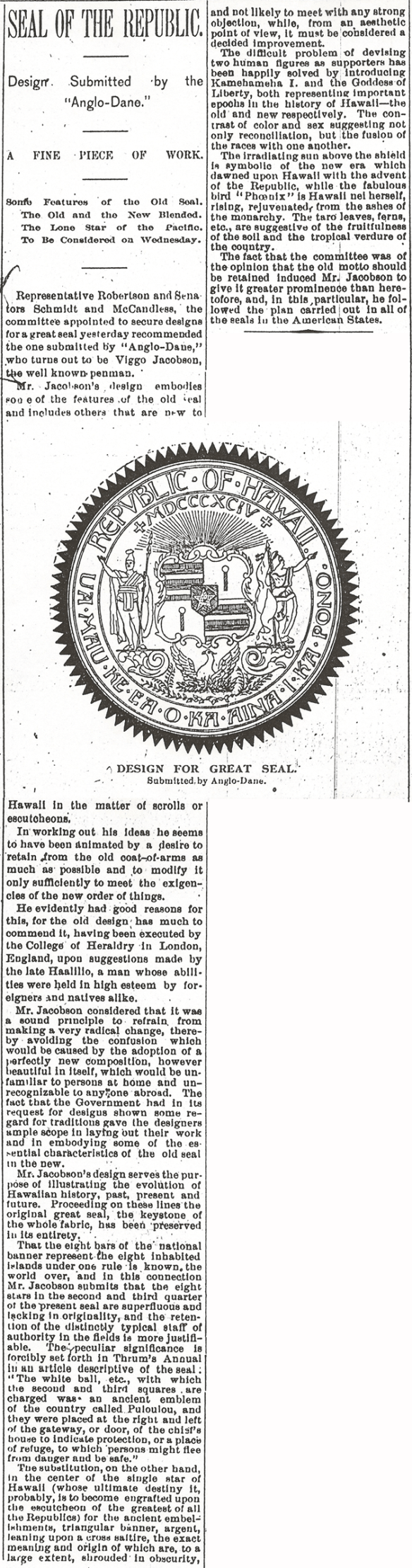
SEAL OF THE REPUBLIC.

Design Submitted by the “Anglo-Dane.”

A FINE PIECE OF WORK.

Some Features of the Old Seal. The Old and the New Blended. The Lone Star of the Pacific. To be Considered on Wednesday.

Representative Robertson and Senators Schmidt and McCandless, the committee appointed to secure designs for a great seal yesterday recommended the one submitted by “Anglo-Dane,” who turns out to be Viggo Jacobson, the well known penman.

Mr. Jacobson’s design embodies some of the features of the old seal and includes others that are new to Hawaii in the matter of scrolls or escutcheons.

In working out his ideas he seems to have been animated by a desire to retain from the old coat-of-arms as much as possible and to modify it only sufficiently to meet the exigencies of the new order of things.

He evidently had good reasons for this, for the old design has much to commend it, having been executed by the College of Heraldry in London, England, upon suggestions made by the late Haalilio, a man whose abilities were held in high esteem by foreigners and natives alike.

Mr. Jacobson considered that it was a sound principle to refrain from making a very radical change, thereby avoiding the confusion which would be caused by the adoption of a perfectly new composition, however beautiful in itself, which would be unfamiliar to persons at home and unrecognizable to anyone abroad. The fact that the Government had in its request for designs shown some regard for traditions gave the designers ample scope in laying out their work and in embodying some of the essential characteristics of the old seal in the new.

Mr. Jacobson’s design serves the purpose of illustrating the evolution of Hawaiian history, past, present and future. Proceeding on these lines the original great seal, the keystone of the whole fabric, has been preserved in its entirety.

That the eight bars of the national banner represent the eight inhabited islands under one rule is known, the world over, and in this connection Mr. Jacobson submits that the eight stars in the second and third quarter of the present seal are superfluous and lacking in originality, and the retention of the distinctly typical staff of authority in the fields is more justifiable. The peculiar significance is forcibly set forth in Thrum’s Annual in an article descriptive of the seal: “The white ball, etc., with which the second and third squares are charged was an ancient emblem of the country called Puloulou, and they were placed at the right and left of the gateway, or door, of the chief’s house to indicate protection, or a place of refuge, to which persons might flee from danger and be safe.”

The substitution, on the other hand, in the center of the single star of Hawaii (whose ultimate destiny it, probably, is to become engrafted upon the escutcheon of the greatest of all the Republics) for the ancient embellishments, triangular banner, argent, leaning upon a cross saltire, the exact meaning and origin of which are, to a large extent, shrouded in obscurity, and not likely to meet with any strong objection, while, from an aesthetic point of view, it must be considered a decided improvement.

The difficult problem of devising two human figures as supporters has been happily solved by introducing Kamehameha I. and the Goddess of Liberty, both representing important epochs in the history of Hawaii—the old and new respectively. The contrast of color and sex suggesting not only reconciliation, but the fusion of the races with one another.

The irradiating sun above the shield is symbolic of the new era which dawned upon Hawaii with the advent of the Republic, while the fabulous bird “Phœnix” is Hawaii nei herself, rising, rejuvenated, from the ashes of the monarchy. The taro leaves, ferns, etc., are suggestive of the fruitfulness of the soil and the tropical verdure of the country.

The fact that the committee was of the opinion that the old motto should be retained induced Mr. Jacobson to give it greater prominence than theretofore, and, in this particular, he followed the plan carried out in all of the seals in the American States.

(Pacific Commercial Advertiser, 2/25/1896, p. 1)
SEAL OF THE REPUBLIC.

The Pacific Commercial Advertiser, Volume XXIII, Number 4234, Page 1. February 25, 1896.
Kalawao bodies exhumed for study, 1884.

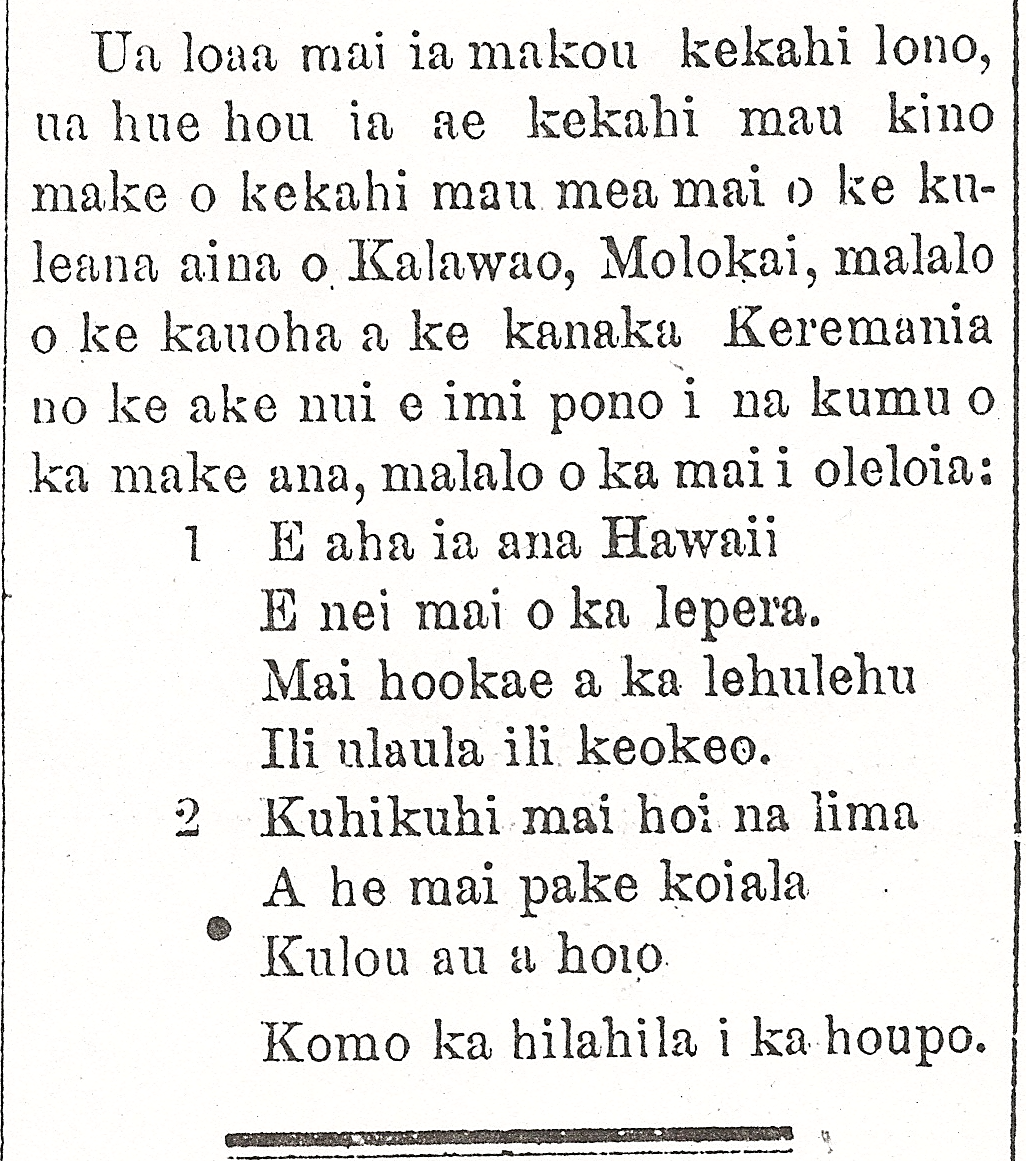
We’ve received word that more bodies were exhumed of patients in Kalawao, Molokai, under the orders of the German [Eduard Arning], because of his great desire to find the reasons for the deaths by the disease of which it is said:

1 E aha ia ana Hawaii
E nei mai o ka lepera.
Mai hookae a ka lehulehu
Ili ulaula ili keokeo.

2 Kuhikuhi mai hoi na lima
A he mai pake koiala
Kulou au a holo
Komo ka hilahila i ka houpo.

[1 What is up with Hawaii
With this disease, leprosy
Disease hated by the masses
By the dark skinned and the white skinned.

2 The hand points this way
“That one there has leprosy [mai pake]”
I look down and flee
Shame filling my heart.]

[“Ke Ola o Hawaii” is yet another newspaper that is available on microfilm that ulukau for some reason chose not to digitize. Hopefully this will be corrected soon!]

(Ola o Hawaii, 3/22/1884, p. 3)

Ua loaa mai ia makou kekahi lono...

Ke Ola o Hawaii, Buke I, Helu 11, Aoao 3. Maraki 22, 1884.

Ka Anoi, Mele for Queen Kapiolani, 1883.

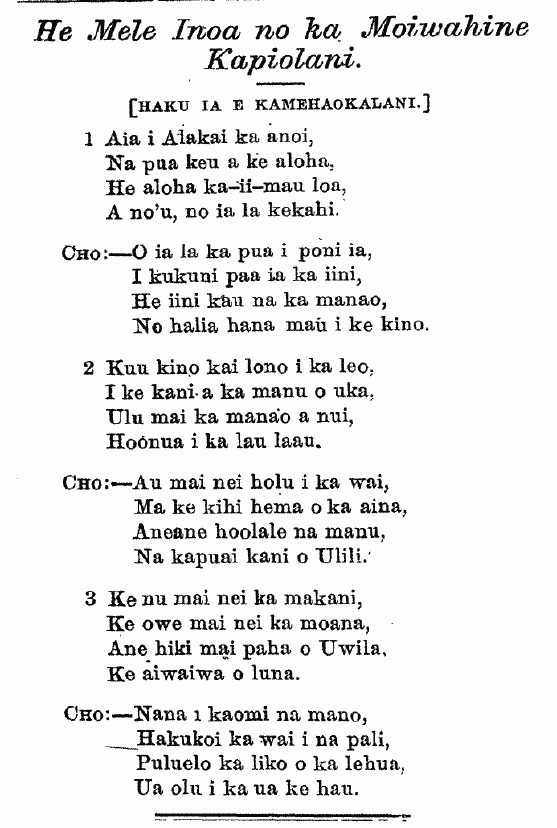
A Name Song for Queen Kapiolani.

[COMPOSED BY KAMEHAOKALANI.]

1 Aia i Alakai ka anoi,
Na pua keu a ke aloha,
He aloha ka–ii–mau loa,
A no’u no ia la kekahi.

Cho:—O ia la ka pua i poni ia,
I kukuni paa ia ka iini,
He iini kau na ka manao,
No halia hana mau i ke kino.

2 Kuu kino kai lono i ka leo,
I ke kani a ka manu o uka,
Ulu mai ka manao a nui,
Hoonua i ka lau laau.

Cho:—Au mai nei holu i ka wai,
Ma ke kihi hema o ka aina,
Aneane hoolale na manu,
Na kapuai kani o Ulili.

3 Ke nu mai nei ka makani,
Ke owe mai nei ka moana,
Ane hiki mai paha o Uwila,
Ke aiwaiwa o luna.

Cho:—Nana i kaomi na manao,
Hakukoi ka wai i ka pali,
Puluelo ka liko o ka lehua,
Ua olu i ka ua ke hau.

(Koo o Hawaii, 8/29/1883, p. 8)

He Mele Inoa no ka Moiwahine Kapiolani.

Ke Koo o Hawaii, Buke 1, Helu 2, Aoao 8. Augate 29, 1883.

Bernice Pauahi Bishop Museum’s Government and Governance Digital Initiative, 2012.

I was at a presentation tonight by DeSoto Brown of the Bishop Museum on some of their treasures held in the Museum’s archives. Of particular interest to you all might be the number of new material that is available online and is word searchable!

Here is the search page for their Government and Governance: A Digital Initiative page.

One of the great many topics of interest is Leprosy.

Vital Statistics, 1912.

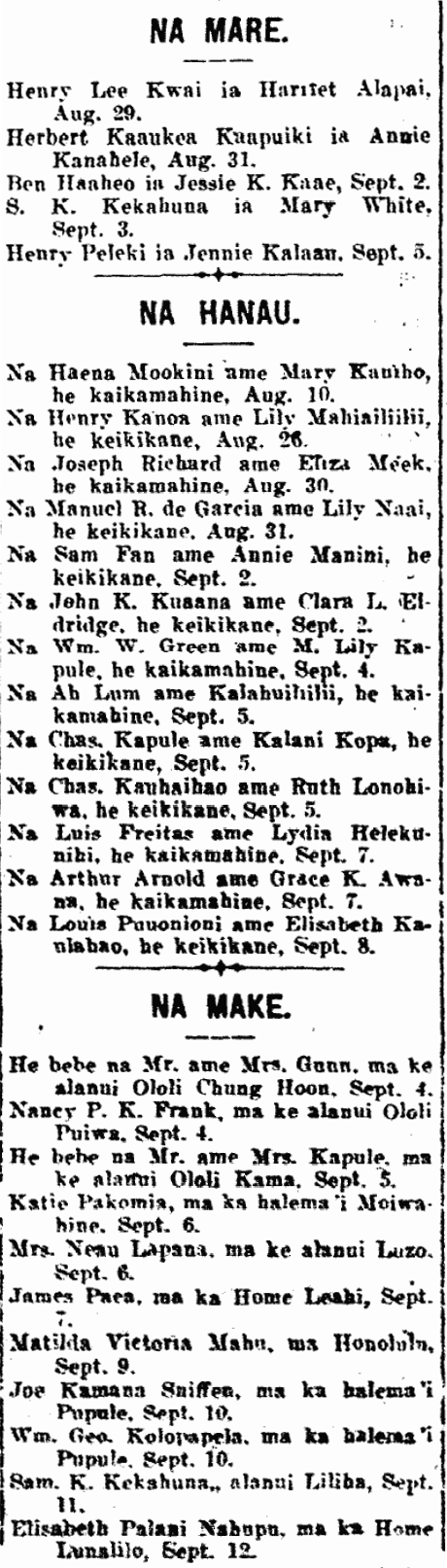
MARRIAGES.

Henry Lee Kwai to Harriet Alapai, Aug. 29.
Herbert Kaaukea Kaapuiki to Annie Kanahele, Aug. 31.
Ben Haaheo to Jessie K. Kaae, Sept. 2.
S. K. Kekahuna to Mary White, Sept. 3.
Henry Peleki to Jennie Kalaau, Sept. 5.

BIRTHS.

To Haena Mookini and Mary Kaniho, a daughter, Aug. 10.
To Henry Kanoa and Lily Mahiailiilii, a son, Aug. 26.
To Joseph Richard and Eliza Meek, a daughter, Aug. 30.
To Manuel R. de Garcia and Lily Naai, a son, Aug. 31.
To Sam Fan and Annie Manini, a son, Sept. 2.
To John K. Kuaana and Clara L. Eldridge, a son, Sept. 2.
To William W. Green and M. Lily Kapule, a daughter, Sept. 4.
To Ah Lum and Kalahuiliilii, a daughter, Sept. 5.
To Charles Kapule and Kalani Kopa, a son, Sept. 5.
To Charles Kauhaihao and Ruth Lonohiwa, a son, Sept. 5.
To Luis Freitas and Lydia Helekunihi, a daughter, Sept. 7.
To Arthur Arnold and Grace K. Awana, a daughter, Sept. 7.
To Louis Puuonioni and Elisabeth Kaulahao, a son, Sept. 8.

DEATHS.

A baby of Mr. and Mrs. Gunn, on Chung Hoon Lane, Sept. 4.
Nancy P. K. Frank, on Puiwa Lane, Sept. 4.
A baby of Mr. and Mrs. Kapule, on Kama Lane, Sept. 5.
Katie Pakomia, at Queen’s Hospital, Sept. 6.
Mrs. Neau Lapana, on Luzo Street, Sept. 6.
James Paea, at Leahi Home, Sept. 7.
Matilda Victoria Mahu, in Honolulu, Sept. 9.
Joe Kamana Sniffen, at the insane asylum, Sept. 10.
William George Kolopapela, at the insane asylum, Sept. 10.
Samuel K. Kekahuna, on Liliha Street, Sept. 11.
Elisabeth Palani Nahupu, at Lunalilo Home, Sept. 12.

(Kuokoa, 9/13/1912, p. 8)

MARE. / HANAU. / MAKE.

Ka Nupepa Kuokoa, Buke XLVIII, Helu 37, Aoao 8. Sepatemaba 13, 1912.