More on the California Midwinter International Expo, 1894.

More Exhibits.

The Hawaiian Exposition Company will send another large shipment of exhibits to the Midwinter Fair by the Australia next Saturday. Among the things to be sent are native mats and tapa, poi boards and pounders, surf-boards, etc. Apu, the expert surf-rider from Niihau, will be among the twenty-five natives who will go up on the Australia. Mr. and Mrs. J. Ailau will take with them ten native women, who will make leis, fans and hats at the Fair.

(Hawaiian Gazette, 1/5/1894, p. 6)

More Exhibits.

Hawaiian Gazette, Volume XXIX, Number 2, Page 6. January 5, 1894.

Mild hula ku’i and California Midwinter International Exposition, 1894.

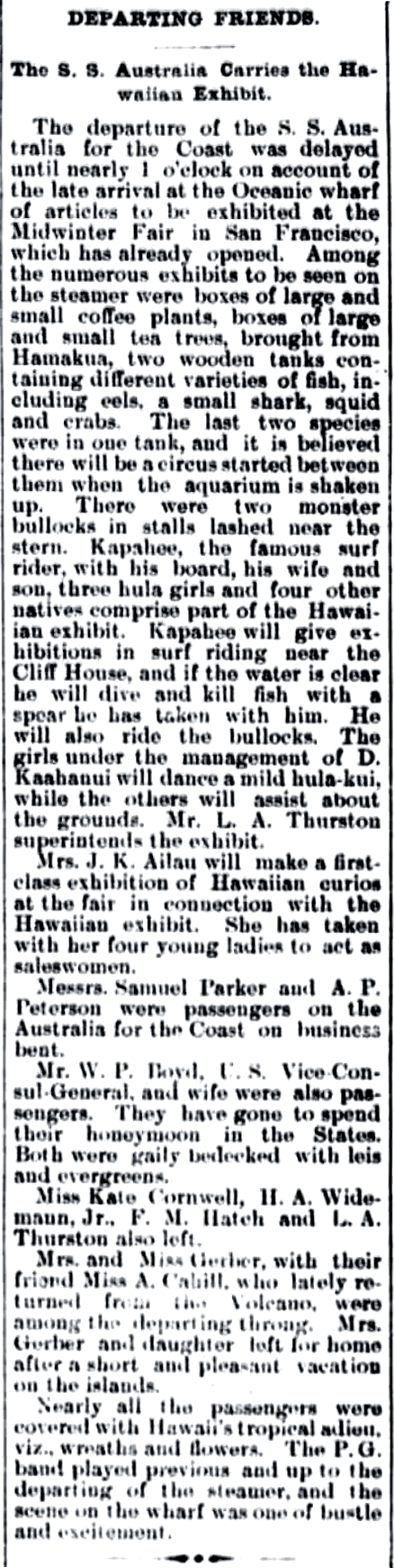
DEPARTING FRIENDS.

The S. S. Australia Carries the Hawaiian Exhibit.

The departure of the S. S. Australia for the Coast was delayed until nearly 1 o’clock on account of the late arrival at the Oceanic wharf of articles to be exhibited at the Midwinter Fair in San Francisco, which has already opened. Among the numerous exhibits to be seen on the steamer were boxes of large and small coffee plants, boxes of large and small tea trees, brought from Hamakua, two wooden tanks containing different varieties of fish, including eels, a small shark, squid and crabs. The last two species were in one tank, and it is believed there will be a circus started between them when the aquarium is shaken up. There were two monster bullocks in stalls lashed near the stern. Kapahee, the famous surf rider, with his board, his wife and son, three hula girls and four other natives comprise part of the Hawaiian exhibit. Kapahee will give exhibitions in surf riding near the Cliff House, and if the water is clear he will dive and kill fish with a spear he has taken with him. He will also ride the bullocks. The girls under the management of D. Kaahanui will dance a mild hula-kui, while the others will assist about the grounds. Mr. L. A. Thurston superintends the exhibit.

Mrs. J. K. Ailau will make a first-class exhibition of Hawaiian curios at the fair in connection with the Hawaiian exhibit. She has taken with her four young ladies to act as saleswomen.

Messrs. Samuel Parker and A. P. Peterson were passengers on the Australia for the Coast on business bent.

Mr. W. P. Boyd, U. S. Vice-Consul-General, and wife were also passengers. They have gone to spend their honeymoon in the States. Both were gaily bedecked with leis and evergreens.

Miss Kate Cornwell, H. A. Widemann, Jr., F. M. Hatch and L. A. Thurston also left.

Mrs. and Miss Gerber, with their friend Miss A. Cahill, who lately returned from the Volcano, were among the departing throng. Mrs. Gerber and daughter left for home after a short and pleasant vacation on the islands.

Nearly all the passengers were covered with Hawaii’s tropical adieu, viz., wreaths and flowers. The P. G. band played previous and up to the departing of the steamer, and the scene on the wharf was one of bustle and excitement.

(Daily Bulletin, 1/6/1894, p. 2)

DEPARTING FRIENDS.

The Daily Bulletin, Volume VII, Number 924, Page 2. January 6, 1894.

More on the missionaries and hula ku’i …and Sweet Emalia, 1894.

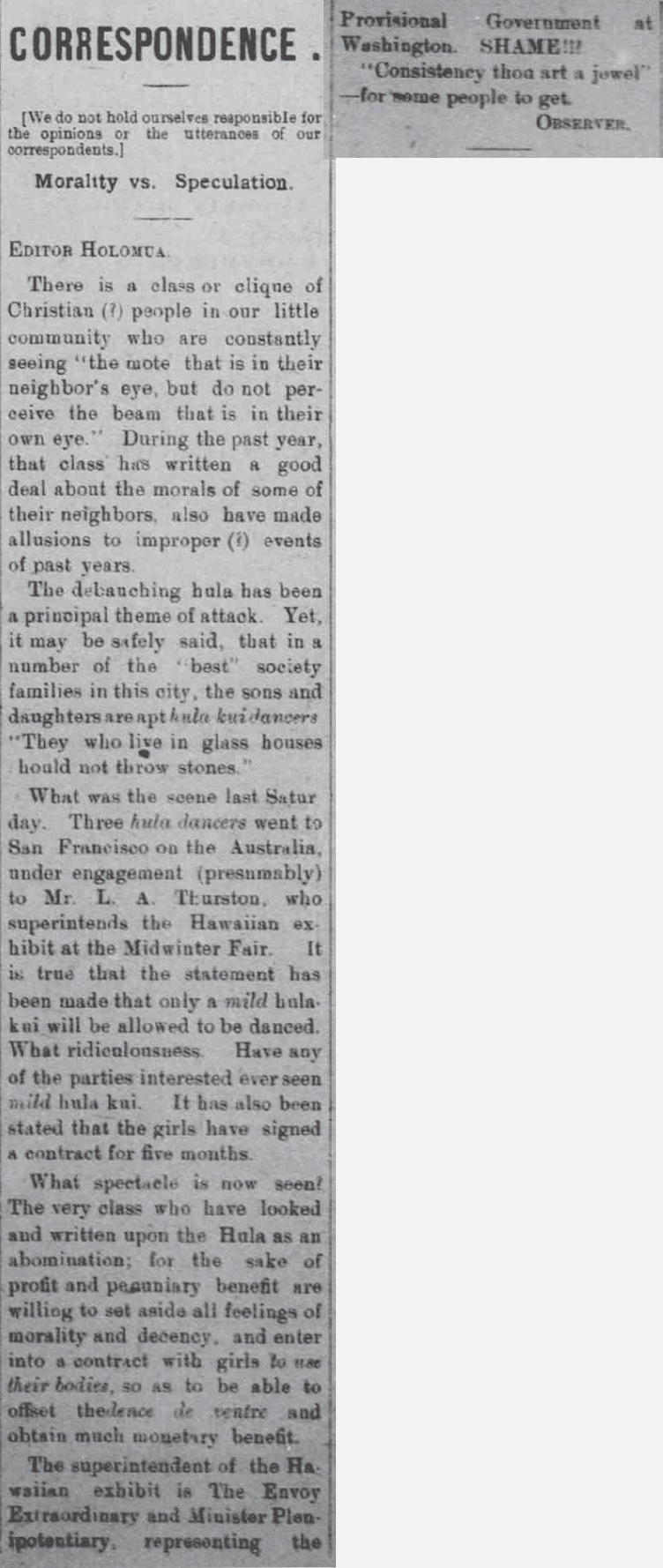
CORRESPONDENCE.

[We do not hold ourselves responsible for the opinions or the utterances of our correspondents.]

Morality vs. Speculation.

Editor Holomua.

There is a class or clique of Christian (?) people in our little community who are constantly seeing “the mote that is in their neighbor’s eye, but do not perceive the beam that is in their own eye.” During the past year, that class has written a good deal about the morals of some of their neighbors also have made allusions to improper (?) events of past years.

The debauching hula has been a principal theme of attack. Yet, it may be safely said, that in a number of the “best” society families in this city, the sons and daughters are apt hula kui dancers. “They who live in glass houses should not throw stones.”

What was the scene last Saturday. Three hula dancers¹ went to San Francisco on the Australia, under engagement (presumably) to Mr. L. A. Thurston, who superintends the Hawaiian exhibit at the Midwinter Fair. It is true that the statement has been made that only a mild hula kui will be allowed to be danced. What ridiculousness. Have any of the parties interested ever seen mild hula kui. It has also been stated that the girls have signed a contract for five months.

What spectacle is now seen? The very class who have looked and written upon the Hula as an abomination; for the sake of profit and pecuniary benefit are willing to set aside all feelings of morality and decency, and enter into a contract with girls to use their bodies, so as to be able to offset the dence de ventre and obtain much monetary benefit.

The superintendent of the Hawaiian exhibit is the Envoy Extraordinary and Minister Plenipotentiary, representing the Provisional Government at Washington. SHAME!!!

“Consistency thou art a jewel”—for some people to get.

¹One of these was of course, Emalia Kaihumua.

(Hawaii Holomua, 1/8/1894, p. 3.)

CORRESPONDENCE.

Hawaii Holomua, Volume II, Number 6, Page 3. January 8, 1894.

More on the missionaries, 1894.

Missionary Descendants Show Their Knowledge of Hula Ku’i.

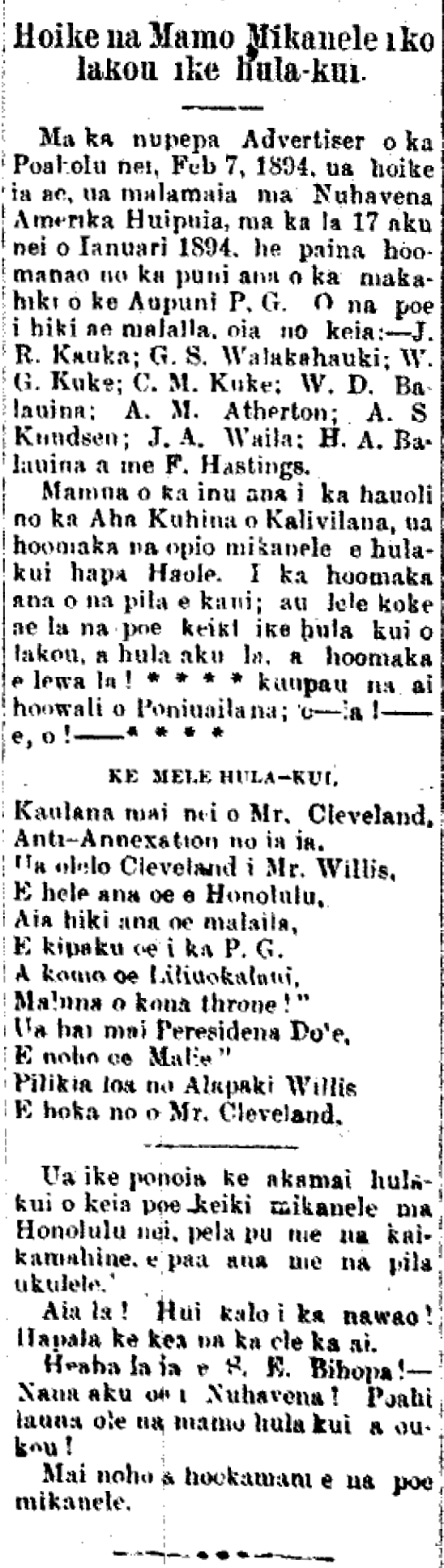
In the Advertiser of 2/7/1894, was shown that at New Haven, United States of America, on the past 17th of January 1894, there was held a party to commemorate the anniversary of the government by the P. G. Those present were: J. R. Kauka [James Robert Judd?], G. S. Walakahauki [George S. Waterhouse], C. M. Kuke [C. Montague Cooke, Jr.?], W. D. Balauina [William D. Baldwin], A. M. Atherton, A. S. Knudsen, J. A. Waila [James Austin Wilder], H. A. Balauina [Harry A. Baldwin], and F. Hastings.

Before drinking to the delight at the Cabinet of Ministers of Cleveland, the young missionaries danced a hula ku’i to a hapa haole song. When the music started, the youths among them who knew how to hula ku’i jumped up immediately and danced and started to sway! …the mixed poi of Poniuailana goes the limit; there you go!—answer the call!—…¹

KE MELE HULA-KUI.

Kaulana mai nei o Mr. Cleveland,
Anti-Annexation no ia ia,
Ua olelo Cleveland i Mr. Willis,
E hele ana oe e Honolulu,
Aia hiki ana oe malaila,
E kipaku oe i ka P. G.
A komo oe Liliuokalani,
Maluna o kona throne!”
Ua hai mai Peresidena Dole,
E noho oe Malie”
Pilikia loa no Alapaki Willis,
E hoka no o Mr. Cleveland.

A MELE HULA KU’I

Famed is Mr. Cleveland,
An Anti-Annexationist is he,
Cleveland said to Mr. Willis,
[“]You are going to Honolulu,
When you get there,
Banish the P. G.
And place Liliuokalani,
Upon her throne!”
President Dole spoke,
[“]You just sit still.”
Albert Willis is perplexed,
Mr. Cleveland is thwarted.

The adeptness at the hula ku’i by these missionary descendants was seen first hand here in Honolulu, along with the girls carrying ukulele.

There you go! Mixed up is the cultivated taro with the wild! The white is smeared; the black gets the score.

What is this S. E. Bishop!—Look to New Haven! Your people’s hula ku’i dancer descendants were  gyrating away!

You missionaries, don’t be hypocritical.

¹…kuupau na ai hoowali o Poniuailana; o—ia!—e, o!—…

[Does anyone have more information on the “Kuupau na ai hoowali o Poniuailana” phrase?]

(Nupepa Ka Oiaio, 2/9/1894, p. 3)

Hoike na Mamo Mikanele i ko lakou ike hula-kui.

Nupepa Ka Oiaio, Buke VI, Helu 6, Aoao 3. Feberuari 9, 1894.

The Hawaiian Moses? 1893.

“THE MISTAKES OF MOSES.”

We refer, of course, to the Hawaiian political Moses, who has recently broken camp, and set the faithful in motion through sea, desert and wilderness to the Land of Promise, beyond the shadow of the Throne. Yes! We refer to the Hawaiian political Moses, but whether his other name is Dole or Thurston, has not, at this writing, fully transpired. Still, the doubt as to his other name is a merely nominal doubt, not affecting the merits of the case. And as the original state—man of that name was not gifted with immunity from error, so neither has the Hawaiian Moses, even during his very brief pilgrimage, avoided all mistakes. It should ever be the part of a friend to note his friends’ infirmities, and, by bringing them mildly to their authors’ notice, suggest their reform, or convey a warning against their repetition.

———

We are all aware of the high pressure of seeming necessity under which the present government was formed. We can therefore appreciate, to some extent, the causes of the neglect to observe, towards the numerous Native element, those marks of regard and confidence without which no government can hope to endure in Hawaii. We repeat, that the pressure of the occasion must be the excuse of the gentlemen at the head of the movement for their seemingly unfriendly, and even hostile attitude toward the entire Native race, in the ordering of early events under the new dispensation.

———

The exclusion of Hawaiians from a participation in the beneficent project not only seemed, but was, and is complete. There may have been, and no doubt were reasons, seemingly sound to those who adopted them, for such a course,—reasons of which the public cannot judge, because the public know them not. Yet it would seem that one of two propositions must be true; viz.: either the Hawaiians were needlessly, and, therefore, harshly excluded from such participation in the reforming of their own government, or else the entire race were deemed by the leaders to be unfit to participate in such an enterprise.

———

If the former of the above propositions be true, one would naturally expect the mistake to be rectified at the earliest opportunity. That it has not been rectified would seem to stamp it as having been no mistake, but a course deliberately adopted, for, note the opportunity to retrieve the error, (if error it had been thought to be) in the filling of the four vacancies in the Advisory Council, on the 21st inst. It was then, as seems to us, the manifest duty of the government to seek out and appoint to those vacancies, men of Hawaiian blood, whose brains, interests and loyalty to the new idea bespoke than as deserving of such honor and confidence.

———

The failure of the government to attempt to bring even one Hawaiian to a seat at the Council Board is susceptible of only one of two meanings:—1st, that no Hawaiian could be found possessing those qualifications, or, 2nd, that the government were determined to ignore and exclude them, in any event.

———

If such exclusion was premeditated and malicious, the less said of it the better, as it is self-condemnatory. If on the other hand, there be no native Hawaiian fit to occupy a seat in the government councils, with what degree of candor or confidence can the Provisional Government request of expect the United States to incorporate our country into itself? What a commentary upon that request is the action of the government itself, in thus excluding from their confidence the entire aboriginal race, more completely than the Mongolian is now excluded from the Union. Forty odd thousand Hawaiians on these shores, and not one, (in the opinion of the government,) entitled or qualified to have a voice in the government of his native land. What a text for the American enemies of annexation, and how they will use it!

(Liberal, 1/25/1893, p. 2)

"THE MISTAKES OF MOSES."

The Liberal, Volume I, Number 39, Page 2. January 25, 1893.

Annexation or not? 1893.

[Found under: “THIS AND THAT.”]

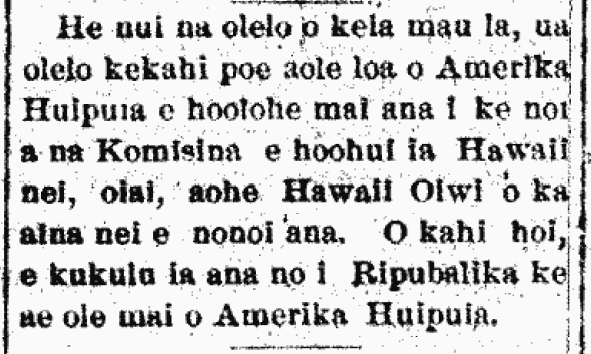
There is much talk these day; some say that there is no way that the United States of America will listen to the request of the Commission to annex Hawaii, being that there is no Native Hawaiian of the land asking for this. Some say that a Republic will be established if the U. S. doesn’t agree.

(Liberal, 1/25/1893, p. 4)

He nui na olelo o keia mau la...

The Liberal, Volume I, Number 39, Page 4. January 25, 1893.

C. C. Moreno on missionaries, 1893.

A Misunderstood People.

MORENO ON THE MISSIONARIES.

Editor Post: For several years your public-spirited paper has published correspondence and statements submitted by me about Hawaii in which was foreshadowed the present state of affairs. The revolution which has just taken place is the inevitable result of missionary rule; the long-standing and deep-rooted cause of the unrest.

The missionaries in Hawaii, as in China, Japan, and elsewhere, consider that country as their open hunting grounds, regardless of the rights, customs, wishes, and priviliges of the natives and of stipulations.

I positively know that the self-appointed four chiefs of the Provisional Government in the Hawaiian Islands and the five commissioners coming to Washington to negotiate a treaty of annexation are, without a single exception, missionariesʻ confederates. Not a single native Hawaiian is with them, therefore, they cannot be considered as the representatives of the Hawaiian nation, of which they are aliens and enemies, but only as the emissaries of one side (or of a higher), which is not the right side.

The truth about Hawaiian affairs has never reached the State Department and that is the reason why, in the department, the knife has always been taken by the blade instead of by the handle in dealing with the Hawaiian question.

The United States always sent third rate politicians as ministers and consult to Honolulu, hence the erroneous information about Hawaii. I have on the spot studied Hawaii and the Hawaiians, their troubles with the missionaries of all creeds, and when distant from the islands I have kept an uninterrupted correspondence with the leaders of the Hawaiian nation, such as the Hons. Wilcox, Bush, Testa, Kaai, Kapena, Kaunamano, Kimo Pelekane [James I. Dowsett], and others.

My views on the Hawaiian question I explained at length to President Hayes and Secretary of State Evarts, to President Cleveland and to Assistant Secretary of State Porter: later, to Senator Morgan and to Congressman McCreary, and these are the statesmen that ought to dispose of the Hawaiian question and render justice to the weak, ill-treated, honest, and generous Hawaiian people that have been continually misrepresented, misjudged, and grossly wronged.

In accordance with the good order of things the coming self-appointed and self-styled Hawaiian commissioners, with more appearance than substance, should not be received by the United States authorities, because their self-attributed mission to Washington is based only upon selfish and malignant motives.

This will be a good opportunity for the great people of the United States to show their sentiment for fair play and generosity toward the unfortunate, harmless, friendly, and oppressed Hawaiian people, worthy of sympathy and of help in this their hour of national distress.

Celco Cæsar Moreno.

(Liberal, 2/25/1893, p. 2)

A Misunderstood People.

The Liberal, Volume I, Number 48, Page 2. February 25, 1893.

Royal huakai, 1865.

[Found under: “BITS OF NEWS OF HAWAII NEI.”]

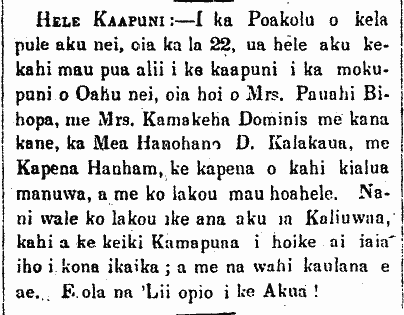
Circuit:—On Wednesday of the week last, that being the 22nd, some of the royal descendants made a circuit of Oahu nei, that being Mrs. Pauahi Bishop, Mrs. Kamakeha Dominis [Kamakaeha Dominis] and her husband, the Honorable D. Kalakaua, and Captain Hanham, the captain of a single-masted warship, along with their travelling companions. Splendid was their view of Kaliuwaa, where the youth Kamapuaa revealed himself and his strength; along with the other famous sites. Long live the young Alii in God!

(Kuokoa, 3/30/1865, p. 2)

Hele Kaapuni...

Ka Nupepa Kuokoa, Buke IV, Helu 13, Aoao 2. Maraki 30, 1865.

More on the Honorable Lilia Kamakaeha Paki’s marriage, 1862.

The Ones Who Were Married.

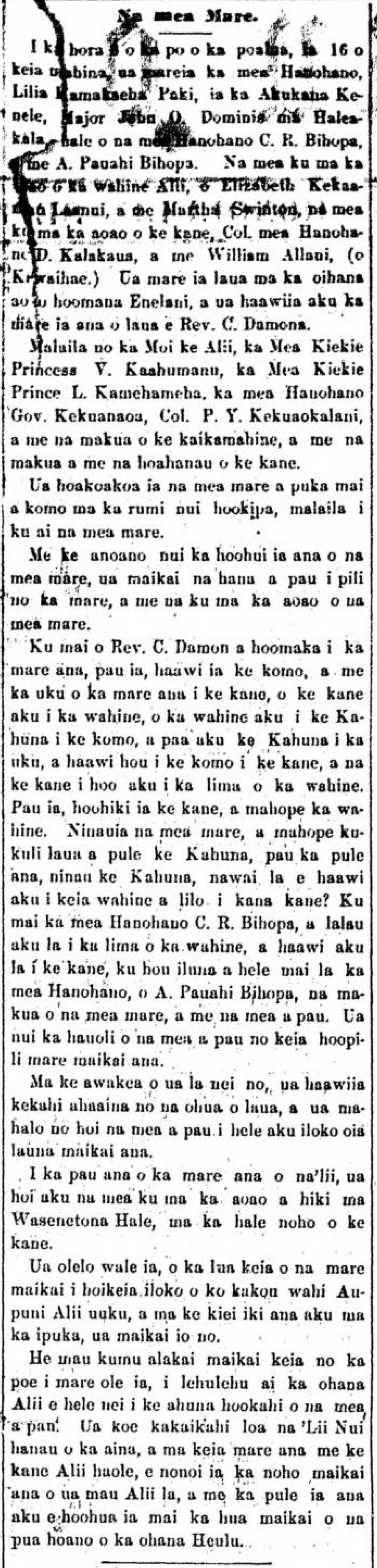
At 8 o’clock at night, on the 16th of this month, the Honorable Lilia Kamakaeha Paki was married to Adjutant General, Major John O. Dominis at Haleakala, the house of the Honorable C. R. Bishop and A. Pauahi Bishop. The ones who attended the royal bride were Elizabeth Kekaaniau Laanui and Martha Swinton; those attending the groom were the Honorable Colonel D. Kalakaua and William Allen [? William Allani] (of Kawaihae).

Present were the Chief, the King; her Highness Princess V. Kaahumanu, his Highness L. Kamehameha; the Honorable Governor Kekuanaoa; Colonel P. Y. Kekuaokalani; and the parents of the bride, and the parent and cousins of the groom.

The ones to be wed were gathered and they went out and entered the great parlor and it was there that the couple stood.

The uniting of the pair was done with much reverence, and all the proceedings of the wedding were fine, as well as with the attendants.

The Rev. C. Damon stood and began the marriage ceremony; then the ring and the marriage fee [? ka uku o ka mare ana] was given to the groom, from the groom to the bride, and from the bride to the Priest; the Priest took the fee and gave the ring once more to the groom, who put it on the brideʻs finger. When this was done, the groom was made to give his vow and then the bride. The couple were questioned, and then the two knelt down and Priest gave a prayer, and after the prayer, the Priest asked, “Who will give this woman to this man?” The Honorable C. R. Bishop stood and took the hand of the bride and gave it to the groom; the Honorable A. Pauahi Bishop, the parents of the couple and everyone else stood once more and approached. Everyone was full of joy for this beautiful wedding.

In midday of that very day, a party was given for their cortege, and all who found themselves amongst that fine gathering felt admiration.

After the marriage of the alii, the attendants returned to their sides until they reached Washington Place [Wasenetona Hale], the place of residence of the groom.

It is said that this is the second of the righteous marriages known in our tiny Kingdom, and by glancing through the gate, it is indeed righteous.

These are fine examples for those who are not married, so that the Royal family that associates with the multitudes will become numerous. There are but a few High Chiefs born of the land left, and with this marriage to a haole Royal one, it is hoped that the Royal couple live righteously along with the prayer that they bear good fruit of the sacred descent of the line of Heulu.

[Does anyone know if Pauahi had a name that started with an “A.”? For some reason she is here twice referred to as A. Pauahi Bihopa.]

(Hoku o ka Pakipika, 9/18/1862, p. 2)

Na mea Mare.

Ka Hoku o ka Pakipika Buke I, Helu 52, Aoao 2. Sepatemaba 18, 1862.

More on Liliu’s marriage, 1862.

I was engaged to Mr. Dominis for about two years and it was our intention to be married on the second day of September, 1862. But by reason of the fact that the court was in affliction and mourning, our wedding was delayed at the request of the king, Kamehameha IV., to the sixteenth of that month; Rev. Dr. Damon, father of Mr. S. M. Damon, at present the leading banker of the Islands, being the officiating clergyman. It was celebrated at the residence of Mr. and Mrs. Bishop, in the house which had been erected by my father, Paki, and which, known as the Arlington Hotel [Haleakala], is still one of the most beautiful and central of the mansions in Honolulu. To it came all the high chiefs then living there, also the foreign residents; in fact, all the best society of the city.

[This is what Queen Liliuokalani had to say about her marriage in Hawaii’s Story by Hawaii’s Queen, first published in 1898. Mahalo to Heather Wilkinson Rojo for her response on the previous post, saying she posted an image of their marriage certificate on her blog. This is one of the many priceless treasures cared for by the Bernice Pauahi Bishop Museum!]

(Hawaii’s Story by Hawaii’s Queen, 1988. p. 22.)