One more mele for Kawailani, 1913.

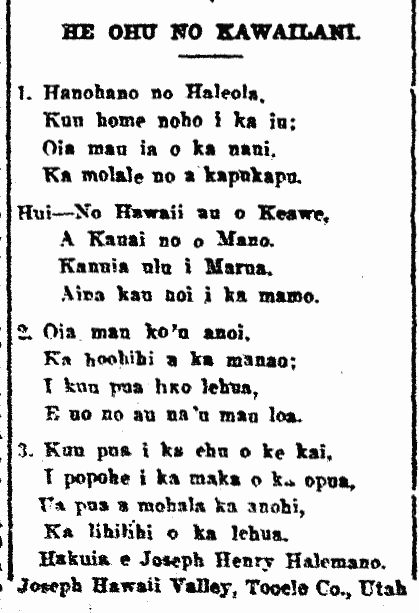
HE OHU NO KAWAILANI.

1. Hanohano no Haleola,
Kuu home noho i ka iu;
Oia mau ia o ka nani,
Ka molale no a kapukapu.

Hui—No Hawaii au o Keawe,
A Kauai no o Mano,
Kanuia ulu i Marna,
Aina kau hoi i ka mamo.

2. Oia mau ko’u anoi,
Ka hoohihi a ka manao;
I kuu pua liko lehua,
E uo no au na’u mau loa.

3. Kuu pua i ka ehu o ke kai,
I popohe i ka maka o ka opua,
Ua pua a mohala ka anohi,
Ka lihilihi o ka lehua.

Hakuia e Joseph Henry Halemano
Joseph Hawaii Valley, Tooele Co., Utah.

(Kuokoa, 1/10/1913, p. 6)

HE OHU NO KAWAILANI.

Ka Nupepa Kuokoa, Buke XLIX, Helu 2, Aoao 6. Ianuari 10, 1913.

Aloha Aina, 2015.

Expressing aloha ʻāina on the anniversary of the overthrow

“And so it happened that on the 16th day of January, 1893, between four and five o’clock in the afternoon, a detachment of marines from the United States Steamer Boston, with two pieces of artillery, landed at Honolulu. The men, upwards of 160 in all, were supplied with double cartridge belts filled with ammunition and with haversacks and canteens, and were accompanied by a hospital corps with stretchers and medical supplies. This military demonstration upon the soil of Honolulu was of itself an act of war. . .”

By nightfall of the next day, the Kingdom of Hawaiʻi had been illegally overthrown.

Hawaiʻi’s people today live in the resulting repercussions of that infamous day. For some, reflection on those historical events still conjures up the ʻeha (pain, hurt) of being wronged.

There may never be an adequate outlet to express the ʻeha, nevertheless, this story commemorates the 122nd anniversary of the illegal overthrow and honors some of the great expressions of aloha ʻāina (patriotism) coming from Hawaiʻi’s aliʻi (monarchs) and lāhui (people).→Continue reading.

Queen Liliʻuokalani, Hawaiʻi’s last reigning monarch, was imprisoned after her kingdom was illegally overthrown on January 17, 1893.

George Kainapau, singer from Hilo, 1944.

Arrived Here in Hilo

Last week, a youth from the Kanilehua rains arrived, that being George Kainapau to Hilo nei, to spend some days here in the land of his birth, and in the afternoon of the following Monday he left for Honolulu.

This was not a child coming home to visit his parents living there, for they passed away many years ago, and their children are who remain.

When we saw that youth, we recalled our first choir leader, Harry Naope, because this youth, George Kainapau was one of the members of the Haili choir in 1927.

He is a youngster with a very good voice for singing. His voice is like the voice of a woman singing. Continue reading

Princess Kaiulani returns home, 1897.

PRINCESS KAIULANI.

This past Tuesday, the 10th of Nov., with the arrival of the steamship Australia, the “Princess” Kaiulani, and her birth father [luaui makuakane], Hon. A. S. Cleghorn returned. Her attire carried the “alii” colors of Hawaii nei, that being the yellow of mamo feathers and the red [“pai-ula”] of the oo. Upon her head was a lei of carnation “poni-moi” [coronation]. She was in fine health, and has the stature of a well-educated lady.

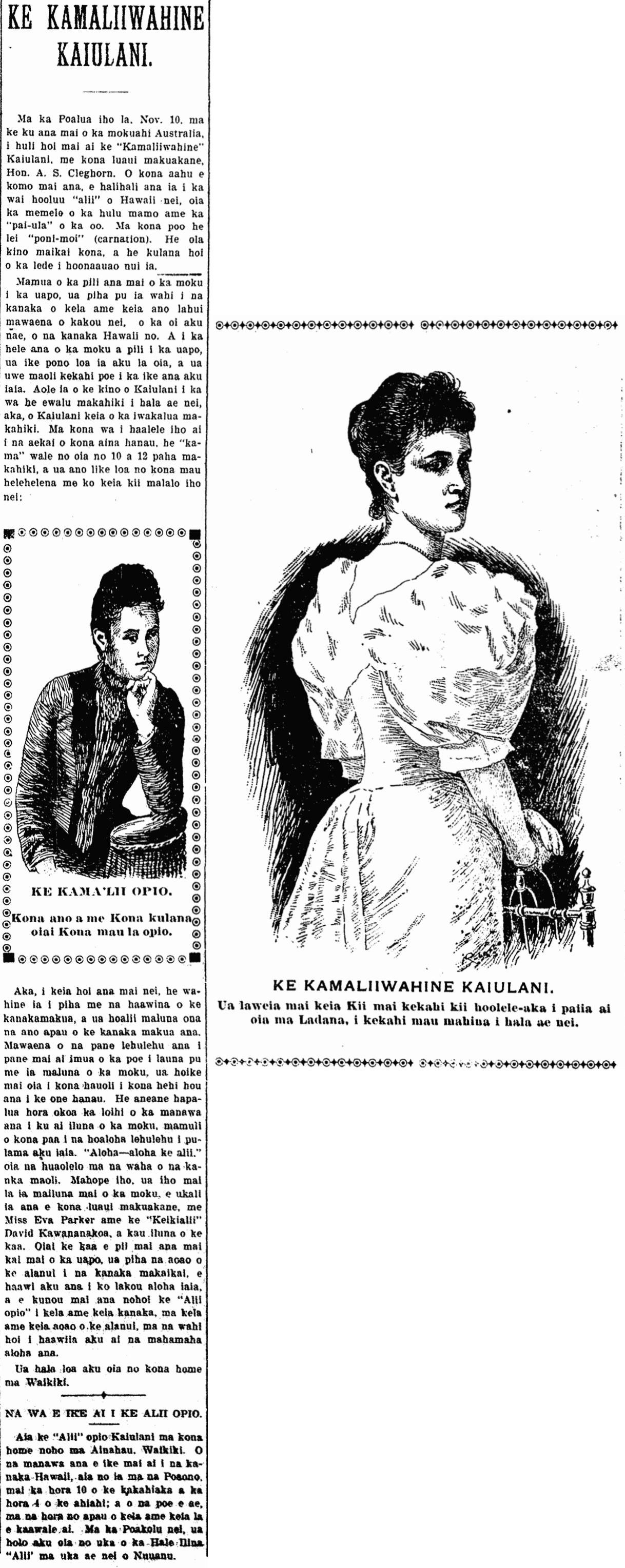
Before the ship docked, the wharf was filled with people of all of the different lahui among us; the most however were Hawaiians. And when the ship came of to the dock, she was clearly seen, and some sobbed at her sight. This was not the body of Kaiulani eight years ago, but this was Kaiulani at twenty years old. When she left the shores of her land of birth, she was bight a child [“kama”] of 10 or 12 years of age, and she looked very much like the picture below:

THE YOUNG PRINCESS.

Her features and Her demeanor in the days of Her youth.

But upon this return, she is a woman that is a full-grown adult, and invested upon her are all the qualities of an adult. Among the words she gave to the people who met with her aboard the ship, she expressed her joy in stepping once again on the sands of her birth. She stood on the ship for almost a half an hour being detained by the many friends who hugged her. “Aloha—aloha to the alii,” are the words from the mouths of the kanaka maoli. Thereafter, she stepped of of the ship, accompanied by her birth father, along with Miss Eva Parker and the “Prince” David Kawananakoa, and she stepped into the car. While the car headed up from the dock, the sides of the street were filled with spectators who gave their aloha to her, and the “young Alii” nodded to each one on both sides of the road at the places which expressed their aloha.

She left for her home in Waikiki.

TIMES TO SEE THE YOUNG ALII.

The young “Alii” Kaiulani is at her residence in Ainahau, Waikiki. She will have audience with the Hawaiians on Saturdays from 10 in the morning until 4 in the afternoon; and the others on each day at the hours set aside. On this Wednesday, she went into the uplands to the Crypt of the “Alii” up in Nuuanu.

THE PRINCESS KAIULANI

This Picture is taken from a lime-light picture [? kii hoolele aka] taken of her in London, a few months ago.

[It is good to be wary of the loyalties of the newspaper (just as it is today) when reading coverage of events. The Kuokoa seems to be at this time pro-annexation and anti-monarchy. This is reflected in their use of quotation marks around words like “Princess” and “Alii”.]

(Kuokoa, 11/12/1897, p. 1)

KE KAMALIIWAHINE KAIULANI.

Ka Nupepa Kuokoa, Buke XXXVI, Helu 46, Aoao 1. Novemaba 12, 1897.

Alapaki Smith for auditor, 1928.

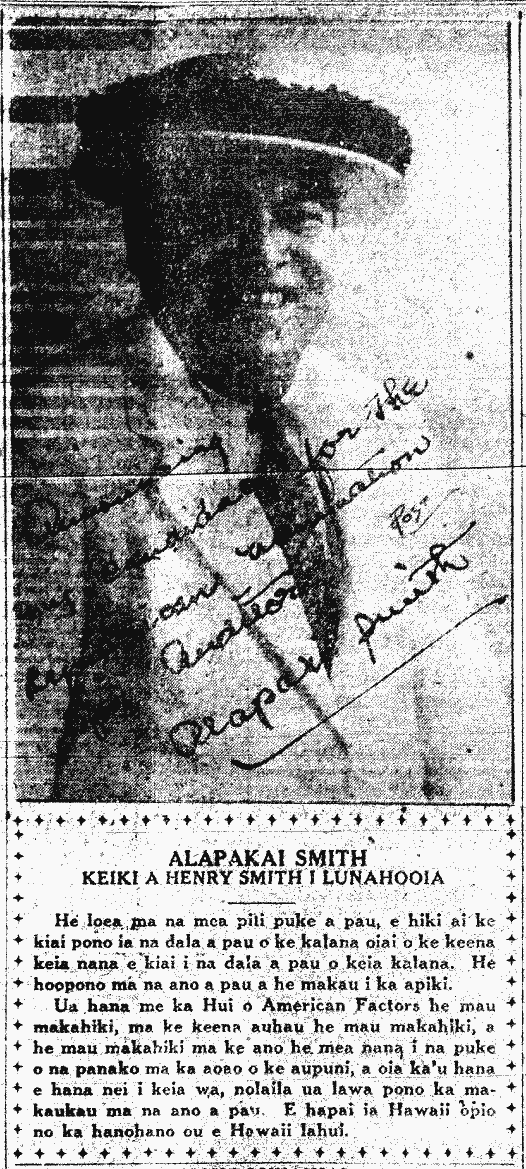
ALAPAKAI SMITH [ALAPAKI SMITH]

SON OF HENRY SMITH, FOR AUDITOR [LUNAHOOIA]

An expert in all types of books; he can care for all the finances of the county being that this is the office which watches over all the money of the county. He is conscientious in all ways and is fearful of dishonesty.

I worked with the American Factors Company for a number of years, in the tax department for a number of years, and a number of years doing the books for banks from the side of the government, and that is what I am currently doing; therefore I am fully capable in all aspects. Lift up this Hawaiian youth for the pride of the Hawaiian people.

[I think the inscription on the picture reads: “Announcing my candidacy for the Republican nomination for Auditor. Alapaki Smith.” And there is “Post” written in another hand on the right side.]

(Alakai o Hawaii, 10/4/1928, p. 4)

ALAPAKAI SMITH

Ke Alakai o Hawaii, Buke 1, Helu 23, Aoao 4. Okatoba 4, 1928.

The beginning of the “Pineapple Island,” 1922.

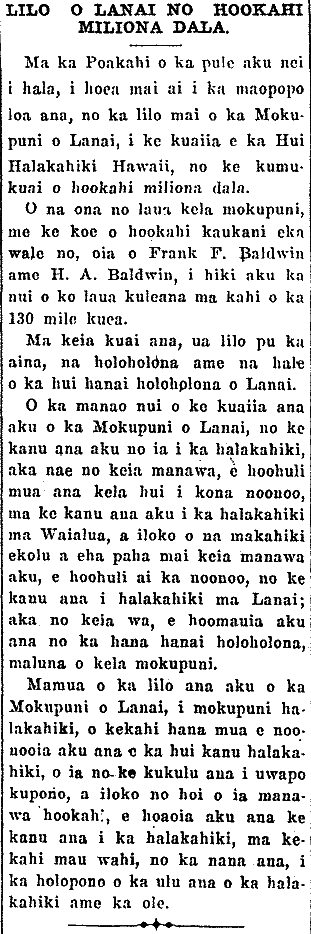
LANAI SOLD FOR A MILLION DOLLARS.

Last week Monday, it was confirmed that Lanai was purchased by Hawaiian Pineapple Company [Hui Halakahiki Hawaii] for the price of a million dollars.

The two owners of the island, except for a remainder of but a thousand acres, are Frank F. Baldwin and H. A. Baldwin, giving them ownership of about 130 square miles.

Included in this purchase was the land, animals, and the buildings of Lanai Ranch [hui hanai holoholona o Lanai].

The main purpose for buying the island of Lanai was to plant pineapple, but for the time being, the company will explore planting pineapple in Waialua, and within three or four years from now, they will think about planting pineapple on Lanai; but for now, ranching will continue on the island.

Before Lanai becomes a pineapple island, one of the things that the pineapple company must think about first is the building of a proper pier, and at the same time, to do test plantings of pineapple at different places to see how the pineapple grows or does not grow.

(Kuokoa, November 23, 1922, p. 3)

LILO O LANAI NO HOOKAHI MILIONA DALA.

Ka Nupepa Kuokoa, Buke LXI, Helu 47, Aoao 3. Novemaba 23, 1922.

Letters from Samoa, 1889.

Malietoa Arrives in Samoa!

Three-thousand Go to Meet Him with Gifts!
Important Correspondences!

Apia, Upolu, Samoa.

July 23, 1889.

John S. Kukahiko,

Much aloha between us.

I arrived on the 18th of June and am doing well.

Before I left Honolulu on the 7th of June, I went to your place often, thinking that perhaps we would meet one final time, but you weren’t at your place.

I’ve seen what’s new here and I have gone with Hairama Kaumialii to see the battlegrounds here in Samoa. All of their actions are admirable; they are a fearless people and true warriors. They are a loving and kind people. These are the most comely people I’ve seen throughout the world.

Each morning the King Mataafa attends Catholic Mass nearby where I live. And when he attends mass, he is accompanied by his fearless warriors very prepared, carrying weapons and firearms. They are very cautious [?? lili] in their protection of him; there is no enemy who is able to abduct him, lest he be abused.

The German and British warships are here in the port of Apia, but the Germans cannot try once again wage war and take him captive. Mataafa has fine features, and when he goes to pray, he and his guards are a magnificent sight to see. He is well regarded by the haole and his own people.

On the 22nd of this month, the American Consul and Admiral Kimberly bestowed upon him gifts from the President of the United States for them helping the Americans in Apia in the recent terrible storm. The Counsul and Admiral Kimberly gave speeches, and Mataafa gave a short reply which was printed in the newspaper, “Samoan Times.”

I’ve met fequently with Hairam Kaumialii, but where he lives is twelve miles away from here, in Malie. Continue reading

Kohala Hula Club and Emma Moniz, 1936.

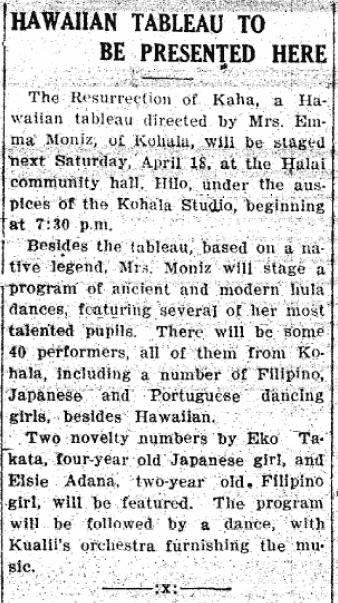
HAWAIIAN TABLEAU TO BE PRESENTED HERE

The Resurrection of Kaha, a Hawaiian tableau directed by Mrs. Emma Moniz, of Kohala, will be staged next Saturday, April 18, at the Halai community Hall, Hilo, under the auspices of the Kohala Studio, beginning at 7:30 p. m.

Besides the tableau, based on a native legend, Mrs. Moniz will stage a program of ancient and modern hula dances featuring several of her most talented pupils. There will be some 40 performers, all of them from Kohala, including a number of Filipino, Japanese and Portuguese dancing girls, besides Hawaiian.

Two novelty number by Eko [? Eiko] Takata, four-year old Japanese girl, and Elsie Adana, two-year old Filipino girl, will be featured. The program will be followed by a dance, with Kualii’s orchestra furnishing the music.

(Hoku o Hawaii, 4/15/1936, p. 1)

HAWAIIAN TABLEAU TO BE PRESENTED HERE

Ka Hoku o Hawaii, Volume XXII, Number 39, Aoao 1. April 15, 1936.

Paaiea Pond, from the pen of J. W. H. Isaac Kihe, 1914.

SOME STORIED LANDS OF KONA

Written for the Hoku o Hawaii by ka Ohu Haaheo i na Kuahiwi Ekolu¹

PAAIEA POND

Paaiea was a great pond almost like the ponds of Wainanalii and Kiholo. In the olden days, when the great ruling chiefs were living, and when these fish ponds were full of the riches of Awa, Anae, and Ahole, along with all sorts of fish which swam within.

During that time, Konohiki were stationed, and he was the guard of the pond that watched over the pond and all things, as here we are talking about Paaiea Pond which was destroyed by lava and became pahoehoe lava which remains today, which is what the writer is introducing to the readers of the Hoku o Hawaii.

In the correct and trues story of this pond, its boundaries began from Kaelehuluhulu on the north and on the south was at the place called Wawaloli, and the distance from one end to the other was 3 miles or more, and that was the length of this pond; and today within these boundaries, there are a number of pools [lua wai loko] remaining during this time that the writer is speaking before the readers of the Hoku.

The great Overseer [Konohiki] who cared for this pond was Kepaalani, and everything fell under him: the storehouses [hale papaa] where poi and fish were stored, the halau for the fishing canoes, the nets and all thing, and from him the fishermen and the retainers of the court would obtain their sustenance.

And at this time when the pond was destroyed by lava, Kamehameha was residing in Hilo for the purpose of waging war, and this war was called Kaipalaoa; during this war, Namakehaikalani died and was offered atop the Heiau of Piihonua in Hilo; and this was Kamehameha’s final war, and his enemies lived quietly without uprising once again. This was the time between 1798 until 1801, and it is said that this is when lava destroyed this pond that was full of riches, and turned it into a land of pahoehoe lava which remains to this day. Continue reading

Advertisement by company that made Kauikeaouli memorial, 1914.

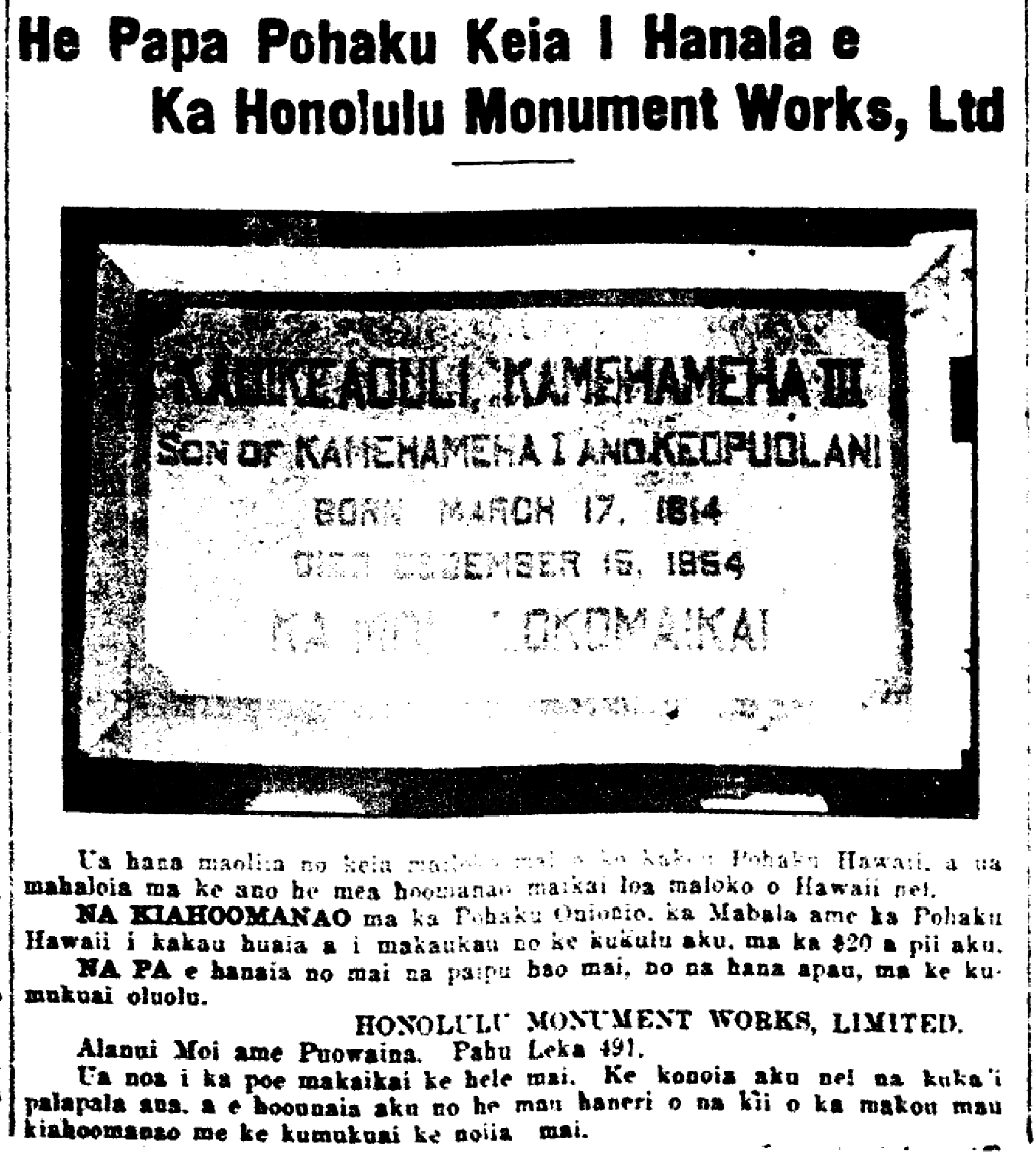
Stone Tablet Made by the Honolulu Monument Works, Ltd

This was actually made out of our Hawaiian Stone, and it is praised as a fine memorial here in Hawaii.

MONUMENTS of Granite [Pohaku Onionio], Marble [Mabala], and Hawaiian Stones engraved and ready to stand, from $20 and higher.

FENCES made of metal pipe, for all jobs, at reasonable prices.

HONOLULU MONUMENT WORKS, LIMITED.

King and Punchbowl Streets, Mail Box 491.

It is open for people to come tour. Mail correspondences are welcomed, and hundreds of pictures of our monuments and their prices will be sent if asked for.

[It seems like this establishment was located right across from Kawaiahao Church, as seen in this picture on page 303 of the July 1912? edition of the Pacific Magazine.

Do check out all the rest of the priceless pictures in that volume of Pacific Magazine!]

(Kuokoa, 4/3/1914, p. 4)

He Papa Pohaku Keia i Hanaia e Ka Honolulu Monument Works, Ltd

Ka Nupepa Kuokoa, Buke LII, Helu 14, Aoao 4. Aperila 3, 1914.