Unknown's avatar

About nupepa

Just another place that posts random articles from the Hawaiian Newspapers! It would be awesome if this should become a space where open discussions happen on all topics written about in those papers!! And please note that these are definitely not polished translations, but are just drafts!!! [This blog is not affiliated with any organization and receives no funding. Statements made here should in now way be seen as a reflection on other organizations or people. All errors in interpretation are my own.]

Kuhio and the Hawaiian Civic Clubs. 1918.

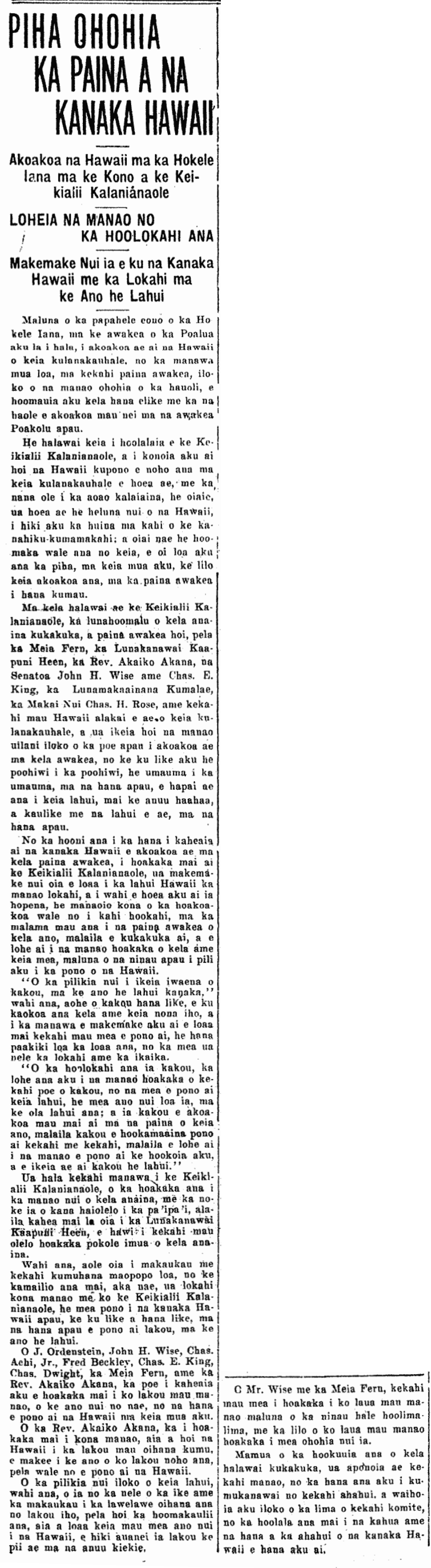
THE PARTY OF HAWAIIANS  WAS FILLED WITH ENTHUSIASM

Hawaiians Gathered at the Young Hotel at the Invitation of Prince Kalanianaole

HEARD WAS IDEAS FOR UNIFICATION

Desired that Hawaiians Stand Together as a People

On the sixth floor of the Young Hotel, at noon this past Tuesday, the Hawaiians of this town gathered for the first time, for a luncheon amid enthusiasm and joy, and this will be a regular thing, like the haole regularly meet at noon on Wednesdays.

This was a meeting organized by Prince Kalanianaole, and Hawaiians of good standing who live here in town were invited to attend, without attention being paid to political affiliation; it is true, many Hawaiians came, and the total number was about seventy-one; and being that this is just the beginning, it will be more full in the future, should this gathering at lunch become a regular thing.

At this meeting was Prince Kalanianaole, the chairman of this meeting and luncheon, and also Mayor Fern, Circuit Judge Heen, Rev. Akaiko Akana, Senators John H. Wise and Charles E. King, Representative Kumalae, Sheriff Charles H. Rose, and some other Hawaiian leaders of town; and everyone gathered there that afternoon seemed spirited to stand shoulder to shoulder, chest to chest, in all things; to lift this lahui from the low level to be equal with the other ethnicities in all aspects.

In order to move forward the agenda for which the Hawaiians gathered at that luncheon, Prince Kalanianaole explained that he greatly wished that the Hawaiian people would think as one, and as a means to that ends, he believes that meeting together in one place by holding regular luncheons of that sort, is where you’d discuss things and hear explanation from different people on all questions regarding the well-being of Hawaiians.

“The great problem seen amongst us, as a people,” according to him, is that we don’t cooperate; we all stand independently, and when we want good works to be done, it is very hard to accomplish for we lack unity and strength.

“Unifying ourselves, and listening to people talk about things that will benefit this lahui is very important for the perpetuation of the lahui; and as we gather regularly at meals of this sort, we will become familiar with each other, and we will hear ideas that should be carried out, and we will be seen as a lahui.”

Some time was spent by Prince Kalanianaole explaining the goals of that gathering while his speech was encouraged by applause, then he called up Circuit Judge Heen to give a few words of clarification before the crowd.

According to him, he was not prepared with a clear topic to talk about, however, he was in agreement with Prince Kalanianaole; all Hawaiians must stand together and work as one in all endeavors that will better themselves as a lahui.

J. Ordenstein, John H. Wise, Charles Achi, Jr., Fred Beckley, Charles E. King, Charles Dwight, Mayor Fern, and Rev. Akaiko Akana were called to explain their overall thoughts as to what is to be done to benefit Hawaiians from here forth.

Rev. Akaiko Akana shared his thoughts; when Hawaiians go back to their traditional occupations [?] and cherish their way of life, that is the only way Hawaiians will be blessed.

The big problem with this lahui, according to him, is the lack of knowledge and readiness to go into business for themselves and so too with being economical; when these important things are acquired by Hawaiians, they will be able to climb to a high level.

Mr. Wise and Mayor Fern were some who spoke of their ideas on the question of leasing a building [?], and their ideas were heard with much enthusiasm.

Before the meeting was adjourned, one idea was approved, to draft a constitution for a club, and to place it in the hands of a committee to lay out the foundation and mission that this association of Hawaiians would carry out.

(Kuokoa, 11/29/1918, p. 1)
PIHA OHOHIA KA PAINA A NA KANAKA HAWAII

Ka Nupepa Kuokoa, Buke LVI, Helu 48, Aoao 1. Novemaba 29, 1918.
Kapihe and his prophecy. 1862.

The Story of Kapihe.

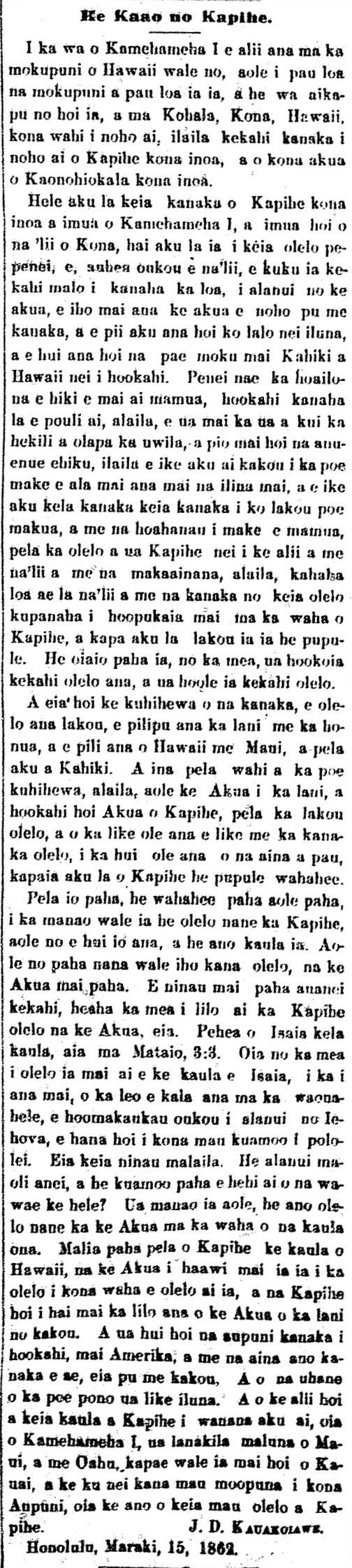
When Kamehameha I was ruler over only Hawaii Island, and not all of the islands were his, and while the eating kapu was still enforced, and while he was living in Kohala, Kona, Hawaii, it was there that a certain man lived named Kapihe, and his god was called Kaonohiokala.

This man named Kapihe went before Kamehameha I and before the alii of Kona, and he said these words, “Listen, O Chiefs, a malo will stand, forty in length, as a path for the god; the god will come down and live with man, and what is down here will rise up above, and the archipelago from Kahiki* all the way to Hawaii will be joined as one. This is the sign that will come before this: there will be forty days of darkness and then rain will fall and thunder will crash and lightning will flash and seven rainbows will arch; there we will see the dead rise from the graves and all people will see their parents and hoa hanau [siblings, cousins] who died earlier.” And that is what Kapihe said to the King, alii, and makaainana. The chiefs and commoners were astounded at these shocking words spoken by Kapihe, and they called him crazy. This perhaps is the truth, for some of his predictions came true and others were denied.

This is how people are mistaken, they say, the heavens and earth will come together, and Hawaii and Maui will join together, and so too with Kahiki. And if that is the case, according to the mistaken ones, then God is not in heaven, and there is but one God, and that is Kapihe; that is what they said, and because all of the lands did not merge together as the they were saying, Kapihe was called a lying, crazed person.

Perhaps that is so, perhaps he was a liar, and perhaps not; it might be thought that Kapihe’s was a riddle and the land would not literally join together, and that he was a prophet. Perhaps his words were not his alone, but from God. Someone might ask, how did Kapihe’s words come from God, and here is the answer. What of Isaiah, that prophet, in Matthew 3:3? For this is what was spoken by the prophet Isaiah, ‘The voice of the one crying in the wilderness: ‘Prepare ye the way of Jehovah, make his paths straight.'” Here is the question there. Is it a real road, and is it a path that will be tread on by feet? It is believed not, but that it was a riddle from God through the mouth of his prophet. Maybe so too it was of Kapihe, the prophet of Hawaii; God gave the words for his mouth to speak, and Kapihe spoke what God of the heavens gave to us. And the nations of man joined as one, from America, and the other inhabited lands, they are here together with us. And the souls of the righteous are the same up above. The alii of whom Kapihe predicted was Kamehameha I, who was victorious over Maui and Oahu, and Kauai was left, and his grandchildren now rule over his Kingdom. This is the nature of Kapihe’s words. J. D. Kauakoiawe

Honolulu, March 15, 1862.

*Kahiki usually refers to foreign lands.

(Hoku o ka Pakipika, 3/20/1862, p. 1)

Ke Kaao no Kapihe.

Ka Hoku o ka Pakipika, Buke I, Helu 26, Aoao 1. Maraki 20, 1862.

Bad weather on Kauai. 1862.

Great Flooding in Waimea.

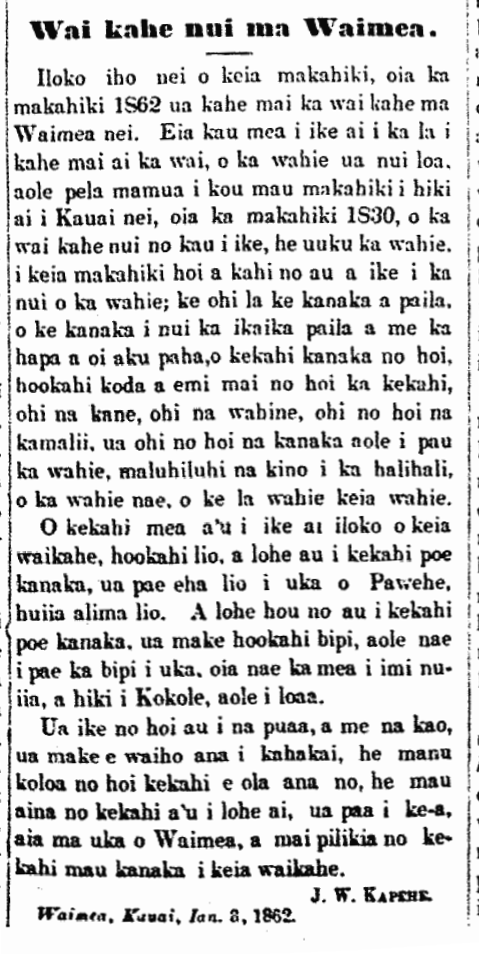
During this year, 1862, there was flooding here in Waimea. This is what I saw on the day of the flood, a lot of kindling; it wasn’t like that before in the years since I arrived here to Kauai, that being 1830; in the floods I’ve witnessed, there was only a little kindling. This year is the first time I’ve seen so much wood for fire; people were gathering it up and making piles. A strong man would have a pile and a half or more, and another would have a cord or less. Men would gather, women, and children too; people gathered it up, but there was no end to it; your body would get tired from carrying the wood, and yet the kindling, it would still be remain here and there.

Another thing I witnessed in the flood was a horse, and I hear from some other people that four horses came ashore at Pawehe; all together that makes five horses. And from some other people I hear that a cow died but did not wash up ashore, but was searched carefully for all the way until Kokole, but was not found.

I’ve seen pigs and goats that were dead, laying on the shore, and there are some ducks still alive; there are places which I’ve heard that are obstructed in the uplands of Waimea, and some people almost got in trouble in this flood.

J. W. Kapehe,

Waimea, Kauai, Jan. 3, 1862.

(Kuokoa, 3/22/1862, p. 2)

Wai kahe nui ma Waimea.

Ka Nupepa Kuokoa, Buke I, helu 17, Aoao 2. Maraki 22, 1862.

Poi description in English. 1909.

[Found under: “Our English Items”]

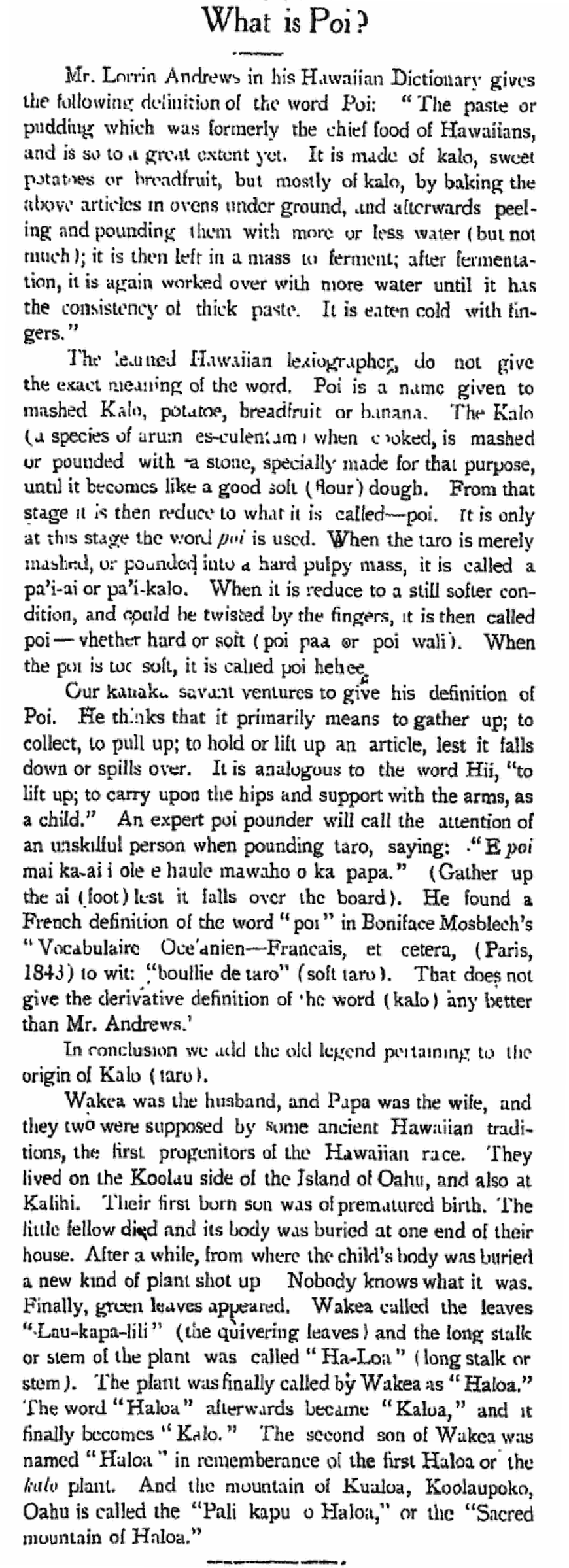
What is Poi?

Mr. Lorrin Andrews in his Hawaiian Dictionary gives the following definition of the word Poi: “The paste or pudding which was formerly the chief food of Hawaiians, and is so to a great extent yet. It is made of kalo, sweet potatoes or breadfruit, but mostly of kalo, by baking the above articles in ovens under ground, and afterwards peeling and pounding them with more or less water (but not much); it is then left in a mass to ferment; after fermentation, it is again worked over with more water until it has the consistency of thick paste. It is eaten cold with fingers.”

The learned Hawaiian lexiographer [lexicographer] do not give the exact meaning of the word. Poi is a name given to mashed Kalo, potatoe, breadfruit or banana. The Kalo (a species of arum ex-culentum [arum esculentum] when cooked, is mashed or pounded with a stone, especially made for that purpose, until it becomes like a good soft (flour) dough. From that stage it is then reduce to what is called—poi. It is only at this stage the word poi is used. When the taro is merely mashed, or pounded into a hard pulpy mass, it is called a pa’i-ai or pa’i-kalo. When it is reduced to a still softer condition, and could be twisted by fingers, it is then called poi—whether hard or soft (poi paa or poi wali). When the poi is too soft, it is called poi hehee.

Our kanaka savant ventures to give his definition of Poi. He thinks that it primarily means to gather up; to collect, to pull up; to hold or lift up an article, lest it falls down or spills over. It is analogous to the word Hii, “to lift up; to carry upon the hips and support with the arms, as a child.” An expert poi pounder will call the attention of an unskillful person when pounding taro, saying: “E poi mai ka ai i ole e haule mawaho o ka papa.” (Gather up the ai (foot [food]) lest it falls over the board). He found a French definition of the word “poi” in Boniface Mosblech’s “Vocabulaire Oce’anien—Francais, et cetera, (Paris, 1843) to wit: “boullie de taro” (soft taro). That does not give the derivative definition of the word (kalo) any better than Mr. Andrews.

In conclusion we add the old legend pertaining to the origin of Kalo (taro).

Wakea was the husband, and Papa was the wife, and they two were supposed by some ancient Hawaiian tradition, the first progenitors of the Hawaiian race. They lived on the Koolau side of the Island of Oahu, and also at Kalihi. Their first born son was of premature birth. The little fellow died and its body was buried at one end of their house. After a while, from where the child’s body was buried a new kind of plant shot up. Nobody knows what it was. Finally, green leaves appeared. Wakea called the leaves “Lau-kapa-lili” (the quivering leaves) and the long stalk or stem of the plant was called “Ha-Loa” (long stalk or stem). The plant was finally called by Wakea as “Haloa.”

(Kuokoa Home Rula, 1/1/1909, p.1)

What is Poi?

Kuokoa Home Rula, Buke VII, Helu 1, Aoao 1. Ianuari 1, 1909.

Because February shouldn’t be the only Hawaiian Language month… 1948.

THE MOTHER TONGUE

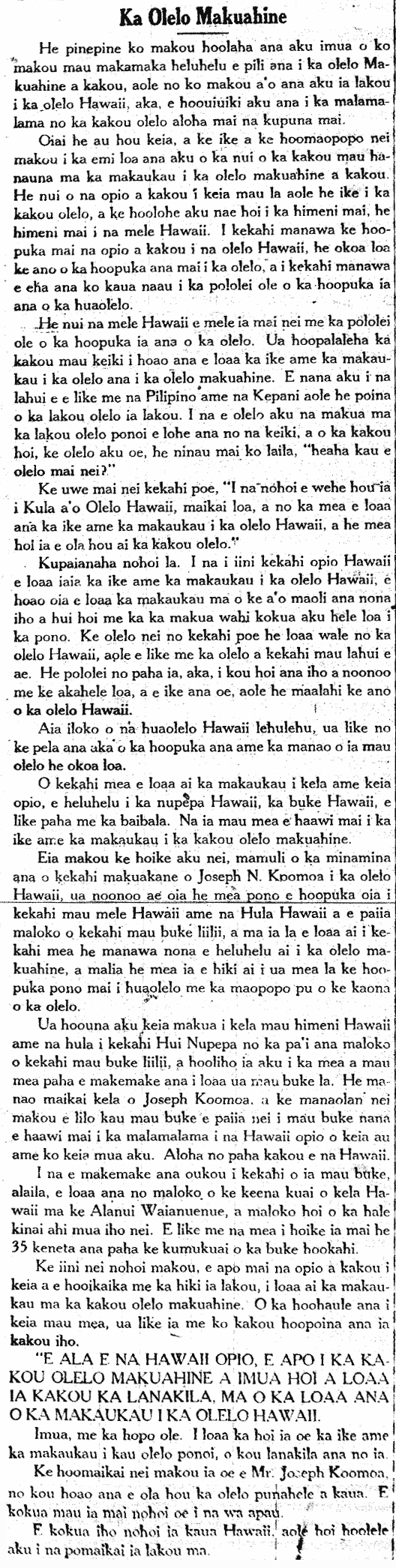
We frequently speak to our dear readers about our Mother tongue, not about our teaching them the Hawaiian language, but that the light of our beloved language from our forefathers is being extinguished.

Being that this is a new era, and we see and realize that there is a drastic reduction in the number of our generations capable in our mother tongue. There are many of our youths these days who have no knowledge of our language, but when you listen to them singing, they sing Hawaiian songs. Sometimes when our children speak Hawaiian, their production of the language is so strange, and sometimes our naau [gut, heart] aches at their mispronunciation of words.

There are many Hawaiian songs sung with incorrect pronunciation. Our children are neglecting trying to acquire knowledge and proficiency in speaking the mother tongue. Look at the other ethnicities like the Filipinos and the Japanese, they haven’t forgotten their language. If parents spoke in their own language then the children would hear; and when we talk to them, they’ll ask, “he aha kau e olelo mai nei? [what are you saying?]”

Some people bewail, “If only Hawaiian-Language Schools were reopened, that would be a good thing because we’d get knowledge and proficiency in the Hawaiian language and it would revive our language.”

That is astonishing. Should a young Hawaiian have the desire to acquire knowledge and competency in the Hawaiian language, he should try to get this competency by studying diligently by himself and to get together with an adult for help and there would be great progress. Some say that Hawaiian can be gotten just like that, not like the languages of other people. Perhaps it is true, but if you go back and think with great seriousness, you will see that the Hawaiian language is not easy.

Within the many Hawaiian words, spellings might be the same, but the pronunciation and meanings of those words are different.

One thing that will give every youth proficiency is the reading of Hawaiian newspapers and Hawaiian books like perhaps the bible. Those things will give knowledge and competence in our native language.

We point out that because of the great love of a certain father, Joseph N. [Nihiaumoe] Koomoa, for the Hawaiian language, he thought it would be important to publish some Hawaiian songs and Hawaiian Hula and print some booklets, and through that someone could make time to read the Hawaiian language and perhaps that way the person could pronounce the words while understanding the kaona [underlying meanings].

This man sent those Hawaiian songs and hula to a Newspaper company to be printed in booklets, and it will be sold to the person or persons who want those books. This is a good idea of Joseph Koomoa’s, and we hope that your books that are being printed will become books that give knowledge to the Hawaiian youths of this age and of the future. Aloha to us, O Hawaiians.

Should you want one of those books, they will be available at the shop of that Hawaiian on Waianuenue Avenue, and also the former fire station [?] According to what was announced, the books will probably cost 35 cents each.

We want our youngsters to get a hold of this and and improve themselves to the best of their ability so that they can get proficiency in our mother tongue. Letting these go would be like forgetting our own selves.

“RISE YOUNG HAWAIIANS, GRASP OUR MOTHER TONGUE AND GO FORTH AND LET US BE TRIUMPHANT BY BEING PROFICIENT IN THE HAWAIIAN LANGUAGE.

Forge forward with no fear. So that you can get knowledge and proficiency in your own language—that will be your triumph.

We give our congratulations to you, Mr. Joseph Koomoa, for you attempt to revive the prized language of ours. You will be helping for all times [E kokua mau ia mai nohoi oe i na wa apau. ?]

Help ourselves Hawaiians, and don’t let the benefits go to those others [E kokua iho nohoi ia kaua Hawaii, aole hoi hoolele aku i na pomaikai ia lakou ma. ?]

[Anyone know of any copies of these music booklets by Joseph N. Koomoa still in existence???]

(Hoku o Hawaii, 2/11/1948, p. 2)

Ka Olelo Makuahine.

Ka Hoku o Hawaii, Volume XLI, Number 19, Aoao 2. Pepeluali 11, 1948.

Kawaihau Orchestra and Glee Club in SF. 1905.

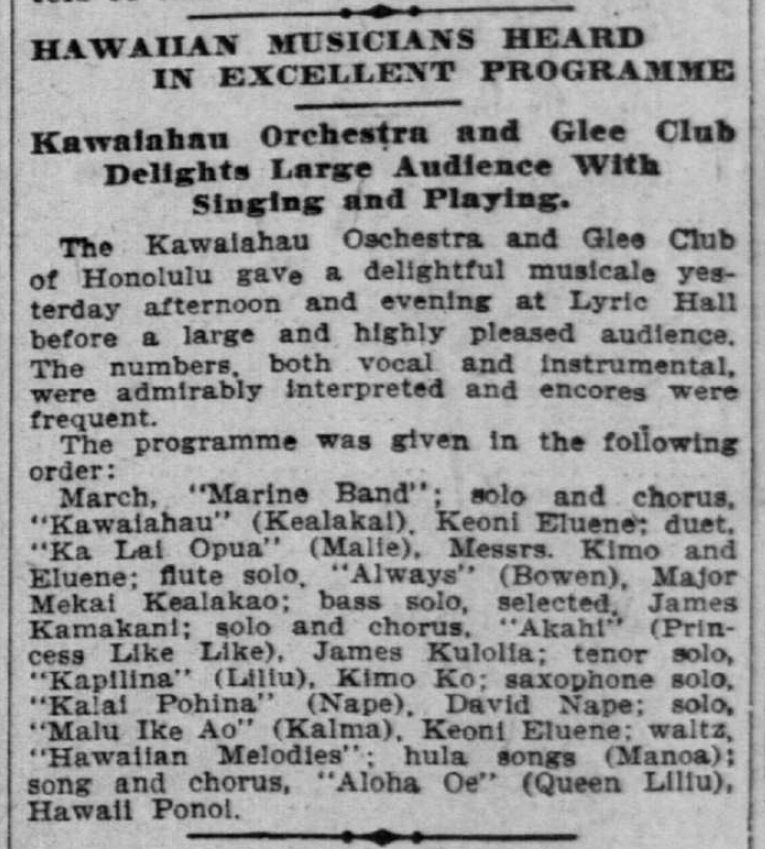
HAWAIIAN MUSICIANS HEARD IN EXCELLENT PROGRAMME

Kawaiahau Orchestra and Glee Club Delights Large Audience With Singing and Playing.

The Kawaiahau Orchestra and Glee Club of Honolulu gave a delightful musicale yesterday afternoon and eveing at Lyric Hall before a large and highly pleased audience. The numbers, both vocal and instrumental, were admirably interpreted and encores were frequent.

The programme was given in the following order:

March, “Marine Band”; solo and chorus, “Kawaiahau” (Kealakai), Keoni Eluene; duet, “Ka Lai Opua” (Malie), Messrs. Kimo and Eluene; flute and solo, “Always” (Bowen), Major Mekia Kealakao [Kealakai]; bass solo, selected, James Kamakani; solo and chorus, “Akahi” (Princess Like Like [Likelike]), James Kulolia; tenor solo, “Kapilina” (Liliu), Kimo Ko; saxophone solo, “Kalai Pohina” (Nape), David Nape; solo, “Malu Ike Ao” (Kalima), Keoni Eluene; waltz, “Hawaiian Melodies” ; hula songs (Manoa); song and chorus, “Aloha Oe” (Queen Liliu), Hawaii Ponoi.

[Because of its location, The San Francisco Call had much Hawaii coverage.]

(San Francisco Call, 10/7/1905, p. 16)

HAWAIIAN MUSICIANS HEARD IN EXCELLENT PROGRAMME

The San Francisco Call, Volume XCVIII, Number 129, Page 16. October 7, 1905.

Kawaihau Glee Club performs in Washington State. 1905.

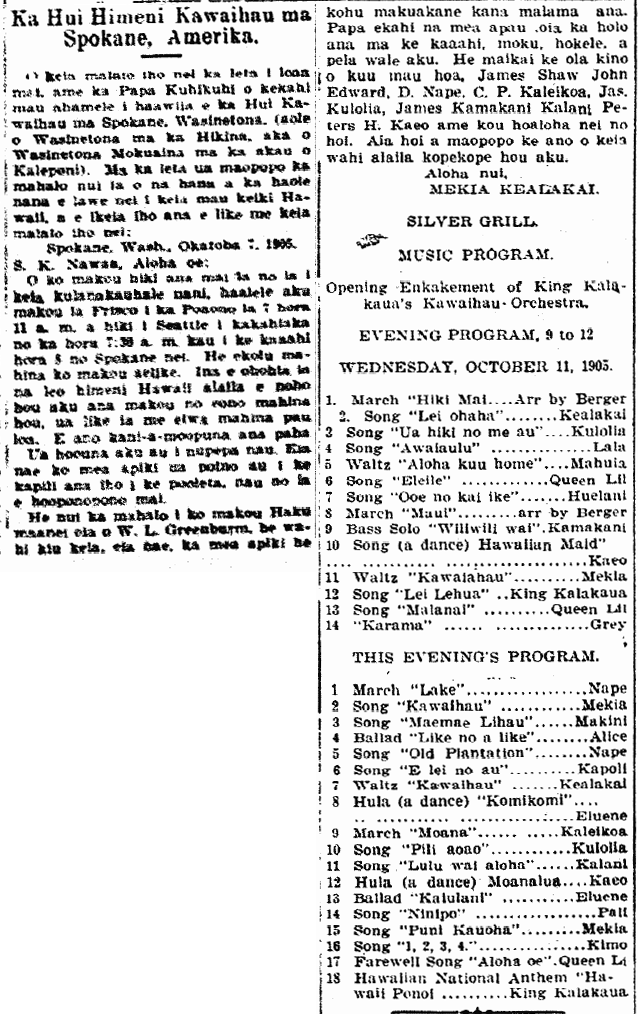
The Kawaihau Glee Club in Spokane, America.

Here below is a letter received as well as a program from some performances given by the Kawaihau Glee Club at Spokane, Washington (not Washington in the East, but Washington State to the North of California). It is apparent from the letter that the actions of that haole taking these Hawaiian boys around is much appreciated, and this is seen as below:

Spokane, Wash., October 7, 1905.

S. K. Nawaa, Aloha to you:

We’ve arrived in this beautiful town, we left Frisco on Saturday the 7th [?] at 11 a. m. and got to Seattle in the morning, at 7:30 a. m. boarded the 8 o’clock train for Spokane. Our contract is for 3 months. If they are taken by the sound of Hawaiian music, we will stay on for another 6 months, which would make 9 months total. Perhaps we will be like old grandparents by then.
I have sent a newspaper to you. But here is the thing, I had problems with the postage, so you will have to take care of it.
We really are thankful for our Boss here, W. L. Greenburn [?], he is an investigator. The one problem is that he treats us as if he is our father. Everything is first class, from the train, to the boat, to the hotel, and so forth. My friends, James Shaw, John Edward [Edwards?], D. Nape [David Nape], C. P. Kaleikoa, James Kulolia, James Kamakani, Kalani Peters, H. Kaeo and me, your friend as well, we are all in good health. As soon as I get acclimated to how it is here, I will write again.
Much Aloha,
Mekia Kealakai.

SILVER GRILL
MUSIC PROGRAM
Opening Enkakement of King Kalakau’s Kawaihau Orchestra.
EVENING PROGRAM, 9 to 12

WEDNESDAY, OCTOBER 11, 1905.

1 March “Hiki Mai” Arr by Berger
2 Song “Lei ohaha” Kealakai
3 Song “Ua hiki no me au” Kulolia
4 Song “Awaiaulu” Lala
5 Waltz “Aloha kuu home” Mahuia
6 Song “Eleile” Queen Lil
7 Song “Ooe no kai ike” Huelani
8 March “Maui” arr by Berger
9 Bass Solo “Wiliwili wai” Kamakani
10 Song (a dance) Hawaiian Maid” Kaeo
11 Waltz “Kawaiahau” Mekia
12 Song “Lei Lehua” King Kalakaua
13 Song “Malanai” Queen Lil
14 “Karama” Grey

THIS EVENING’S PROGRAM.

1 March “Lake” Nape
2 Song “Kawaihau” Mekia
3 Song “Maemae Lihau” Makini
4 Ballad “Like no a like” Alice
5 Song “Old Plantation” Nape
6 Song “E lei no au” Kapoli
7 Waltz “Kawaihau” Kealakai
8 Hula (a dance) “Komikomi” Eluene
9 March “Moana” Kaleikoa
10 Song “Pili aoao” Kulolia
11 Song “Lulu wai aloha” Kalani
12 Hula (a dance) Moanalua Kaeo
13 Ballad “Kaiulani” Eluene
14 Song “Ninipo” Pali
15 Song “Puni Kauoha” Mekia
16 Song “1, 2, 3, 4.” Kimo
17 Farewell Song “Aloha oe” Queen Li
18 Hawaiian National Anthem “Hawaii Ponoi King Kalakaua

[I am assuming that they copied the program as it was printed out in Washington…]

(Kuokoa, 11/3/1905, p. 5)

Ka Hui Himeni Kawaihau ma Spokane, Amerika.

Ka Nupepa Kuokoa, Buke XLIII, Helu 44, Aoao 5. Novemaba 3, 1905.

Kawaihau Glee Club off to San Francisco. 1905.

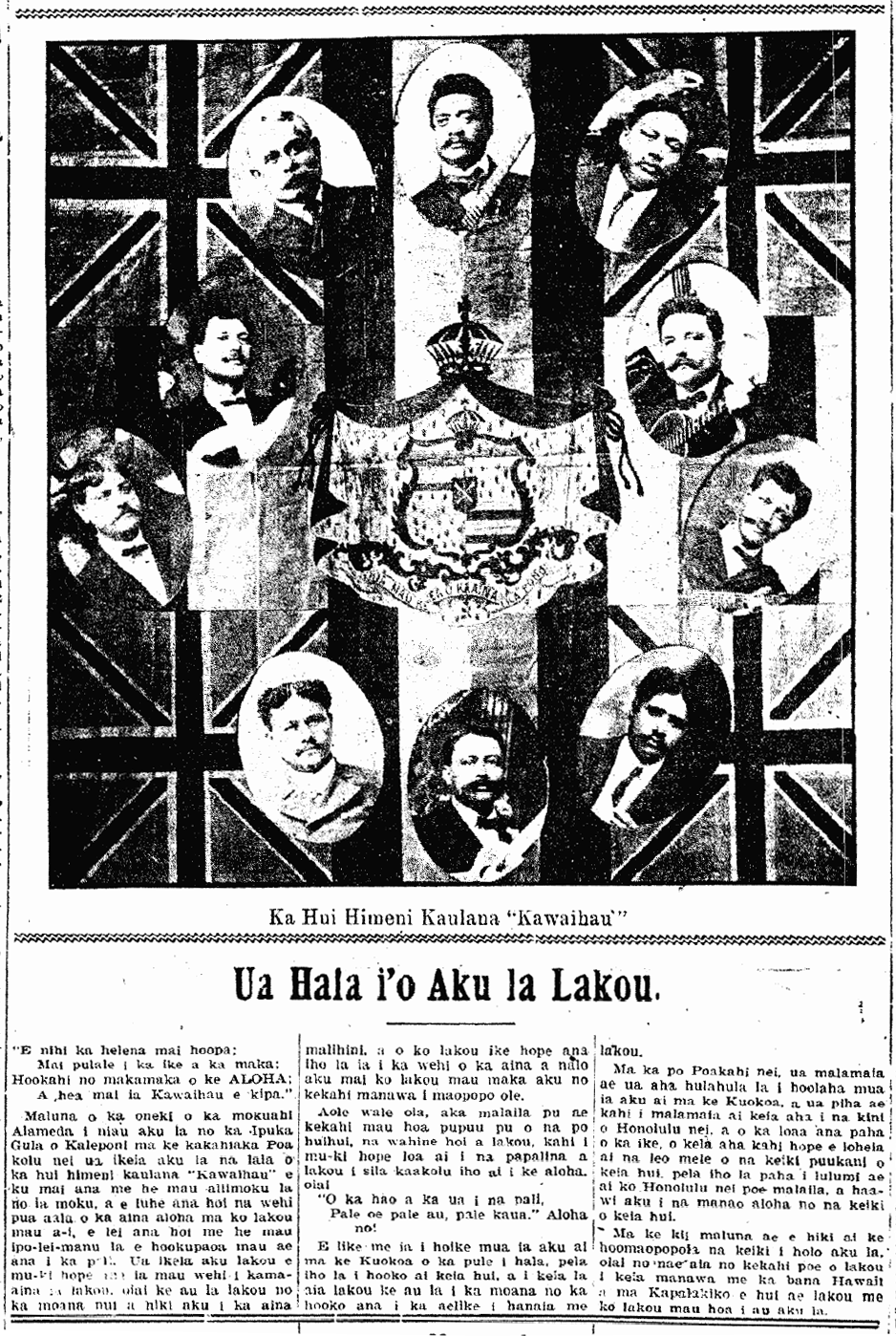
The Famous Singing Group “Kawaihau”

They Left for Afar.

“E nihi ka helena mai hoopa; [Tread carefully, don’t touch;]
Mai pulale i ka ike a ka maka [Don’t get excited by what the eye sees:]
Hookahi no makamaka o ke ALOHA [There is but one companion, that is ALOHA];
A hea mai ia Kawaihau e kipa. [Calling out to Kawaihau to come visit.]”¹

Aboard the deck of the steamship Alameda that moved swiftly on to the Golden Gate of California on the morning of Wednesday was seen the members of the famed singing group “Kawaihau” standing like officers of the ship while garlands of fragrant flowers of the beloved land hung about their necks; they wore the lei like a beloved sweetheart ever imbuing fragrance in their bosom. They were seen inhaling for the last time the adornment familiar to them as they were leaving for the great sea headed for foreign lands; and they were seeing for the last time the verdure of the land which disappeared from their eyes for who knows how long.

Not just them, but also there were the companions to curl up together in the cold nights—their wives, there to kiss their cheeks for the last time, which they sealed threefold with love, as

“O ka hao a ka ua i na pali [The assault of the rain in the cliffs]
Pale oe, pale au, pale kaua.” Aloha no! [I fend off, you fend off, we both fend off.”² Aloha!]

Just as reported earlier in the Kuokoa of last week, so did this group carry out, and today they are travelling over the ocean to fulfill the contract made with them.

This past Monday that dance advertised earlier in the Kuokoa was held, and the venue where the event took place was filled with the multitudes of Honolulu; perhaps they knew that this gathering would be the last they’d hear the singing of the performers of this group, and that is probably why Honolulu’s people thronged there and gave their aloha to the boys of the band.

In the picture above, you can see the boys who went, although some of them are currently with the Hawaiian Band in San Francisco and will meet up with their companions who left.

¹Play on the chorus of Kalakaua’s “E Nihi ka Hele.”
²Anyone know what mele this might come from?

[This is who played at that huge wedding celebration in Pauoa attended by Kaiulani in 1898 (the articles posted yesterday)]

(Nupepa Kuokoa, 9/22/1905, p. 1)

Ua Hala i'o Aku la Lakou

Ka Nupepa Kuokoa, Buke XLIII, Helu 38, Aoao 1. Sepatemaba 22, 1905.