“Missionary Herald,” 1821–.

 Here is another reference available online. This publication was put out by the American Board of Commissioners for Foreign Missions (ABCFM), reporting home to America on their work throughout the world. Of particular interest to us is what they say about Hawaii. Here for instance is an article appearing in the year of the overthrow, 1893.

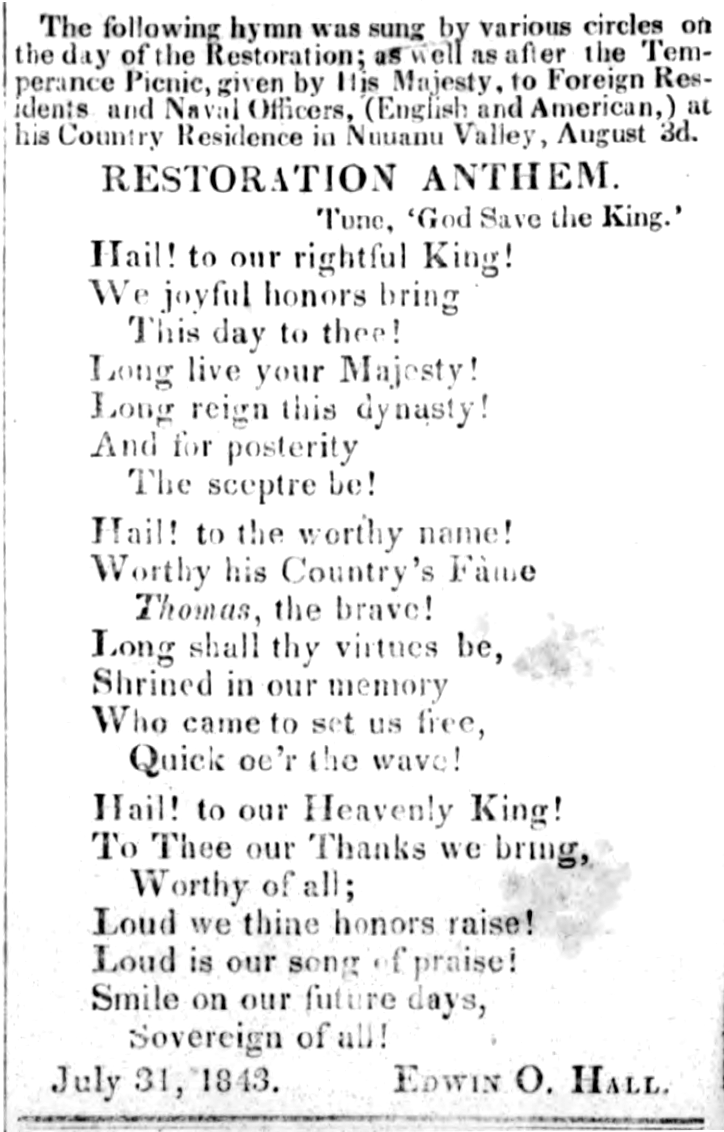
The position taken by the United States Secretary of State in regard to affairs at the Hawaiian Islands is simply astounding. That he should suggest that the United States interpose for the restoration of the late Hawaiian Queen seems almost incredible. Even were it admitted, as it is not, that our representatives at Hawaii afforded unwarrantable aid to the revolutionary party, it is a strange suggestion that, after this lapse of time, our government should reseat upon the throne one who had forfeited all her rights to it, and whose influence was only detrimental to the interests of the islands. The so-called royal house of Hawaii has been its curse for years. Queen Liliuokalani had yielded to the corrupting influences which every decent man had recognized as becoming more and more potent in political affairs at the islands, and by influences which she knew how to exert on the worst classes, she secured the passage of the bill giving a home on Hawaii to the infamous Louisiana Lottery which had been driven out of the United States. Restrictions upon the opium traffic, so necessary for the welfare of Hawaiians, were removed. A faithful cabinet was displaced and men of no character were placed in power. But the final act, which was practical…

(Missionary Herald, 12/1893, p. 510.)


The position taken...

The Missionary Herald, Volume LXXXIX, Number XII, Page 510. December 1893.

…suicide of the monarchy, was the attempt on her part to abrogate the Constitution and by sheer force establish a new one of her own making. Even her subservient ministers refused to endorse the scheme, yet she insisted upon it and sought to incite the populace to stand by her in her autocratic plans. It was then that all the better classes united as one man and deposed her. Never was there a revolution more warranted by facts, never was one more peacefully accomplished, and a queen of worthless character was set aside and the monarchy by its own act came to an end. If Minister Stevens or the commander of the Boston erred in judgment in any transaction, which we are not prepared to admit, yet there is no valid ground for the interference of our government to reverse the revolution months after it was consummated. We do not speak here of the political question as to what it is expedient for the United States to do in reference to a protectorate or to annexation. Opinions of these points may differ, but it would seem as if there were no room for difference of opinion in regard to this question of reestablishing the old monarchy on Hawaii. The best portion of her citizens have asked for some form of connection with the United States. Our government has a perfect right to say yes or no to all these proposals. And the Provisional Government at Honolulu has a right to say to us, “Either accept our proposal or hands off.” We regret to be obliged to speak in such terms of propositions that come from our national administration. We certainly should not do so did we not believe that any attempt to restore the Hawaiian Queen to her throne would be a gross outrage, and would be followed by the most serious consequences to the moral and religious interests of the islands, as well as to their material prosperity. We cannot think that our people will tolerate any intervention which has for its object the replacing upon the throne of a sovereign whose influence will be only for evil.

(Missionary Herald, 12/1893, p. 511.)
Continue reading

Restoration Anthem, 1843.

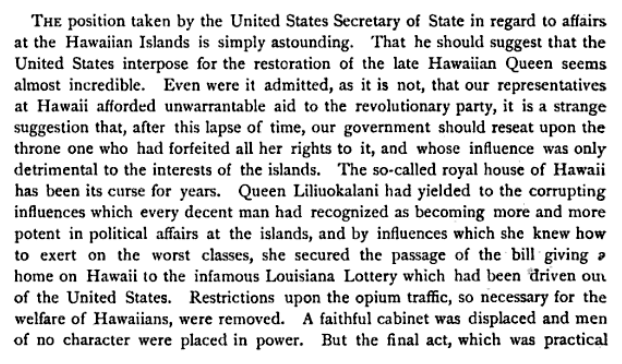
The following hymn was sung by various circles on the day of the Restoration; as well as after the Temperance Picnic, given by His Majesty, to Foreign Residents and Naval Officers, (English and American,) at his Country Residence in Nuuanu Valley, August 3d.

RESTORATION ANTHEM.

Tune, ‘God Save the King.’

Hail! to our rightful King!
We joyful honors bring
This day to thee!
Long live your Majesty!
Long reign this dynasty!
And for posterity
The sceptre be!

Hail! to the worthy name!
Worthy his Country’s Fame
Thomas, the brave!
Long shall they virtues be,
Shrined in our memory
Who came to set us free,
Quick oe’r the wave!

Hail! to our Heavenly King!
To Thee our Thanks we bring,
Worthy of all;
Loud we thine honors raise!
Loud is our song of praise!
Smile on our future days,
Sovereign of all!

July 31, 1843.  Edwin O. Hall.

[This post may be just a little early this year, but it is good to not just remember momentous events like Ka La Hoihoi Ea just one day of the year. Last year, the Hawaiian Historical Society put up handwritten lyrics of this mele on their Facebook page on the 27th of July. Here we find it in print, just a few days following its being penned by Edwin O. Hall!]

(Temperance Advocate and Seamen’s Friend, 8/11/1843, p. 42)

RESTORATION ANTHEM.

Temperance Advocate and Seamen’s Friend, Volume I, Number VIII, Page 42. August 11, 1843.

On Hooulu Lahui, 1876.

SATURDAY, MARCH 4.

REPOPULATION.

The following is the text of the memorial of citizens which was presented to His Majesty on Tuesday last, by a committee of signers:

To His Majesty the King,

Sire:—We, the undersigned, subjects and residents of this kingdom and friends of your Royal Person, in view of what we deem a grave condition of public affairs, take the liberty to address you in a spirit of frankness and loyalty in order to point out the danger that threatens the state, and at the same time the necessary measures to avoid the national peril.

We desire to say at the outset, that we are prompted to take part in this address not only on account of a loyal and friendly regard for Your Majestyʻs person, but also by reason of our strong desire to see maintained, with ample honor and prosperity, the Independence of the Hawaiian Kingdom.

The propriety of according the privileges of independent sovereignty to a state so much reduced in people as Your Majestyʻs dominions is very much questioned, and the discussion is most detrimental to the dignity and permanence of the throne. This question was even raised in past years, when Hawaii numbered far more souls than at this time within her borders. When the commissioners of Kamehameha III presented the claims of this archipelago for recognition as an independent state to the Government of Great Britain in 1843, they were met at first with a peremptory refusal from Lord Aberdeen, the British foreign minister, on the ground that the state of Hawaii was a mere chieftaincy under foreign influences, and too small to be entitled to diplomatic courtesies and treaty making powers. And if such a view could be taken of our state thirty-three years ago, when we numbered about one hundred thousand people, what must be thought of our capability for independence now when perhaps we number barely fifty thousand souls, natives and foreigners all told? Continue reading

Re-population in the eyes of the haole, 1876.

Palapala Hoopii i ka Moi.

Ka Hooulu Lahui.

[This memorial urging re-population of the nation was probably an English document, translated here into Hawaiian. For the English and the interesting list of signatures, see the following post.]

(Kuokoa, 3/18/1876, p. 1)

Palapala Hoopii i ka Moi.

Ka Nupepa Kuokoa, Buke XV, Helu 12, Aoao 1. Maraki 18, 1876.

More on Emma Nakuina, W. T. Brigham, and the Bishop Museum, 1897.

NOT COURTEOUS

Treatment of Ladies at Bishop Museum.

An Open Protest to the Trustees of the Kamehameha Schools.

MR. EDITOR:—The undersigned with three other ladies, Hawaiians of the highest respectabily, standing and position, with five little children, were sitting this morning in the shade of the Kamehameha Museum enjoying the fine showing made by the naval men drilling on the College campus. Chairs had been offered by a Kamehameha graduate, he placing them on the grass plot adjoining the Museum. After a little while, Mr. Brigham, the curator of the Museum, drove by within a few feet of us. He scowled most savagely at us. In a few minutes a Portuguese workman came to order us away from the place.

As it has invariably been the custom to throw the College grounds open to the public when any sort of a public or semi-public show is taking place within its precincts, we did not pay any attention to his orders, thinking it a piece of officiousness on the part of an ignorant person, and the man went away. After a while the man re-appeared and ordered us off again, saying he was acting by Brigham’s orders, and to use force if necessary. He took hold of the chair of the wife of a prominent official and tipped it partly over. She sprang up to avoid a fall, as did two other ladies. I, being at the very corner of the building and a little in advance of the others did not perceive the man until he had taken hold of my chair and had partly spilled me on my knee. I turned around to protest, when he grabbed my arm and pulled me out of my chair, saying “you get out of this, those are my orders from Mr. Brigham. If you don’t go yourself, I make you go. Mr. Brigham don’t allow any one to get on this grass.”

There were quite a number of carriages standing around, occupied by spectators of the drill.

The actions of the Portuguese were so rough and insulting that the attention of quite a number were attracted to our forcible ejectment. Continue reading

Emma Metcalf Nakuina affronted, 1897.

Contemptuous Act Against Women.

Being that the parading was being held in the uplands of the Kamehameha School for Boys, on the plains of Kaiwiula, Mrs. Emma Metcalf Nakuina went attended by Mrs. R. W. Maea [Mrs. Rudolph William Meyer] of Kalae, Molokai and two of her daughters, Mrs. Mutch and Mrs. Hitchcock. They went and sat in a calm and shady place at the Bishop Museum, atop a area covered with manienie grass, and the son of the one named first, F. W. Kahapula Beckley, brought them chairs. Continue reading

Paaiea Pond, part 4 and final, from the pen of J. W. H. Isaac Kihe, 1914.

SOME STORIED LANDS OF KONA

Written for the Hoku o Hawaii by ka Ohu Haaheo i na Kuahiwi Ekolu¹

PAAIEA POND

Meeting with Kolomu’o and Pahinahina.

When the flames subsided, the fire disappeared, and this is why it was assumed it was the fire of the Uau Bird Catchers in the Mountains.

In the middle of that night, the lava emerged and flowed like water below a crater on the side of a peak called Kileo, and it is black, shiny pahoehoe that remains there to this day. And from there the lava dove down and resurfaced makai side and several deep fissures cracked open and remain near the village that Mr. Maguire lives at.

The lava dropped down again and on the makai side of the old road there opened up a small furrow six (6) feet wide, and from here the lava began to flow and overran everything before it.

Villages were destroyed and some people died as victims to the wrath of the Goddess of the crater, because of the denial of Pele by that Konohiki [Kepaalani] which the Alii [Kamehameha I] stationed to oversee all of his wealth. And when the Konohiki saw the lava burning everything and turning into pahoehoe and gorging away, he finally realized that the old lady was Pele that appeared before him asking for fish, palu, and then shrimp, and he regretted this filled with dread and great fear. Continue reading

Newspapers, translation, and a mele for the Merrie Monarch, 1913 / Timeless.

You can find various translations for the beautiful song, “Kaipoleimanu” in the archives of the Bernice Pauahi Bishop Museum, online, and on liner notes. None however seems to acknowledge that Kaipoleimanu itself was a wahi pana, along with its neighboring hau of Maihi, ulu of Weli [also seen as Wehi], and hala of Mapuana.

There is a priceless church meeting report/travelogue appearing in the Kuokoa from 12/5/1913 to 2/6/1914: Ka Ike Hou ana o ke Kamahele i ka Mokupuni o Kauai [The Traveler Sees Once More the Island of Kauai], signed, Kamahele. Amongst all the fascinating information found in this report is a description of the places hearkened to in the mele Kaipoleimanu, to which the traveller is taken by his guide, the Deputy Sheriff of Hanalei, William Werner. He says: Continue reading

The Queen visits Hilo, 1914.

QUEEN LILIUOKALANI

Queen Liliuokalani arrived here in Hilo in the afternoon of this past Sunday, and she is an honored guest of Mrs. Aima Nawahi these days. The Royal one of Hawaii is in good health. She will return to Honolulu the following Friday.

This Thursday, at 10 a. m. until 12 noon, our Queen graciously has granted loving audience with all those who go to see her at the home of Mrs. Aima Nawahi. The members of all the Hawaiian Associations of Hilo nei also want to see their beloved Queen. This audience is open to all the people here in Hilo. Continue reading

Paaiea Pond, part 3, from the pen of J. W. H. Isaac Kihe, 1914.

SOME STORIED LANDS OF KONA

Written for the Hoku o Hawaii by ka Ohu Haaheo i na Kuahiwi Ekolu¹

PAAIEA POND

Meeting with Kolomu’o and Pahinahina.

When the woman left that place at the seaside of Kaelehuluhulu, she arrived in the uplands of Keoneeli, a place that is renown to this day called Kepuhiapele [‘the scorching of Pele’], a heap of aa lava that is almost 200 Feet high, downside of the place where J. A. MaGuire [known also as Keoni Kaimana] is living.

When the woman arrived there, there were two girls named Kolomu’o and Pahinahina broiling breadfruit, while the parents were away farming. This was a huge town during those days, with many people living there. When the woman met up with the girls broiling ulu. The woman said, “The ulu that you are cooking is done.” One of the girls responded, “We are cooking ulu, but it is not totally done.”

The woman went on, “When you ulu is cooked, who will partake of it first?” “La’i, my god, will eat first.” “So La’i is a powerful akua?” “Yes, La’i is powerful.” The name of this girl was Kolomu’o, and the area beneath that scorching of Pele is famous to this day and called Kolomu’o, and famous too is the Opelu fishing shrine [Ko’a] at the beach of Kaupulehu.

Then the woman asked the other girl, Pahinahina, “And when your ulu is done, who is it for?” “It is for Pele Honuamea, my god.” “Then it is our ulu; your ulu is cooked, let the two of us partake in it.” Pahinahina agreed, and the ulu was peeled [makikoe²] and eaten up. Continue reading