On the decline of native birds, 1871.

Locals of the Tuahine Rain are no more.

O Ke Au Okoa:—Aloha to you:

I am sending you a small gift atop your outstretched foundation, should your captain and Editor be so kind, and it will be for you to take it to the shores of these islands so that my newspaper-reading companions may see it, it being the letters placed above: “Some Locals of the Tuahine Rain¹ are no more,” and it has been ten or more years which they have not been seen.

And my friends are probably puzzled about these locals that have gone missing, and you, our old-timers, are all likely saying, not them, here they are, and some people have passed away, but we knew of their passing; but the departure of these kamaaina which I speak of was not witnessed. And this is it, the kamaaina birds of our uplands: the Iwi, the O-u, the Akakane, the Amakihi, the Oolomao, the Elepaio; these are the native birds of these uplands who have disappeared.

And some of you may be questioning, what is the reason for this disappearance? I tell you, it is because of the spread of the evil birds from foreign lands, in our plains, mountains, ridges, valleys, cliffs, forests, terraced taro patches, seashores, and rivers; that is why these kamaaina have gone, because of the spreading of these evil birds among us, and they are damaging the crops, and the food from the forests; rice planted by some are being eaten by these evil birds; and the bananas of the forests are all eaten up by these birds.

What do we gain from these evil birds being spread in Hawaii, and protecting them so that they are not killed? I say that we gain nothing from these evil birds which are hurting our native birds and crops and foods from the forests; because in the past, before the spread of these birds, if a kamaaina of this land wanted to go into the mountains to get thatching or some shrimp, or some oopu, they did not pack food with them, because they thought that there was food in the mountains, like banana, hawane fruit, and uhi; banana would ripen on the plant and then fall, without anything damaging them, but now, the bananas don’t ripen on the plant; they are eaten by these banana-eating mu [mu ai maia] of the forest; bananas don’t ripen, and [now] when you go into the mountains, there is just the oka-i [blossom container of bananas] left and the bananas are lost to these birds; and the kamaaina birds are gone. Where to? Perhaps they all went to Hawaii island.

And I say without any hypocrisy, the decrease of this people was because the arrival of the evil haole to Hawaii nei; it was they who spread the evil sicknesses: gonorrhea [pala] and syphilis [kaokao]. Smallpox [hepera] and leprosy [mai pake] are the reasons that our lahui was decimated, because of the arrival of the evil haole; if all the people who came to Hawaii were like the people who brought the light [missionaries],  then this lahui would not have decreased in number; so too with the arrival of the evil birds to Hawaii nei, which hurt our native birds and plants; this is like the decrease of our lahui with the arrival of the evil haole who spread gonorrhea and syphilis and similar diseases.

Therefore, I feel aloha for the kamaaina birds of my beloved land because they are all gone, and the youngsters of these days question, what are those birds like? They are tiny birds with beautiful voices, and their feathers as well, and they were an enjoyment in our childhood; when times of strong winds arrived, all the birds of the mountains would alight and show up at the doors of the houses which was entertaining for us to watch them flitting amongst the leaves of the ilima in our childhood and they were a playmate in our youth.

Before the arrival of these birds, there was a great abundance of Iwi, Amakihi, Akakane, O-u, Oolokela, and Elepaio, right here above us, atop the clumps of aliipoe, bushes of hau, noni trees, and more upland, the number of birds was amazing, atop the flowers of lehua of the mountain apples, and on the Ahihi and the Lehua Kumakua;  those uplands were so enjoyable but these days, they have all vanished, maybe because there were aggravated by these evil birds.

Here is another thing; if only the coming session of the Legislature could revise the law pertaining to birds from foreign lands, for there are destructive birds that have been imported as well from foreign lands.

And this is a supplication to you, O Ke Au Okoa. With aloha to the one who steers you, and also to the boys of the Government Printing Press. The boy from the uplands is turning back for the Tuahine rain of the land is spreading about.

T. N. Penukahi.

Manoa, June 24, 1871.

¹Tuahine [Kuahine] is the famous rain of Manoa.

(Au Okoa, 6/29/1871, p. 3)

He mau wahi kamaaina no ka ua Tuahine, ua nalowale.

Ke Au Okoa, Buke VII, Helu 11, Aoao 3. Iune 29, 1871.
Lost turtle? 1857.

TURTLE THAT TRAVELLED FAR INLAND.

O Hae Hawaii:

Aloha to you:—I am informing you about a Turtle at Polihua, Lanai: on the 18th of January of this month, a Turtle travelled from within the ocean; it went from the wet sands to the dry sands; passed the dry sands until where the pili grass grows. A woman saw this Honu, and called some people who were elsewhere, a man and his wife; the Turtle heard the voice of the woman that was calling out, and it turned back to return to the sea; it came upon a sandy cliff [kipapali one?] and the Honu slid and flipped over; the three got what they were after, but if it had not flipped over they wouldn’t have caught it; it was a muku¹ in width; the Honu was huge; the shell was removed by R. K_____, who said to me that this was something not heard of; so it is important that the Hae Hawaii covers news from all over so that all from Hawaii to Kauai can know.

With appreciation, S. R. LOHEPONO.

Kulaokahua, 20 Feb. 1857.

¹Muku is when you stretch out both arms, the length from the fingertips of one hand to elbow of other arm.

(Hae Hawaii, 3/4/1857, p. 1)

HE HONU PII MAUKA LOA.

Ka Hae Hawaii, Buke 2, Ano Hou.—Helu 1, Aoao 1. Maraki 4, 1857.

Moo at Mokuhinia, Lahaina, 1861.

Child Grabbed by Moo.

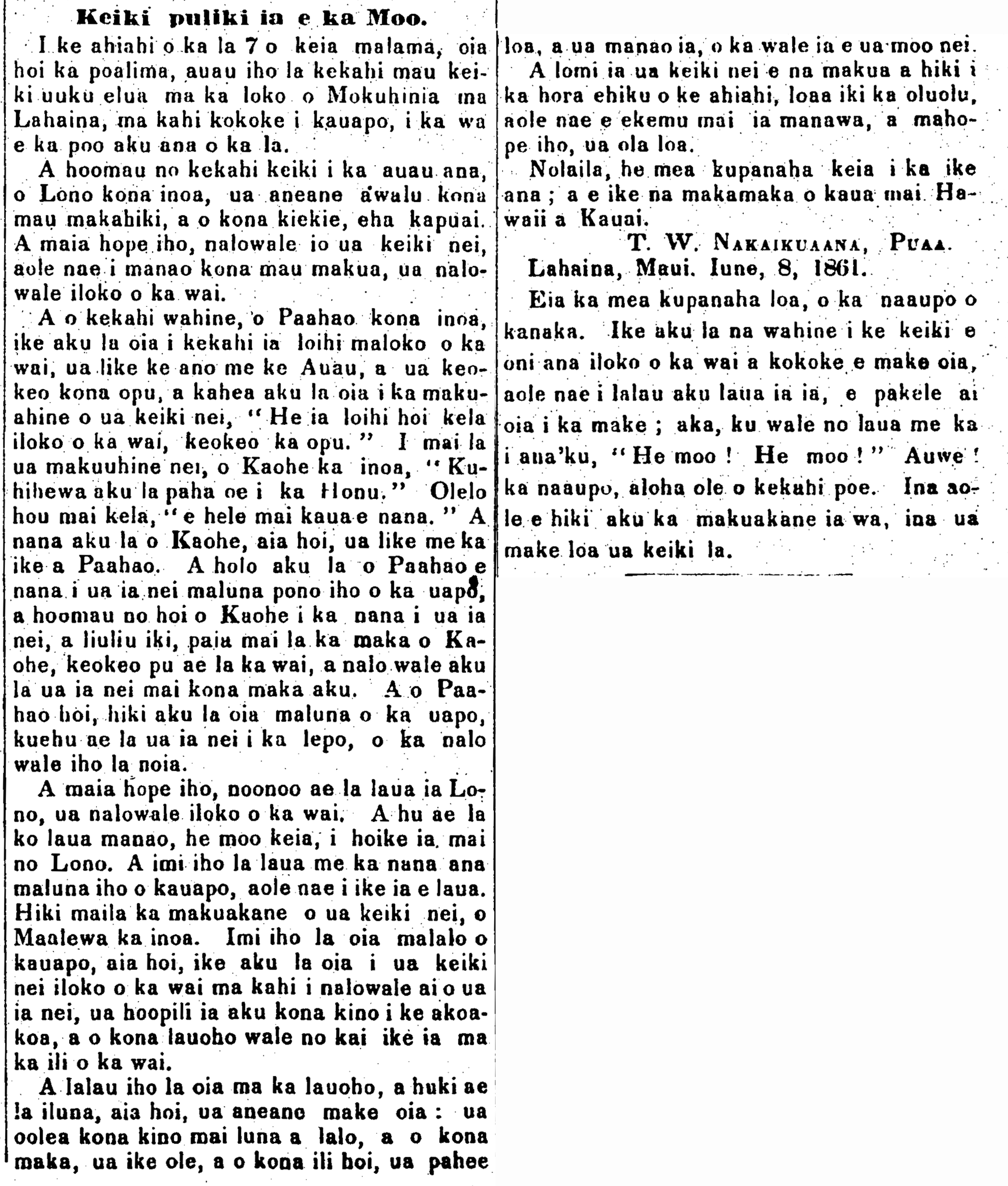
On the evening of the 7th of this month, that being a Friday, a couple of small children were bathing in Mokuhinia Pond in Lahaina, close to the bridge [uapo], when the sun was going down.

One of them continued to bathe, his name was Lono; he was almost eight years old, and his height was four feet. Right then after, this boy plain disappeared, but his parents did not think that he disappeared in the water.

A woman named Paahao saw a long fish in the water like an Swordfish [Auau], and its belly was white; she called out to the mother of the boy, “There is a long fish in the water with a white belly.” The mother named Kaohe said, “You must be confusing it with a Turtle.” The other responded, “Let’s go and see.” Kaohe went, and lo and behold, it was as Paahao had seen. Paahao went to go see the fish from atop the bridge while Kaohe continued to watch the fish; after a little time, Kaohe’s eyes were struck [temporarily blinded? “paia mai la ka maka”] and the water turned white, and the fish disappeared from her sight. As for Paahao, she arrived atop the bridge and the fish sprayed up dust, and it disappeared.

Then after, the two thought of Lono, and that he disappeared in the water. And they concluded that this was a moo that had revealed itself for Lono. They searched and went to look on the bridge, but it was not seen.

The father of the boy arrived, named Maalewa. He looked under the bridge, and come to find out, he saw the boy in the water where he was hidden by the moo; his body was attached to the coral and his hair was all that could be seen on the surface of the water.

The father grabbed him by the hair, and pulled him up, and he was almost dead; his body was stiff from top to bottom, and his eyes could not see, and his skin was slimy, which was believed to be the slime of the moo.

He was massaged by his parents until seven in the evening, whereupon he got slightly better but did not say a word, but later he revived.

Therefore, this was something miraculous to see; let it be known to all our friends from Hawaii to Kauai.

T. W. NAKAIKUAANA, PUAA.

Lahaina, Maui. June 8, 1861.

This is the remarkable thing; the foolishness of man. The women saw the child shaking in the water, close to dying, and they did not grab him and save him; but they just stood there saying, “A moo! A moo!” Auwe! the foolishness and heartlessness of some people. If the father had not arrived then, the child would be dead.

[I posted this article a long time ago on the Hoolaupai Facebook page, but because it has such bad search capabilities, i can’t find it. That is one of the reasons i started this blog. Searching for names or places or subjects, etc., is so much easier to do!

I am not sure what the commentary at the bottom is referring to, about the women seeing the boy shaking in the water…

For more on Mokuhinia and the work being done to restore this historic place, see: Friends of Mokuula.]

(Hae Hawaii, 6/12/1861, p. 41)

Keiki puliki ia e ka Moo.

Ka Hae Hawaii, Buke 6, Ano Hou.—Helu 11, Aoao 41. Iune 12, 1861.

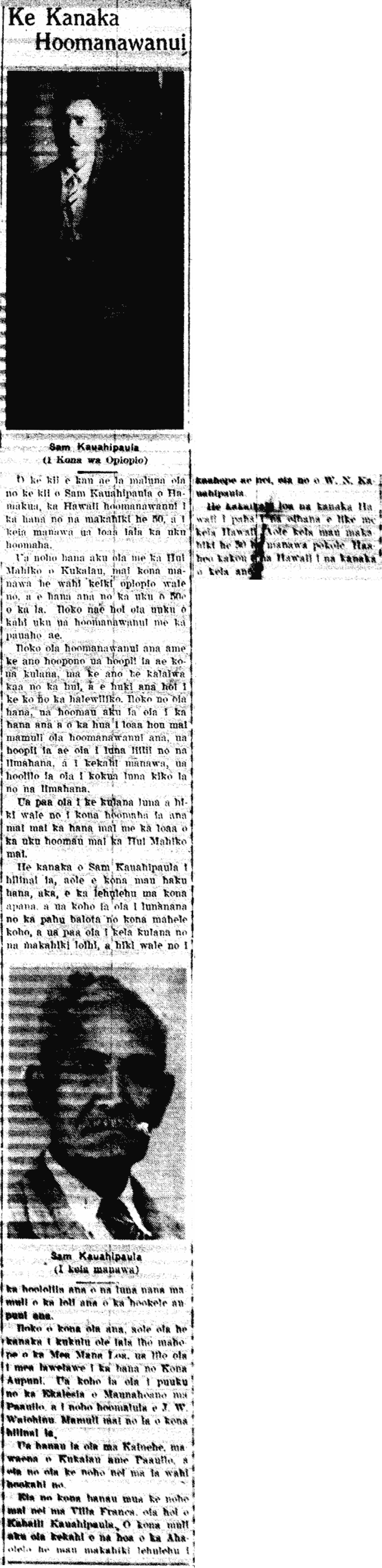
Samuel Kauahipaula, 1940.

A Man of Patience

Sam Kauahipaula
(In His Youth)

The picture placed above is a picture of Sam Kauahipaula of Hamakua, a man who patiently worked for 50 years, and who currently is receiving retirement pay.

He worked at the Kukaiau Sugar Plantation from when he was just a young boy and worked for the pay of 50¢ a day. Although receiving such a pittance, he worked patiently without giving up.

While putting up with adversity and having a good attitude, he was promoted to company driver, where he hauled cane to the mill. He continued at working at this position and the fruit of his patience was that he was promoted to sub-foreman [luna liilii] in charge of the laborers, and at a certain point, he was made assistant timekeeper [kokua luna kiko la] for the workers.

He held on to the position of foreman until he was retired, whereupon he received a pension from the sugar plantation company.

Sam Kauahipaula was a trusted man, not by his bosses, but by the people of his area, and he was chosen as the inspector of elections of his voting district, and he held that position for a great many years, until …

Sam Kauahipaula
(At this time)

the inspectors of election were changed because of the change in government leadership.

Throughout his life, he was never a man that did not put himself behind the Almighty, and became a servant of His Kingdom. He was elected as treasurer of Maunahoano Church in Paauilo that was presided over by J. W. Waiohinu. This is because he was trusted.

He was born in Kainehe, between Kukaiau and Paauilo, and he still lives at the same place now.

His first born, Kahaili Kauahipaula, is living in Villa Franca [Villafranca]. The next born was a member of the Legislature for a number of years gone by, that being W. N. Kauahipaula [W. N. K. Kauahipaula was of the Home Rule Party]

There are very few Hawaiians who continued at a profession like this Hawaiian. 50 years is not a short period of time. Let us Hawaiians be proud of that kind of man.

(Aloha Aina Hoku o Hawaii, 6/12/1940, p. 1)

Ke Kanaka Hoomanawanui

Ke Aloha Aina Hoku o Hawaii, Volume XXXV, Number 7, Page 1. Mei Iune 12, 1940.

Hoku o Hawaii begins printing front page in English, 1936.

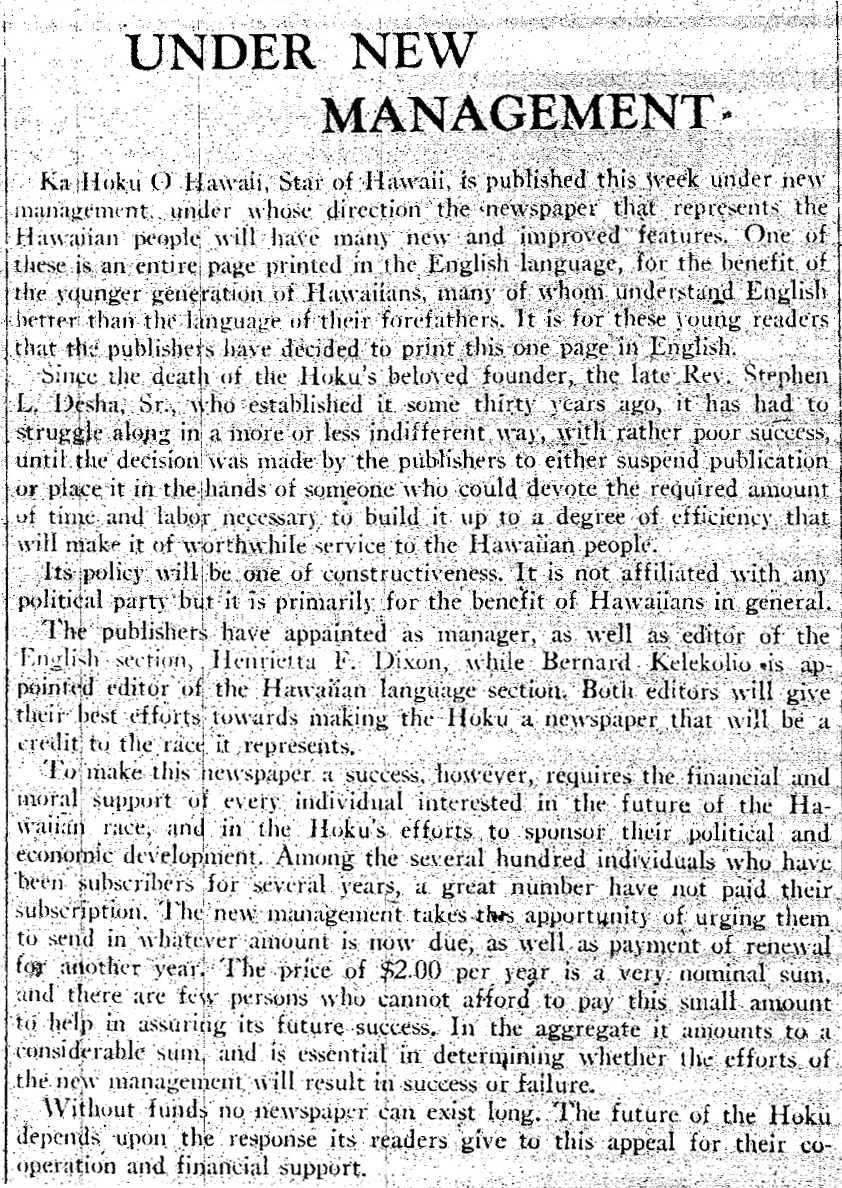
UNDER NEW MANAGEMENT

Ka Hoku o Hawaii, Star of Hawaii, is published this week under new management under whose direction the newspaper that represents the Hawaiian people will have many new and improved features. One of these is an entire page printed in the English language, for the benefit of the younger generation of Hawaiians, many of whom understand English better than the language of their forefathers. It is for these young readers that the publishers have decided to print this one page in English.

Since the death of the Hoku’s beloved founder, the late Rev. Stephen L. Desha, Sr., who established it some thirty years ago, it has had to struggle along in a more o less indifferent way, with rather poor success, until the decision was made by the publishers to either suspend publication or place it in the hands of someone who could devote the required amount of time and labor necessary to build it up to a degree of efficiency that will make it of worthwhile service to the Hawaiian people.

Its policy will be one of constructiveness. It is not affiliated with any political party but it is primarily for the benefit of Hawaiians in general.

The publishers have appainted as manager, as well as editor of the English section, Henrietta F. Dixon, while Bernard Kelekolio is appointed editor of the Hawaiian language section. Both editors will give their best efforts toward making the Hoku a newspaper that will be a credit to the race it represents.

To make this newspaper a success, however, requires the financial and moral support of every individual interested in the future of the Hawaiian race, and in the Hoku’s efforts to sponsor their political and economic development. Among the several hundred individuals who have been subscribers for several years, a great number have not paid their subscription. The new management takes this opportunity of urging them to send in whatever amount is now due, as well as payment of renewal for another year. The price of $2.00 per year is a very nominal sum, and there are few persons who cannot afford to pay this small amount to help in assuring its future success. In the aggregate it amounts to a considerable sum, and is essential in determining whether the efforts of the new management will result in success or failure.

Without funds no newspaper can exist long. The future of the Hoku depends upon the response its readers give to this appeal for their cooperation and financial support.

(Hoku o Hawaii, 2/4/1936, p. 1)

UNDER NEW MANAGEMENT

Ka Hoku o Hawaii, Volume XXVII, Number 31, Page 1. February 4, 1936.

More on the arrival of the British Astronomers, 1874.

Arrived at

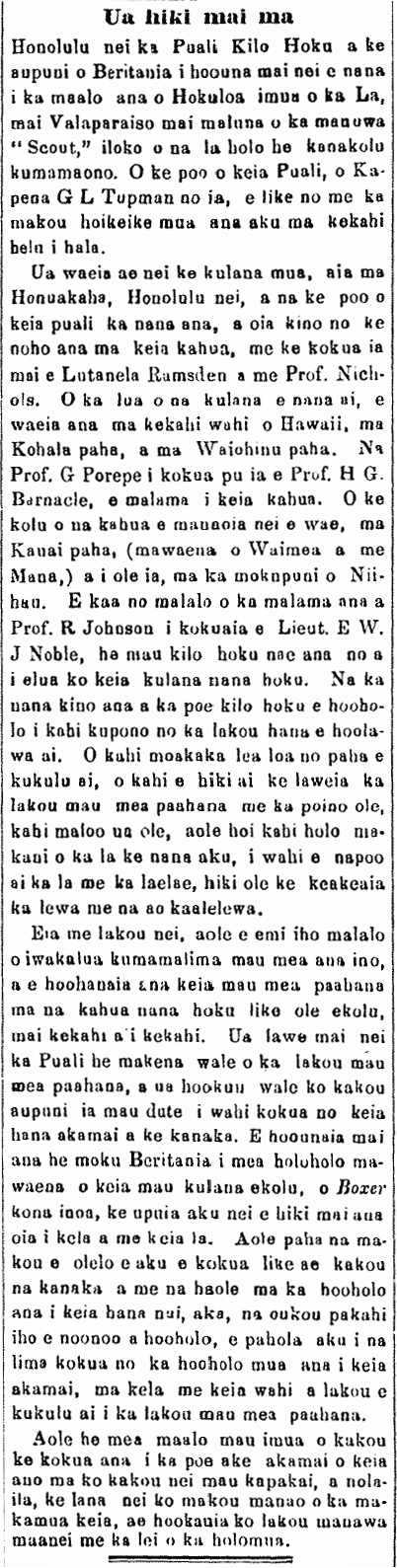
Honolulu, is the Astronomical Expedition sent by the British Empire to observe the transit of Venus in front of the Sun, from Valparaiso, aboard the warship “Scout,” in thirty-six days. The head of the Expedition is Captain G. L. Tupman, just as we explained in an earlier issue.

The first location was chosen at Honuakaha, Honolulu, and the head of this expedition will watch and it is he who will actually be at this location while being assisted by Lieutenant Ramsden and Prof. Nichols. The second location to observe from will be chosen from somewhere on Hawaii Island, perhaps in Kohala, or Waiohinu maybe. This place will be overseen by Prof. G. Porepe [Forbes] assisted by Prof. H. G. Barnacle. The third location under consideration is perhaps on Kauai (between Waimea and Mana), or on Niihau. This will be under the direction of Prof. R. Johnson assisted by Lieut. E. W. J. Noble, but this observation place will have two astronomers there. The observations of the astronomers will decide the right location suitable for their work. An area with great clarity will be built: somewhere that their instruments can easily be transported without being damaged, a place that is dry and without rain, and not somewhere that is seen to be windy during the day, a place that the sun goes down clearly, and the sky cannot be obstructed with drifting clouds.

With them are not less than twenty-five meteorologists [ana ino?] who will be put to work at each of the three observation areas. The Expedition brought along with them a great many workers, and our government has forgave those duties to help this scientific endeavor of man. A British vessel will be sent to travel between the three locations, named Boxer, and it is hoped that it will arrive everyday. It is not for us to say that we should all help, both Hawaiians and haole, to advance this great endeavor, but it is for each of you to think and decide to extend a helping hand to move forward this knowledge, at each of the locations where they set up their equipment.

It is not often that before us appears [opportunities] to assist scientists of this class in our shores, and therefore, we hope as this is the beginning, and that their time here will be adorned with the lei of progress.

(Kuokoa, 9/19/1874, p. 2)

Ua hiki mai ma

Ka Nupepa Kuokoa, Buke XIII, Helu 38, Aoao 2. Sepatemaba 19e, 1874.

Niihau purchased for $10,800. 1864.

The Haole are Really Working Niihau.

O Kuokoa Newspaper; Aloha to you:—I met up with the newspaper article under News of Hawaii, in Issue 15 of the 9th of April, about the selling of Niihau to Mr. James Francis Sinclair, for $10,800, along with the lands of Kuakanu, which are the konohiki lands of Halewela and Kahuku, which the Government sold to the one named above, along with the konohiki lands, and this whole island has gone to the haole; perhaps you all and those others as well have heard that Niihau was sold, along with those penny-pinching folks who don’t get the shining beacon of Hawai nei through the Kuokoa Newspaper. And it is we who know of the great, who know of the small, and who know of the wide, that knows of the selling from Kii to Kawaihoa, from the Makahuena Point to Pueo Point; everything upon the land is bought and there is nothing left for us, the Hawaiians, under the haole owners.

Their Way of Living: They are pleasant and good, and speak nicely with the people, but they are not very proficient in the Hawaiian language. The haole say, “mahope aku kumaki” [?] There are ten Hawaiians, caretakers [hoaaina] of the land, chosen from amongst the locals, but two are from elsewhere, they are newcomers, one from Hawaii and the other from Maui, and including them there are ten caretakers. Here are each of their names which the haole selected: A. Puko, D. Kauki, Hetesia, J. H. Kanakaiki, P. R. Holiohana, H. Haokaku, Mose Kanohai, Ioela, Kapahee and Pouli; Kanakaiki is from Napoopoo, Hawaii, and Holiohana is from Hana, Maui, and are locals from there. Those caretakers are in charge of the three work days every month just like the konohiki of the chiefs, should there be work by haole owner to be done.

Their Number: Mr. James Francis Sinclair them total twelve in number; two brothers, three sisters, five children, one mother, and one in-law, which totals twelve; they live in Kununui; they are religious, with one God, but their religion is very different; their houses were constructed in Britain and brought to Niihau: three houses, one currently stands, and two more to follow; we appreciate how nice and beautiful it is to see.

Dealing with the Animals: There are two horses per man and woman, and should there be three, it is killed, and so forth; as for dogs, there are none left, they were all killed, from the big ones to the small ones because sheep were being killed, and so the government is without money from the dog tax, also the goats were all killed. You Kauai people who own horses and sheep, get them quick, don’t dawdle, or they will be taken by the haole.

Things Grown by the People.

The Hawaiians consume what they produce, and they also assist with the land owners in the watering of the sweet potato, ke pola akaakai [?], and chickens, as long as they were pleasant, or else that was that.

On the Number of Sheep

Set loose on Niihau are the sheep which you have perhaps seen in our Newspaper; as for the count, you probably have not heard; this is the truth as to the abundance or dearth: the number of sheep is 3,400, with 1,400 belonging to the Hon. W. Webster and 2,000 belonging to the King; there is no end to their desire for sheep.

Sugar Cane Cultivation.

Niihau will be planted with sugar cane if the test on one acre goes well; and if the cane grows nicely, then planting will commence, but if it doesn’t grow, that’s it, because it is an arid land.

This is an undesirable land for those foreigners seeking to make money because it is dry and scorched by the sun, and crops die; but here are people who are after wealth, and they tell us, the locals, that this is very valuable land for sheep and cane; our good friend, H. M. Whitney, the local of Waimea and Niihau, along with his parents, are familiar with this island and its extreme heat in the Makalii months [summer]. I will stop writing as the Naulu rain of Niihau is falling. With aloha.

P. R. Holiohana.

Kihalaui, Niihau, May 2, 1864.

[This P. R. Holiohana (later it seems he goes by the name P. R. Holi) writes in to the newspapers often from Niihau on a number of subjects.]

(Kuokoa, 6/4/1864, p. 1)

Hana io ka Haole ia Niihau.

Ka Nupepa Kuokoa, Buke III, Helu 23, Aoao 1. Iune 4, 1864.

Another Wooden Kii found, 1868.

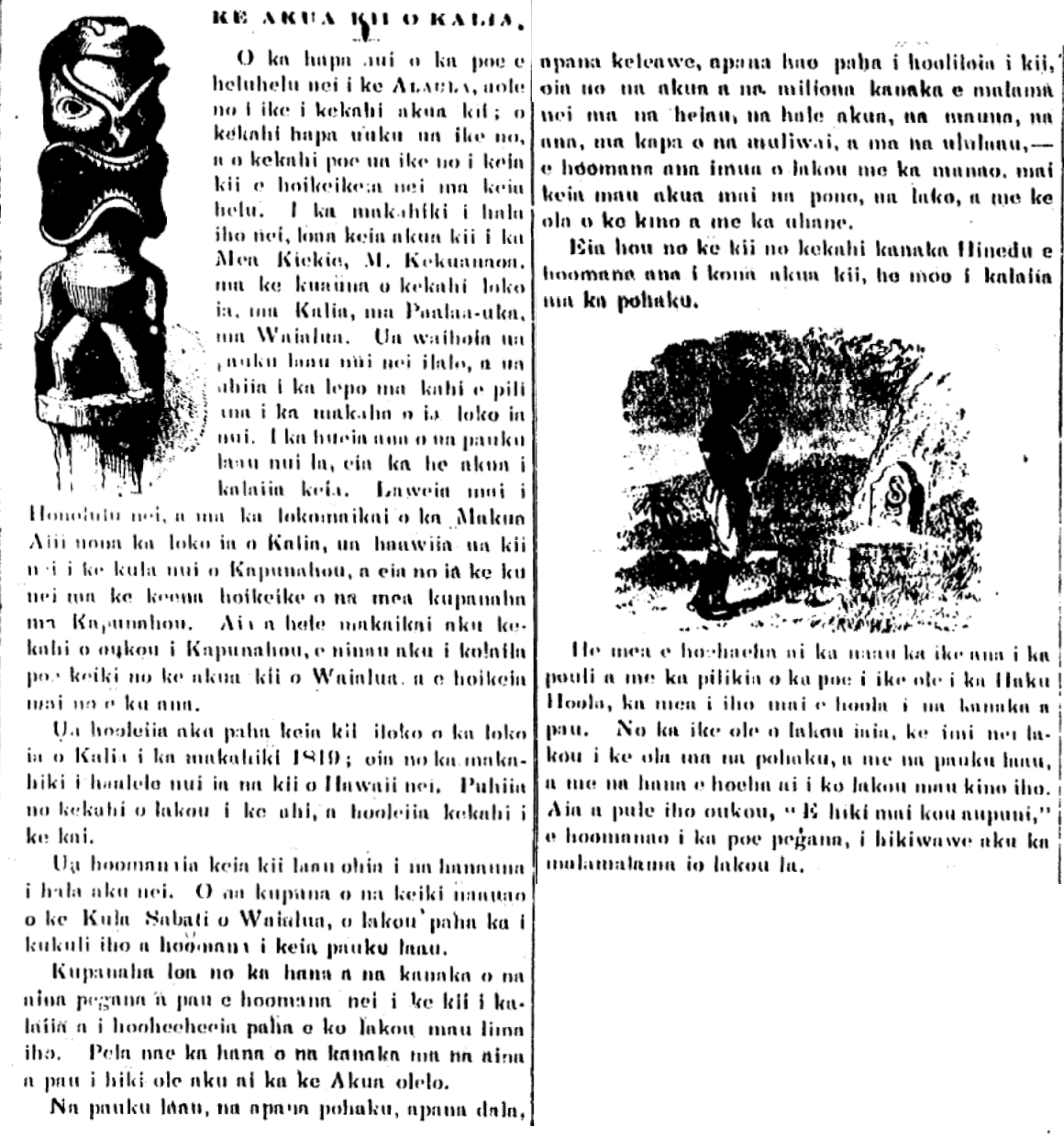
Akua Kii of Kalia.

Most of the people reading Ke Alaula have not seen an akua kii, but a small fraction have seen one, and some of you saw this image that is shown here in this issue. Last year, this god idol was found by the Honorable M. Kekuanaoa on the banks of a fish pond at Kalia in Paalaa Uka in Waialua. That large piece of wood was set down and covered with soil near the sluice gate of that large fish pond. When that big piece of wood was unearthed, lo and behold, it was a carved god. It was brought to Honolulu nei, and through the goodwill of the Alii Elder who owns Kalia fishpond, that kii was given to the college of Kapunahou [Punahou], and there it stands in the exhibition room of curiosities at Kapunahou. When some of you go to visit Kapunahou, ask the children there about the kii from Waialua, and it will be shown to you where it stands.

This kii was probably thrown into the pond of Kalia in the year 1819; that is the year when there was the kii of Hawaii nei were greatly abandoned. Some of them were burnt in fire and some were thrown into the sea.

These ohia wood images were worshiped by previous generations. The kupuna of the educated children of Waialua Sunday School were probably those that knelt down and worshiped this piece of wood.

How astonishing are the actions of the people of all of the pagan lands, who worship idols that are carved or molded by their own hands. That is how all lands are where the word of God has not reached.

Pieces of wood, fragments of rock, chunks of silver, chunks of metal, or perhaps chunks of iron turned into images—those are the gods cared for by millions of people, in heiau, houses of god, mountains, caves, banks of rivers, and in forests; they worship before them thinking that from these gods come well being, wealth, and life in body and spirit.

Here also is a picture of a Hindu man worshiping his godly image; it is a snake carved into a rock.

This is something that pains the heart to see the darkness and trouble of those that don’t know of the God the Savior, the one who came down to save all man. Because they don’t know him, they seek salvation from rocks and pieces of wood and from actions that hurt their very own bodies. When you pray, “Thy kingdom come,” remember the pagans so that the light reaches them quickly.

[Could this Akua Kii be the one now at the Bishop Museum which was found in Waialua and presented to Punahou?]

(Alaula, 1/1868, p. 39)

KE AKUA KII O KALIA.

Ke Alaula, Buke II, Helu 10, Aoao 39. Ianuari, 1868.

More on Liliuokalani and her support of education. 1895.

HYPOCRITICAL REMEMBRANCE.

The celebrating and remembering of the birthday of someone is not a bad thing, or something to criticize. And this applies when the person whose birthday that is being remembered has died, it is a good thing, should that person have done a famous deed or left an important legacy for her trustees to carry out, like the Alii, Pauahi-a-Paki.

We are not opposing the remembrance of her trustees and the heads of the Kamehameha Schools, like what was done this past Thursday, on the birthday of this Alii of this land, who showed her true aloha for her lahui by leaving her great estate for the good and welfare of the new generations of her own people, so that the their thoughts and actions are bettered. We do however oppose and criticize the attempt to deify, and it is almost to the point where the missionaries and teachers of those places of learning are making her, the deceased Alii, into a god [akua? ahua?] to be worshiped. In the presentations on that day mentioned, the girls performed before a huge audience of all sorts of people who attended, where they all knelt before an image of the Alii, and thereafter placed lei and flowers upon that picture. This is not a good lesson for the children.

Pauahi has died, she has gone, she is no more in body, but she still lives through her glorious deeds, perhaps the greatest amongst the Hawaiian Chiefs who left on the “Dark Path of Kane”. It is for her trustees and her representatives that were empowered in her will, which the Supreme Court will fill should there be a vacancy amongst those people, they are they ones carrying out these remembrances without her knowledge of what is being done, and that is why we call it—a hypocritical remembrance.

For here is the Queen, still living, and she is not honored by those missionaries for her good works that are exemplary for the benefit of her people, before and since her ascending the throne. She took up the Liliuokalani Educational Society, with its two divisions, and greatly assisted its funds from her own earnings and property. There were many girls who received an education because of this society, and the girls’ school of Kawaiahao, that grounds of learning of the missionaries, saw benefits, and this cannot be denied in the least.

She is sill living and has followed through on her good works which were established under her very own leadership, not by other like with the late Pauahi. And yet these haughty missionaries of her days don’t at all remember her great deeds which show her true aloha for her lahui while she is alive and not after her death. Aye, she is still living, and we see the fruits of her good labors, and perhaps she mistakenly put her faith in her weak fellow lahui for whom she felt much aloha, and she fell from her position on high; and now she sees clearly those who are steadfastly loyal to her and those who are traitorous, abusive, and speak badly about her.

The missionaries themselves are the true witnesses to her good deeds. They have no words for Pauahi, hers were seen before. They go to her [Liliuokalani] and ask for money from her, and they are not given just a trifle, but they are given great amounts. And yet, those people do not think a bit of her, or thank her, not at all; they instead abuse and fling and besmear her with filth, in return for the good that was done, and given to, and received by them. This is a time to tell tales, to rouse, ask for rudely, to beg, to abuse, to curse, to insult, and that list goes on and on, just filled with indolence.

[How sad that even today, her namesake, Queen Lydia Liliuokalani Elementary School has been shut down. Today there was a celebration of the 100th anniversary of the laying of the cornerstone of the school on the grounds of Liliuokalani Elementary School! Let us remember her always along with her great love for her people!]

(Makaainana, 12/23/1895, pp. 4 & 5.)

HOOMANAO HOOKAMAEMAE.

Ka Makaainana, Buke IV----Ano Hou., Helu 26, Aoao 4 & 5. Dekemaba 23, 1895.

More from David Keaweamahi on Japanese contract laborers, 1890.

From Japan!

INFORMATION FOR THE HAWAIIAN PEOPLE!

Mr. J. U. Kawainui,

Honolulu, H. I.

O Friend,

Please allow me to introduce you to the new things I have seen in my newspaper which I believe are new information important to spread; which I invite you to kindly insert into your newspaper, Ko Hawaii Pae Aina, for the benefit of the readers and the nation.

I was pleased to see the thoughts of a famous newspaper of Japan, praising Hawaii as the place where a great number of Japanese laborers obtained a big sum of money, more than they’d receive in their homeland.

This newspaper likened Hawaii to a school of education, where a child receives the wealth of knowledge, equal to the amount of lessons he studies; so too with the Japanese who are going to Hawaii, where they get high salaries that they’d not get here, and for more intense work than in Hawaii, along with more hours.

This paper also stated that within the past five years, the total number of Japanese laborers including men and women has reached 14,000, sent by the Board for Emigration of Japanese Laborers.

And within this period, these laborers, as a result of their effort and their saving of what they earned, made a great amount in Japanese money, not less than 2,000,000 yen; and not included with this, they paid the ship owners half a million yen to take them from Japan to Hawaii and return.

This great sum of money was sent from Hawaii to here in Japan, the home of these laborers. As a result, there rose within me the desire to encourage my own Hawaiian friends to take a look at the path taken by the Japanese, starting like this:

Their departure from the land of their birth—Their travelling across the great ocean at great expense—The landing as strangers in Hawaii—Working all sorts of jobs for a boss who is a stranger—Enduring the work—Eating only a little without wasting—Caring for what they have—The results of their putting up with the work, that being millions of dollars.

I believe that this is ample explanation, O Friends of the same womb, for you to think about; for the work has come to your door O Hawaiians—diamonds, gold, and money, right before your eyes; it is not far away like for the Japanese for whom it is far, far away.

Look at the hardships and the facing of the spray of the Pacific Ocean whose distance from Hawaii to Japan is 3,440 miles; this distance and hardships became nothing to them.

And you, O Hawaiians, you wake up in the morning and take up your work, and put in your time working, and not with things that waste your time, as goes the saying of the educated people: “Time is like money.”

And O Mr. Editor, I am sending a copy of the newspaper, “The Tokyo Mail” of August 7th, 1890, and within it you will see all of what this paper has said, and it is for you to patiently translate it all.

As I am preparing to send to you the news above, I have also received from my true friend, J. W. Girvin, Esq., our Hawaiian Consul in the city of San Diego, California, the newspaper “The San Diego Union”. Within this paper, he explained fully the value of coconuts, starting from the trunk to the leaves; we are familiar with coconuts and its value; and with our consul explaining the value of the coconut, I am thinking that there are also other sources of wealth for you, O Hawaiians, like sugarcane, rice, bananas, and so forth.

He explains that coconuts can be found in Hawaii and the islands of the Pacific Ocean. Therefore, I am sending this paper with hopes that you will translate it for the good of our people, being that it should not be long before Hawaii starts receiving inquiries for coconuts because of this important description of Hawaii’s good friend dealing with the asset not put to use by Hawaiians in the past years.

It is a very admirable thing that the government selects good people with good ideas to search after the well being of the people that conferred upon him that honorable title, Consul, like J. W. Girvin.

When I look at the ideas of this servant of the nation, I know that he is searching while pulling along the minds of entrepreneurs to look to Hawaii to export coconuts, like the other produce exported from Hawaii to other lands.

And should this description of our Consul become something that the wealthy people and trade companies of foreign lands latch on to, then those great fields of coconut from Hopoe until Kahaualea in Puna, Hawaii will become a source of wealth; so too the stands of coconut in the Kona districts, along with those of Maui, Molokai, Oahu and Kauai. And even more so, with the opening these days of new steamship lines which go directly from San Diego to Hawaii. This clarification should be sufficient.

With aloha,

D. Keaweamahi.

No. 9 Fujimi Sho [Fujimi-cho], Kojimachi, Tokyo, Japan, Sept. 13, 1890.

[As we celebrate Merrie Monarch week, Japanese contract laborers is one of Kalakaua’s many legacies…]

(Ko Hawaii Pae Aina, 9/27/1890, p. 2)

Mai Iapana mai!

Ko Hawaii Pae Aina, Buke XIII, Helu 39, Aoao 2. Sepatemaba 27, 1890.